VersaFlow Mag electromagnetic flowmeter range explained
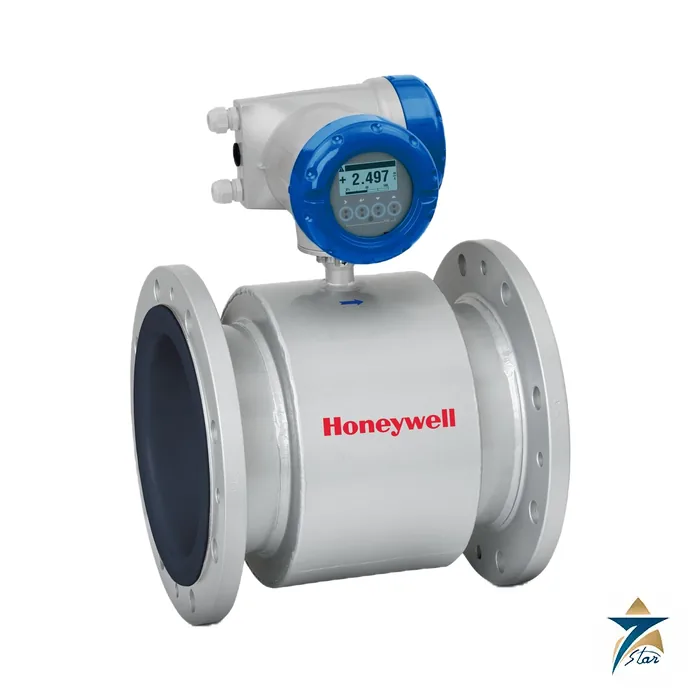
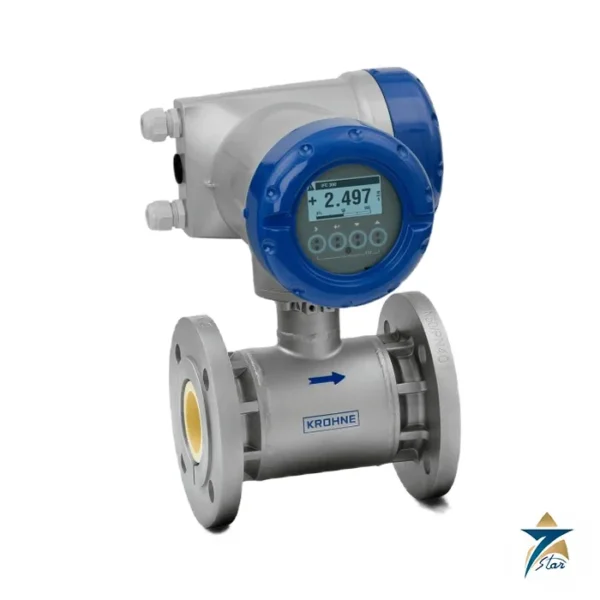
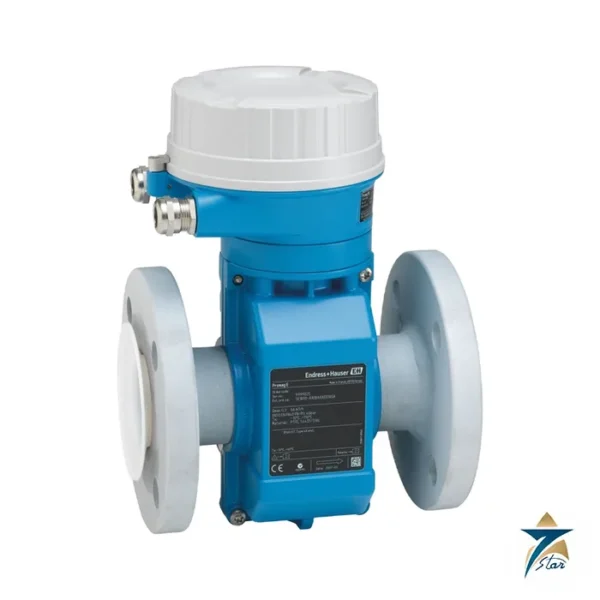
The Honeywell VersaFlow Mag is a family of electromagnetic (magmeter) flow sensors for conductive liquids, pastes and slurries. It is sold as four sensor variants that share one measuring principle but serve very different jobs: Mag 4000 for demanding industrial duty, Mag 1000 for water and wastewater, Mag 100 as an economical all-round meter, and Mag 3000 as a stainless steel hygienic sensor for food, beverage and pharmaceutical lines. Seven Star LLC supplies VersaFlow Mag meters in Oman and the GCC as an independent supplier in Muscat, and this page is written to help you pick the correct variant before you send an enquiry.
VersaFlow Mag is a series name, not a single ordering code. The exact sensor, liner, electrode material, flange standard and converter are fixed in the manufacturer’s ordering information for each variant, so the first task in any enquiry is to agree on the variant and line size. The sections below describe what is common to the range, what separates the four variants and what we need from you to confirm a match.
VersaFlow Mag technical overview
| Parameter |
Specification |
| Manufacturer / part number |
Honeywell / VersaFlow Mag (series; variants Mag 100, Mag 1000, Mag 3000, Mag 4000) |
| Measuring principle |
Electromagnetic flow measurement of conductive liquids, pastes and slurries |
| Accuracy |
Mag 100: ±0.3 to 0.4% + 1 mm/s; Mag 1000 and Mag 4000: ±0.2 to 0.3% + 1 mm/s |
| Repeatability |
±0.1% of measured value, minimum 1 mm/s |
| Measuring range |
−12 to +12 m/s (−40 to +40 ft/s) |
| Nominal sizes |
Mag 100: DN10 to DN150 (3/8 to 6 in); Mag 1000: DN25 to DN2000 (1 to 80 in); Mag 4000: DN10 to DN600 (3/8 to 24 in) |
| Minimum conductivity |
Down to 1 µS/cm (as listed for the range) |
| Mounting |
Wafer (sandwich) or welded, depending on variant |
| Ingress protection |
IP66, IP67 and IP68 options |
| Approvals |
Non-Ex, EEx, FM and CSA options; confirm per variant and configuration |
| Resistance |
Abrasion, chemical and vacuum resistant constructions available |
How an electromagnetic flowmeter like VersaFlow Mag works
A magmeter has no moving parts in the flow path. Coils on the outside of the measuring tube create a magnetic field across the pipe. When a conductive liquid moves through that field it induces a small voltage, and two electrodes in the tube wall pick up this voltage. The induced voltage is proportional to the average velocity of the liquid, so the converter multiplies it by the pipe cross-section to give volumetric flow. Because the tube is lined and unobstructed, there is no pressure drop beyond that of an equivalent length of pipe.
Three practical consequences follow. First, the liquid must be conductive; the range is quoted down to 1 µS/cm, but a very low-conductivity fluid such as a hydrocarbon or ultrapure solvent is not a magmeter application. Second, the pipe must run full at the meter, because the electrodes only read correctly when they are wetted and the tube is filled. Third, the output is largely independent of density, viscosity and temperature, which is why the same meter can be used on clean water, slurry or a chemical dosing line without recalibration.
Choosing between VersaFlow Mag 100, 1000, 3000 and 4000
The four VersaFlow Mag variants overlap in some sizes but are built for different duties. Use the list below as a first filter.
- Mag 4000 is the robust sensor for the most demanding industrial applications, covering DN10 to DN600 (3/8 to 24 in) with the tighter accuracy band of ±0.2 to 0.3% + 1 mm/s.
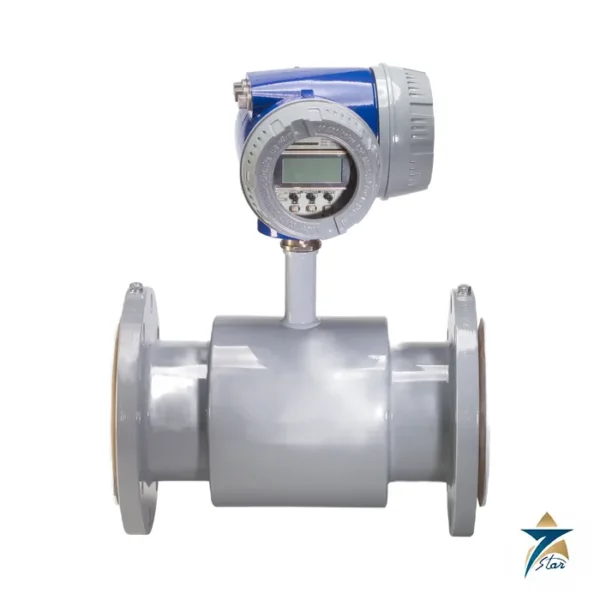
- Mag 1000 is positioned for water and wastewater, with the widest size span in the family, DN25 to DN2000 (1 to 80 in). Large-bore raw water, cooling water and effluent lines belong here.
- Mag 100 is the economical choice for a wide range of general applications from DN10 to DN150 (3/8 to 6 in), with an accuracy band of ±0.3 to 0.4% + 1 mm/s.
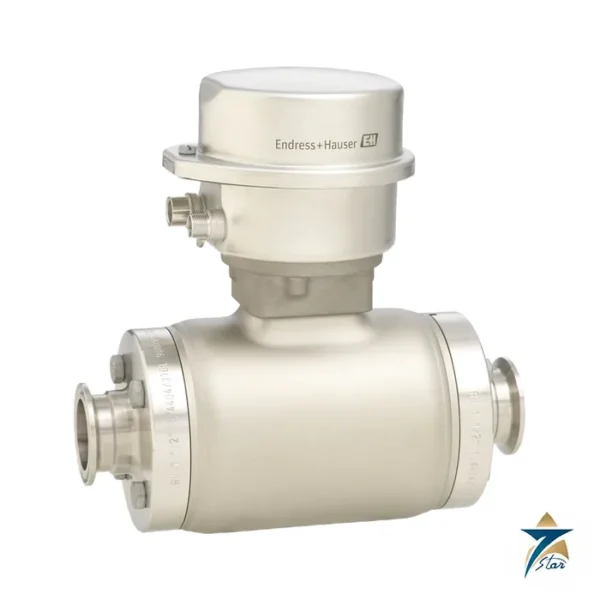
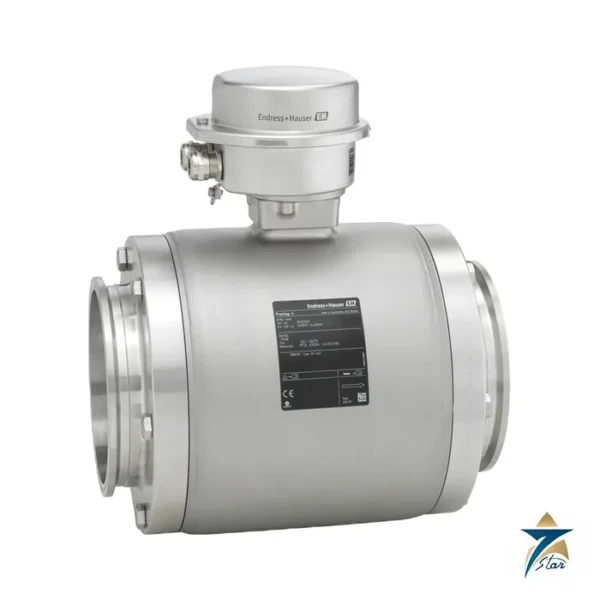
- Mag 3000 is the hygienic stainless steel sensor for food, beverage, cosmetics and pharmaceutical lines, built to FDA-conforming materials and suited to CIP and SIP cleaning.
VersaFlow Mag 3000 hygienic sensor data
The official Mag 3000 sensor specification gives more detail on the hygienic variant, which is useful when a process line needs clean-in-place compatibility. The figures below apply to the Mag 3000 only and should not be assumed for the other three variants.
| Parameter |
Specification |
| Sizes |
DN2.5 to DN150 (1/10 to 6 in) |
| Liner |
PFA, FDA conforming, reinforced to resist collapse under vacuum |
| Measuring tube / housing |
Stainless steel 1.4301 (AISI 304) tube; duplex 1.4462 or 1.4301 housing options |
| Electrode options |
Hastelloy C4, Hastelloy B2, platinum, stainless steel 316L, 316Ti, tantalum, titanium |
| Gaskets |
EPDM; silicone for non-Ex only |
| Process temperature |
Remote sensor −40 to +140°C; compact with TWM 9000 −40 to +140°C; compact with TWM 1000 −40 to +120°C |
| Accuracy with TWM 9000 |
0.2% of measured value + 1 mm/s for DN10 to DN150; 0.3% + 2 mm/s for DN2.5 to DN6 |
| Accuracy with TWM 1000 |
0.3% of measured value + 1 mm/s for DN10 to DN150; 0.4% + 1 mm/s for DN2.5 to DN6 |
| Straight run |
Minimum 5 DN inlet and 2 DN outlet |
| Minimum conductivity |
5 µS/cm for non-water liquids; 20 µS/cm for water |
| Process connections |
DIN 11850 / 11866, DIN 11851, DIN 11864-2a, DIN 32676, ISO 2037, ISO 2852, SMS 1146, Tri-Clamp |
| Protection |
IP66/67 standard; IP68 field or factory sealed optional |
Converters and system fit for VersaFlow Mag
A VersaFlow Mag sensor does not work alone; it is paired with a converter that excites the coils, reads the electrode signal and delivers the measurement to your control system. The official documentation set for the range lists converter and sensor manuals under the references TWM 9000 and TWM 1000 together with the sensor manuals for Mag 100, Mag 1000, Mag 3000 and Mag 4000. In a compact version the converter sits directly on the sensor; in a remote version it is mounted on a wall or pipe stand and connected by a signal cable, which is the better choice where the meter is buried, submerged or too hot to read comfortably.
In practice the converter choice decides the available outputs, communication options and display. A flow measurement that feeds a DCS or PLC usually needs a current output with digital communication, while a batching or dosing loop needs fast pulse output. Tell us which signals your control system expects and we will check them against the variant you are considering.
VersaFlow Mag selection and ordering checklist
- Fluid, its conductivity and whether it contains solids, fibres or gas bubbles.
- Line size, flange rating and standard (ANSI, DIN or hygienic connection), and the face-to-face length your pipework expects.
- Process temperature and pressure range, including cleaning or steam-out cycles, and any vacuum condition.
- Liner and electrode materials suited to the fluid; abrasive slurry and aggressive chemicals need different choices to clean water.
- Straight pipe available upstream and downstream, and whether the pipe will always run full.
- Compact or remote converter, power supply, outputs, communication protocol and display needs.
- Hazardous area classification and the certificate type required (Ex, FM or CSA) for the site.
- Ingress protection: IP67 for general plant, IP68 where the sensor can be flooded or buried.
Installation, commissioning and care of a VersaFlow Mag
Most magmeter problems come from installation rather than the instrument. Mount the sensor where the pipe is full under all operating conditions, which usually means a vertical upward flow or a low point in a horizontal run, and never on a pipe that drains while the process is stopped. Keep the recommended straight lengths and avoid placing a control valve or pump directly upstream. The sensor body must be bonded to the pipework and to the converter earth, using grounding rings or electrodes where the pipe is plastic or lined, because a poor ground is the most common cause of a noisy reading.
At commissioning, confirm the line size and calibration data in the converter, perform a zero check with the pipe full and the liquid at rest, and verify the output scaling against the control system. Routine maintenance is light: inspect cable glands and the terminal compartment for moisture, check the liner and electrodes at planned shutdowns when the fluid is scaling or abrasive, and keep the manufacturer’s calibration documents with the meter for audit purposes. For stainless steel hygienic sensors, follow the allowed cleaning temperatures and chemicals so that the gaskets and liner are not stressed.
Typical VersaFlow Mag applications in Oman and the GCC
Magmeters of this type are widely used on water-related duties across the Gulf. Desalination plants meter feed, product and brine streams; municipal and industrial utilities meter potable water, treated effluent and cooling water; and power stations meter makeup, demineralised and chemical dosing lines. In oil and gas facilities and petrochemical plants, conductive process water, produced water and chemical injection are common targets, while mining and minerals operations use the abrasion-resistant constructions for slurries. Food, dairy and pharmaceutical producers select the hygienic Mag 3000 for filling, dosing and CIP circuits. High ambient temperatures and dust make IP67 or IP68 protection and a well-sealed terminal compartment worth specifying, and remote converters can be placed in a shaded or air-conditioned location.
VersaFlow Mag variant comparison
| Variant |
Nominal sizes |
Accuracy |
Typical duty |
| Mag 100 |
DN10 to DN150 (3/8 to 6 in) |
±0.3 to 0.4% + 1 mm/s |
Economical general-purpose duty |
| Mag 1000 |
DN25 to DN2000 (1 to 80 in) |
±0.2 to 0.3% + 1 mm/s |
Water and wastewater, large bore |
| Mag 3000 |
DN2.5 to DN150 (1/10 to 6 in) |
0.2 to 0.4% depending on converter and size |
Hygienic food, beverage, pharma |
| Mag 4000 |
DN10 to DN600 (3/8 to 24 in) |
±0.2 to 0.3% + 1 mm/s |
Demanding industrial processes |
Information to send with your VersaFlow Mag RFQ
- Variant of interest (Mag 100, 1000, 3000 or 4000) or a description of the duty so that we can suggest one.
- Line size, flange standard and pressure class, or the hygienic connection type.
- Fluid name, conductivity, temperature range, flow range and any solids content.
- Compact or remote converter, signal and communication requirements, and supply voltage.
- Hazardous-area certificate required, ingress protection and any cable length for a remote version.
- Quantity, project name and the delivery location in Oman or elsewhere in the GCC.
Documents and quotation
A datasheet is attached on this page: the official VersaFlow Mag 3000 electromagnetic flow sensor specification. It covers the hygienic variant only, so for Mag 100, Mag 1000 or Mag 4000 send us the variant and size and we will confirm which further documents are available.
Seven Star LLC is an independent supplier in Muscat and quotes VersaFlow Mag meters against the duty you describe. Send the information above and we will reply with availability and lead time.



















Reviews
There are no reviews yet.