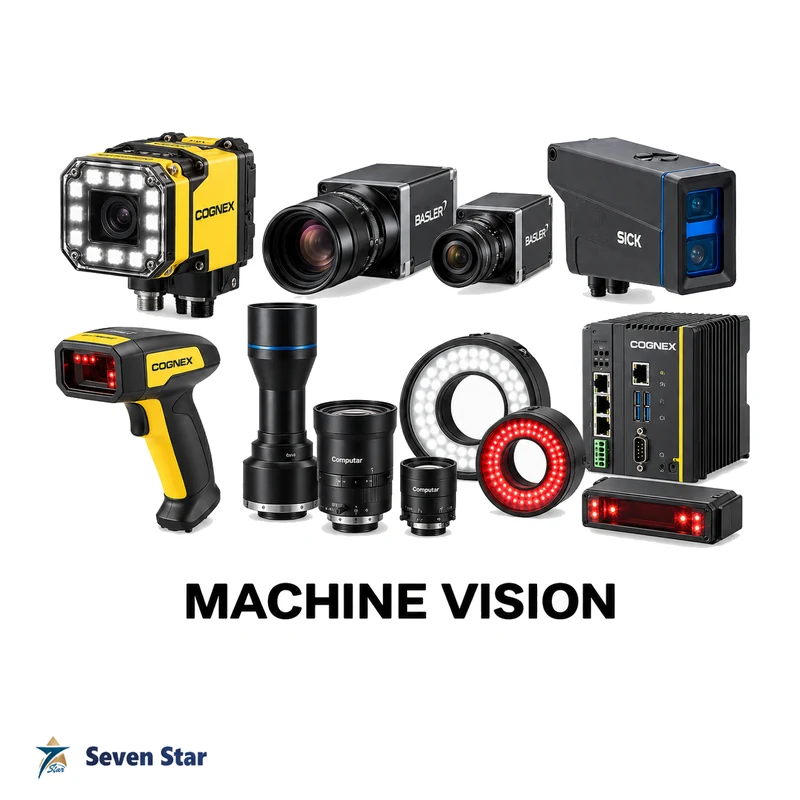
Industrial machine vision cameras, smart cameras, lenses and code readers

Machine Vision

Machine vision brings camera-based inspection, measurement, and identification to production lines that need speed and repeatability beyond what manual checks can deliver, and Seven Star LLC supplies machine vision equipment to customers across Oman and the GCC. Our Machine Vision range includes Keyence smart cameras and 2D code readers, alongside industrial cameras, lenses, ring and bar lighting, and vision controllers used to build complete inspection stations.

This category covers the full vision stack: area-scan and smart cameras that capture the image, C-mount lenses matched to working distance and field of view, LED lighting that makes defects and features stand out reliably, and controllers or processors that run the inspection, measurement, or code-reading algorithm. Keyence’s autofocus code readers, for example, decode 1D and 2D codes on curved, low-contrast, or moving parts without manual focus adjustment, and integrate directly with PLCs, robots, and MES systems for automated traceability.

Seven Star LLC’s technical team helps manufacturing and quality engineers across Oman specify the right camera, lens, lighting, and processing combination for their inspection, measurement, or code-reading application, supplying genuine hardware with full technical support.
Request a Quote for Machine Vision

Looking for a specific model, part number or brand in Machine Vision? Send us your requirements and quantities. Seven Star LLC sources genuine industrial equipment for customers across Oman and the GCC and replies with a formal quotation.

Free, no-obligation quotation · takes about 1 minute

Other enquiries: [email protected] · WhatsApp

Frequently Asked Questions

How do 3D machine vision systems improve upon traditional 2D inspection methods?
3D machine vision utilizes techniques such as laser triangulation, stereovision, or time-of-flight to capture depth, volume, and topographical data, which 2D systems cannot perceive. This capability is crucial for applications like bin-picking, precise coplanarity inspection of electronic components, and verifying structural integrity regardless of lighting variations or low-contrast surface textures.
What is the significance of telecentric lenses in high-precision machine vision metrology?
Telecentric lenses eliminate parallax error by maintaining a constant magnification regardless of the object's distance from the lens, ensuring that orthogonal features are not distorted by perspective. This optical property is essential for highly accurate dimensional gauging, profile measurement, and inspecting deep internal bores where standard lenses would induce severe measurement errors.
How does deep learning integrate with traditional rule-based machine vision algorithms?
Deep learning complements rule-based algorithms by excelling at subjective, complex defect detection—such as identifying unpredictable surface scratches, variations in organic materials, or complex character recognition (OCR) on challenging backgrounds. While traditional algorithms provide precise, measurable geometric alignment, deep learning neural networks handle the nuanced classification tasks that are difficult to explicitly program.
What are the primary considerations when designing an illumination strategy for a machine vision application?
The illumination strategy must maximize the contrast of the features of interest while suppressing background noise. Engineers must consider the object's surface reflectivity, geometry, and color, selecting techniques such as brightfield for diffuse surfaces, darkfield to highlight scratches on specular surfaces, or polarized lighting to eliminate blinding glare from metallic parts.
What challenges arise when deploying machine vision on high-speed continuous web production lines?
High-speed web applications require line-scan cameras coupled with ultra-bright, high-frequency LED line lights to capture continuous images without motion blur. The system must also possess immense processing bandwidth to execute complex inspection algorithms on gigapixel-per-second data streams, ensuring real-time defect identification and automated rejection before the material is rolled.