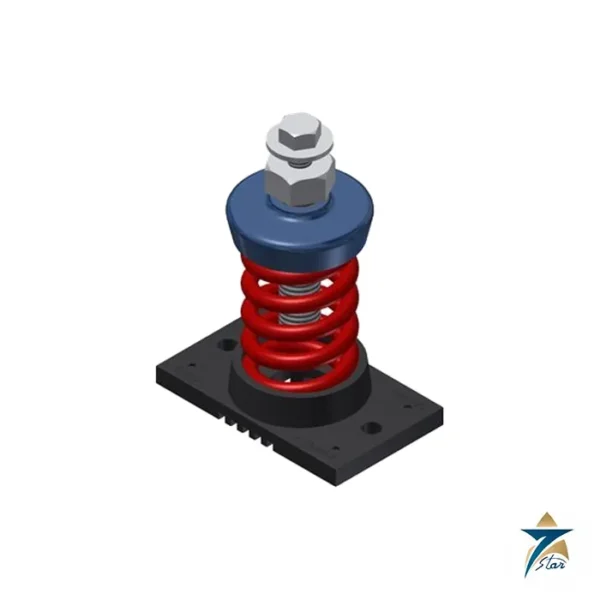
Vibration Isolation

Vibration isolators keep the vibration of rotating machines out of the building structure. The Vibration Isolation category currently lists one product type from Mason Industries: a free-standing spring mount with a bolt-down baseplate, used under floor-mounted mechanical equipment. Seven Star LLC supplies it from Muscat, Oman. Other isolators, including restrained spring mounts, neoprene mounts and spring hangers for pipework and ducts, can be sourced on request as the range grows.
Read more about Vibration Isolation

Category guide

About Vibration Isolation

1 product 1 brand

Vibration isolators keep the vibration of rotating machines out of the building structure. The Vibration Isolation category currently lists one product type from Mason Industries: a free-standing spring mount with a bolt-down baseplate, used under floor-mounted mechanical equipment. Seven Star LLC supplies it from Muscat, Oman. Other isolators, including restrained spring mounts, neoprene mounts and spring hangers for pipework and ducts, can be sourced on request as the range grows.

Where spring vibration isolators are used

Spring mounts go under chillers, pumps on inertia bases, air handling units, fans, compressors and generator sets, most of all on upper floors and roofs where the slab is flexible. Free-standing springs suit equipment whose weight stays constant. Where the weight changes a great deal, as with a cooling tower that is drained, or where wind or seismic loads apply, restrained mounts with limit stops are used instead.

How a spring mount is selected

Isolation depends on the ratio between the lowest disturbing frequency of the machine and the natural frequency of the mount, and the natural frequency is set by the static deflection of the spring under load. Slow machines and flexible floors therefore need springs with more deflection. Each mount is chosen for the load at its own support point, which is rarely an equal share of the total weight.

For a quotation, send the equipment type, the operating weight, the load at each support point or the position of the center of gravity, the lowest operating speed and the type of floor. We check the selection against the manufacturer’s load tables for projects across the GCC.

What to include in your inquiry

These details let us quote the right item the first time.

  • Equipment model and serial number
  • Capacity or duty
  • Refrigerant or medium
  • Power supply
  • Part number, for spare parts

Missing some of them? Send what you have. A nameplate photo or an old part number is enough to start.

Brands in Vibration Isolation

All brands →

Related categories

Request a Quote for Vibration Isolation

Looking for a specific model, part number or brand in Vibration Isolation? Send us your requirements and quantities. Seven Star LLC sources genuine industrial equipment for customers across Oman and the GCC and replies with a formal quotation.

Free, no-obligation quotation · takes about 1 minute

Other enquiries: [email protected] · WhatsApp

Frequently Asked Questions

When should I use a spring mount and when a neoprene mount?
Neoprene and other rubber mounts have small static deflection, so they isolate high-frequency vibration and noise from small, high-speed equipment on stiff floors. Steel springs give much larger deflection and are needed for lower-speed machines and for equipment on upper floors or roofs. Spring mounts normally include a rubber pad under the base, because a steel spring alone passes high-frequency noise.
What is static deflection and why does it matter?
Static deflection is the distance the spring compresses under the weight it carries. It fixes the natural frequency of the mounted system: more deflection means a lower natural frequency. Good isolation requires that natural frequency to be well below the lowest running frequency of the machine. This is why selection tables are organized by deflection as well as by load.
Does a free-standing spring mount have to be bolted down?
Not always. A free-standing spring is designed to be laterally stable and many types simply rest on a friction pad. A bolt-down baseplate is chosen where the mount must be fixed in position on the slab or steel, for example on a roof frame or where the specification demands anchoring. It does not turn the mount into a restrained or seismic type.
When is a restrained spring mount required?
Use a restrained mount when the supported weight changes significantly, for example equipment that is drained for maintenance, because the limit stops prevent the springs from lifting the machine and straining the pipe connections. Restrained types are also used for outdoor equipment exposed to wind load and on projects with seismic requirements, where the mount must hold the equipment in place.
Do pipes and ducts connected to isolated equipment need isolation too?
Yes. A rigid pipe or duct connection bypasses the mounts and carries vibration straight into the structure. Flexible connectors are fitted at the equipment, and the first pipe supports on each side are spring hangers or spring mounts with a deflection similar to that of the equipment mounts. Electrical connections should be made with a flexible loop for the same reason.