Fire & Gas Systems Category Image in Seven Star LLC

Fire & Gas Systems

Fire & Gas Systems covers the full chain of a fire and gas detection system: detectors in the field, the controllers and fire alarm panels that process their signals, alarm devices, and the suppression hardware released on a confirmed fire. Seven Star LLC supplies this equipment from Muscat, Oman, with products from Dräger, Honeywell, Xtralis, MEDC, Det-Tronics and MSA Safety among the brands listed.
Read more about Fire & Gas Systems

Fire & Gas Detectors

Logic Controllers

Fire Fighting

Category guide

About Fire & Gas Systems

90 products 25 brands 3 sub-categories

Fire & Gas Systems covers the full chain of a fire and gas detection system: detectors in the field, the controllers and fire alarm panels that process their signals, alarm devices, and the suppression hardware released on a confirmed fire. Seven Star LLC supplies this equipment from Muscat, Oman, with products from Dräger, Honeywell, Xtralis, MEDC, Det-Tronics and MSA Safety among the brands listed.

Detectors, logic controllers and fire fighting equipment

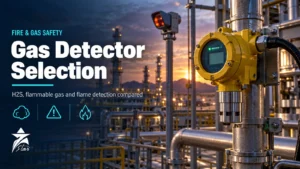
Fire & Gas Detectors is the largest group. It holds fixed and portable gas detectors, flame detectors, aspirating smoke detectors and explosion-protected sounders and beacons.

Logic Controllers holds the equipment that receives those signals: conventional and addressable fire alarm control panels, loop cards, gas detection controllers and a fire and gas safety system controller.

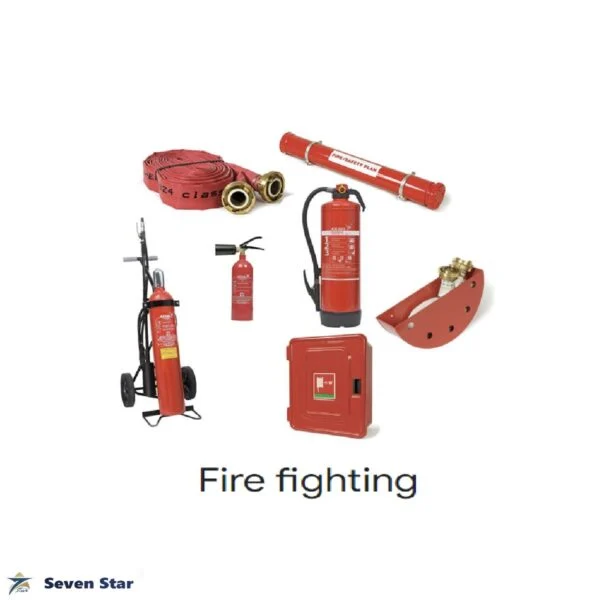
Fire Fighting holds clean agent suppression cylinders with their release components, and landing valves for wet riser systems.

How the parts of a fire and gas system work together

Field detectors report gas concentration, flame or smoke to a controller. The controller applies alarm set points and voting, for example two detectors out of three in one fire zone, and then drives the outputs written in the cause and effect chart: sounders and beacons, ventilation shutdown, signals to the emergency shutdown system and release of extinguishing agent. Compatibility matters at every interface. A replacement detector has to match the controller input type or the loop protocol, not just the target gas.

Hazardous-area ratings and approvals

Field devices in classified areas need ATEX or IECEx certification with a suitable protection concept, such as flameproof or intrinsically safe, and the right gas group and temperature class. Fire alarm equipment for buildings is normally specified to the EN 54 series or to UL and FM listings. Operators in the GCC often add a SIL requirement for detectors and logic solvers used in safety functions.

For an accurate quotation

Send the complete part number where one exists. Otherwise describe the device type, the gas or fire hazard, the output signal, the approvals required and the system it connects to.

What to include in your inquiry

These details let us quote the right item the first time.

  • Hazard to detect (flammable gas, toxic gas, flame, smoke)
  • Detection principle, if specified
  • Output: 4-20 mA, relay, HART, Modbus
  • Area classification and approvals required
  • Existing controller model, for compatibility
  • Quantity and spares

Missing some of them? Send what you have. A nameplate photo or an old part number is enough to start.


Request a Quote for Fire & Gas Systems

Looking for a specific model, part number or brand in Fire & Gas Systems? Send us your requirements and quantities. Seven Star LLC sources genuine industrial equipment for customers across Oman and the GCC and replies with a formal quotation.

Free, no-obligation quotation · takes about 1 minute

Other enquiries: [email protected] · WhatsApp

Frequently Asked Questions

What is the difference between a fire alarm system and a fire and gas system?
A fire alarm system protects buildings. It uses smoke and heat detectors, manual call points and a fire alarm control panel, and its main job is to warn occupants. A fire and gas system protects process plant. It adds flammable and toxic gas detection and flame detection, uses fault-tolerant logic, and takes executive actions such as shutdown, depressurizing and deluge or agent release.
What does voting such as 1oo2 or 2oo3 mean?
Voting defines how many detectors in a group must be in alarm before an executive action is taken. With 2oo3, any two of three detectors must agree. This reduces spurious trips from a single faulty or contaminated detector while still tolerating one detector failure. A single detector in alarm normally raises an alert in the control room without shutting anything down.
Does a plant with fixed gas detectors still need portable gas detectors?
Yes, they serve different purposes. Fixed detectors watch defined leak sources and areas around the clock and drive plant alarms and shutdown actions. Portable detectors protect the individual, who may be working between fixed detector locations or inside a vessel or pit that no fixed detector covers. Permit-to-work procedures for confined space entry rely on portable multi gas instruments.
Can detectors from one manufacturer be connected to a controller from another?
For conventional signals, generally yes. A detector with a 4-20 mA output or relay contacts can be connected to any controller that accepts that signal, provided the supply voltage, current and wiring arrangement match. Addressable fire detection loops are different. Devices and panel must share the same loop protocol, which in practice means the same system family.
Which documents can be provided with fire and gas equipment?
On request we provide the manufacturer's datasheet and the documents the manufacturer issues for the item. Depending on the product these include the ATEX or IECEx certificate, the declaration of conformity, the SIL certificate or safety manual, performance approval certificates and the factory test or calibration certificate. If your project needs a specific document, name it in the inquiry so its availability can be confirmed first.
What information is needed to quote a fire and gas device?
The complete part number is best, since these devices are built from many options. Without it, give the device type, target gas and range or the fire hazard, sensor technology, output signal, approvals, housing material and cable entry thread. For panel cards and loop devices, add the panel model and its software version. For suppression parts, add the cylinder size and fill weight.