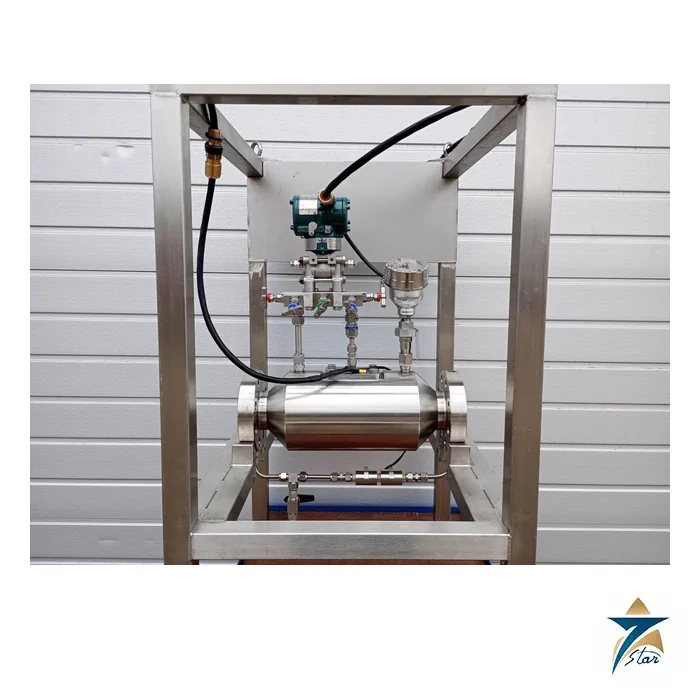
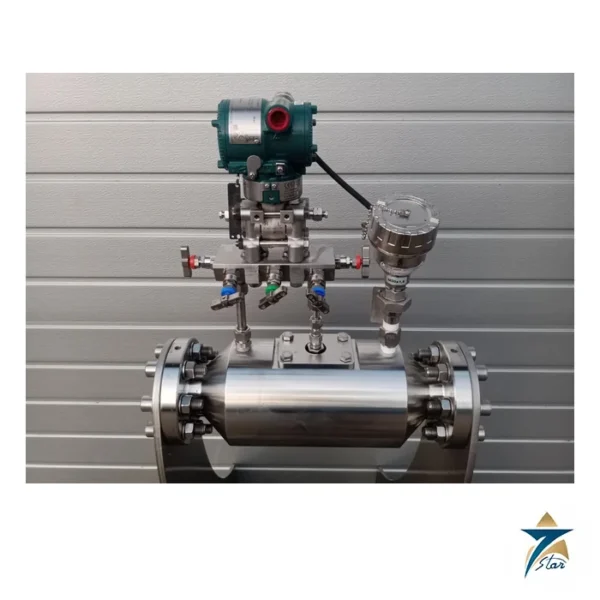
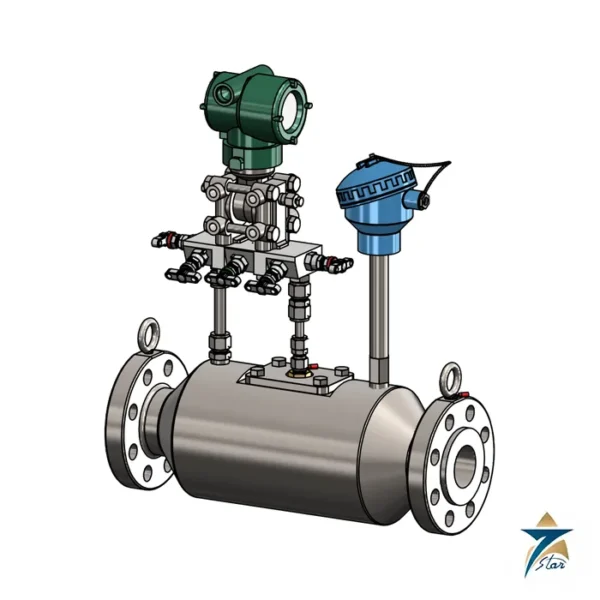
The esmerGSE is a low cost multiphase flow meter from Petroleum Software Ltd that splits the job in two: a conventional venturi measures total flow, and a small bypass line measures water cut. That arrangement keeps the primary element simple and gives the operator an optional sampling point on the same meter.
Bypass water cut measurement
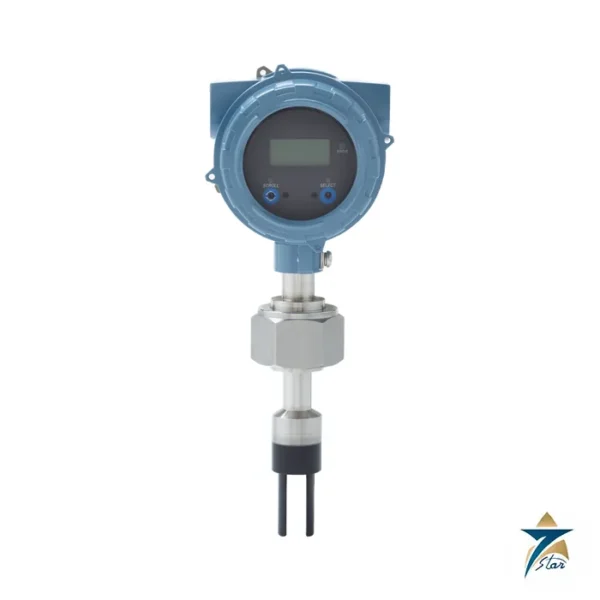
Part of the liquid flows through the bypass, where its impedance is read by the esmerMux impedance transmitter and converted to water cut. The brochure notes an option for sampling on the bypass, which lets the operator take a physical sample to check or tune the reading. Calculation of the individual phase rates combines fluid dynamic and thermodynamic models with signal processing.
Technical specifications
| Parameter |
Specification |
| Product |
esmerGSE multiphase flow meter |
| Total flow element |
Conventional venturi |
| Water cut element |
Bypass line with impedance probe and esmerMux transmitter |
| Sampling |
Optional, on the bypass |
| Water cut range |
0 to 100% |
| GVF range |
0 to 100% |
| Flow range |
Sized to suit given process conditions |
| Pressure |
Up to 150 bar |
| Temperature |
Up to 140 deg C |
| Materials and rating |
To suit given requirements |
| Data link |
RS485 and Modbus to the esmerDigital PC; RS485, Ethernet, Modbus output platform |
| Cabling |
24 V cable plus RS485 cable between field unit and control room PC |
| Typical size 2 in, ANSI 600 |
L 55 cm, H 110 cm, W 70 cm, 90 kg |
| Typical size 4 in, ANSI 600 |
L 70 cm, H 110 cm, W 75 cm, 100 kg |
| Typical size 6 in, ANSI 600 |
L 85 cm, H 110 cm, W 80 cm, 120 kg |
| Accuracy |
Calibration tuned to field conditions; target stated per application |
Software and calibration
Data acquisition, computation and communication run in esmerDigital on an industry standard Windows PC. The starting model for the cone discharge coefficient comes from multiphase flow loop tests and the starting equation-of-state model comes from the PVT data the user provides. Both are tuned in the field with esmerConfigurator, using a separator and or the bypass sample. PSL states that the field calibration procedure and tools follow API 2566 guidelines.
Wiring and multi-meter use
Only a 24 V cable and an RS485 cable run from the field unit to the control room PC. Output to other systems goes through the RS485, Ethernet and Modbus platform, and several field units can be managed from a single PC, which suits a pad or manifold where each well carries its own meter.
Choosing the esmerGSE
Choose this model when a venturi primary element and a bypass probe suit the line, or when physical samples of the liquid are wanted during commissioning. For the cone-based sibling see the esmerMPFM entry. Send line size, pressure, temperature, expected rates and PVT data with your enquiry; the flowmeters category lists related instruments.
Operating notes from the brochure
The esmerGSE shares the esmerDigital software platform with the other esmer meters, so the same Windows PC application handles measurement, display and archiving, and the same esmerConfigurator is used for tune-up. The initial discharge coefficient model for the cone or venturi is derived from PSL multiphase flow loop tests, and the initial equation-of-state model is derived from the PVT data you provide. After that, field data are used to bring both models in line with the real process conditions.
Because water cut is read in a bypass rather than across the full line, the bypass tapping and its sample option are worth planning at the piping design stage. The bypass is quarter inch, which keeps the extra pipework small and puts the impedance probe in a convenient, serviceable position. Accuracy depends on the quality of the PVT data and on process conditions, so share the fluid composition and expected rates when requesting a quotation, and say whether a separator or bypass sample will be available for tuning.
Typical applications
The brochure positions the esmerGSE for oil and wet gas production lines across the full GVF and water cut range. In practice that covers single well lines, well pad manifolds, and test lines that previously depended on a separator, where an operator wants continuous multiphase rates at low cost. Where several wells are close together, running several field units from one control room PC reduces the amount of computing hardware needed. Because the output goes out over Ethernet and Modbus, rates can be handed to the existing SCADA or production allocation system as ordinary tags, and the archive kept by esmerDigital gives engineers a record to review when tuning.
Commissioning and verification
General engineering note (not from the brochure): the bypass sampling option is one of the practical strengths of the esmerGSE. During commissioning, samples drawn from the bypass can be analysed for water cut and compared with the impedance reading, and the same point can be used later whenever the well behaviour changes. Pair this with a comparison against a test separator or tank gauge over several hours, and record the fluid properties entered in the software so that later tune-ups start from a documented baseline.
Because the total flow element is a conventional venturi, the differential pressure transmitter and impulse arrangement can be checked with the same routines that site instrument teams already use for venturi meters. Including the meter in the regular calibration plan for multivariable transmitters, and checking the impedance probe for fouling during shutdowns, helps keep the water cut reading stable over time on wells with wax, scale or sand.
Teams that already run venturi meters on the same site will find the esmerGSE fits their existing maintenance routines with little extra training for technicians and metering engineers.
Documents and quotation
The manufacturer brochure can be downloaded from this page. Seven Star LLC supplies as an independent company in Muscat; quotations are prepared on request and no prices are shown.












Reviews
There are no reviews yet.