Rosemount 2511 vibrating fork solids level switch and how its model code reads
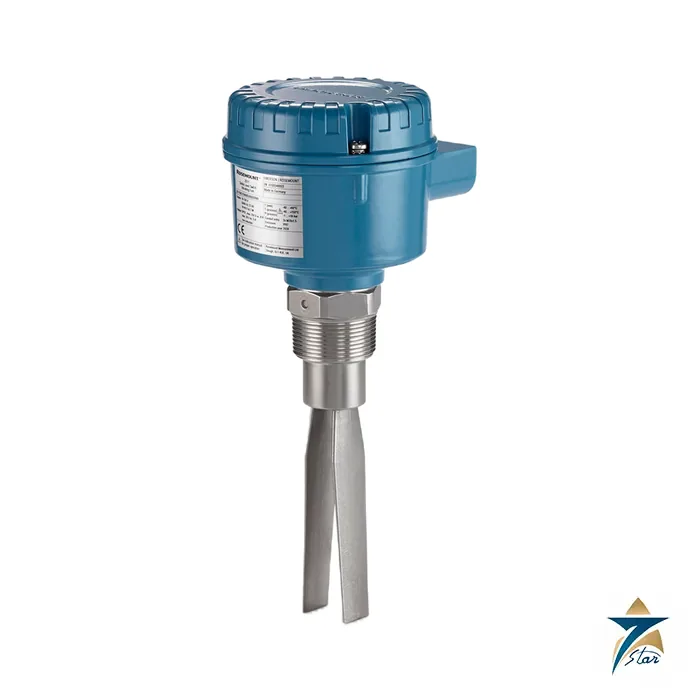
The Rosemount 2511 is a point level switch for bulk solids that uses a short, robust tuning fork. It is the entry model of the Rosemount vibrating-fork family and is aimed at fine-grained and powdered materials in silos, hoppers and process vessels. Seven Star LLC supplies the Rosemount 2511 in Oman and the GCC as an independent supplier in Muscat.
Every unit is built to a model code, and the 2511 code in the manufacturer datasheet follows the pattern 2511 M S 1 5 NN B V A 0000 NA Q4. Reading it from left to right gives the thermal profile, wetted material, conduit entry, connection size, rating, type, electronics, fork length and approvals, which is why a bare model number alone is never enough to place an order.
Rosemount 2511 technical specifications
| Parameter |
Specification |
| Manufacturer / part number |
Rosemount (Emerson) / 2511 Solids Level Switch, Vibrating Fork |
| Measuring principle |
Tuning fork with piezo-electric crystal, vibrating at about 200 Hz |
| Minimum powder density |
Setting A: 9.5 lb/ft³ (150 g/l); setting B: 1.9 lb/ft³ (30 g/l) |
| Process temperature |
-40 to +302 °F (-40 to +150 °C) |
| Ambient temperature (housing) |
-40 to +140 °F (-40 to +60 °C) |
| Process pressure |
-14.5 to 232 psi (-1 to +16 bar) |
| Standard fork length |
6.68 in. (170 mm); extended lengths customer-specified |
| Housing and ingress |
Powder-coated aluminum; IP67 (EN 60529), NEMA Type 4X |
| Fork material |
1.4581 stainless steel, food grade |
| Electronics options |
PNP 18 to 50 Vdc (3-wire); DPDT relay 19 to 230 Vac or 19 to 40 Vdc |
| Relay contact rating |
250 Vac, 8 A or 30 Vdc, 5 A, non-inductive |
| Switching delay |
1 s uncovered-to-covered; 1 to 2 s covered-to-uncovered |
| Maximum grain size / lateral load |
8 mm / 500 N on the fork |
| Weight (standard length) |
3.7 lbs (1.7 kg) |
How the Rosemount 2511 detects material
A piezo-electric crystal drives the fork at its natural frequency. While the tines swing in air the frequency stays high; when the bulk solid rises around them, the material damps the movement and the frequency drops. The electronics watch this change continuously and flip the output between the covered and uncovered state.
Because the decision rests on frequency rather than on the dielectric properties of the material, the 2511 is not affected by dust, electrostatic charging or humidity in the way capacitance probes can be. Two sensitivity settings (A and B) on the electronics board let you match the fork to lighter or heavier powders, and the output delay can be tuned to avoid false trips from falling product. Fail-safe high or low is selectable for each output.
Where the 2511 fits among Rosemount solids switches
Within the same range, the Rosemount 2521 is the enhanced fork for very light powders below 5 g/l, the 2535 is a single-rod design for caking material, and the 2555 is a capacitance probe for hot or heavily loaded vessels. The 2511 is the economical choice when the material is a free-flowing powder or granule with density of at least 30 g/l and no strong tendency to cake.
For spares, the datasheet lists two electronics boards: 02500-1000-0129 (DPDT relay) and 02500-1000-0130 (PNP). Flange mounting kits for DN100 flanges are available as 02500-7500-0001, -0004, -0007 and -0010.
Selecting and ordering the Rosemount 2511
- Thermal profile: M without extension tube, or E with an extension tube when ambient temperature exceeds 104 °F (40 °C).
- Material: D for 304/321 stainless steel, or S for 316/316L with 1.4581 fork tines.
- Conduit entry: M20 x 1.5 with one gland (1) or two glands (2), or NPT ½ in. (4) or ¾ in. (5).
- Process connection: sizes 1¼ in. to 4 in., thread (BSPT or NPT), Tri Clamp, or ASME Class 150 / EN 1092-1 PN6 / PN16 flange.
- Electronics: G for PNP 18 to 50 Vdc, V for DPDT relay.
- Fork length: A for standard 170 mm, or E / M for a length you specify in tenths of inches or millimeters.
- Approvals: NA for none, or dust certifications such as ATEX (ND), IECEx (NK), INMETRO (NR), China (NS), and American and Canadian codes KZ and KB.
Rosemount 2511 installation, commissioning and maintenance
Mount the switch in a vertical, horizontal or angled position, with the fork clear of the filling stream. Where falling product can hit the fork hard, fit an angled reverse-V shield above it; the datasheet limits lateral load to 500 N and torque to 250 Nm for extended forks. Do not use sliding sleeve S1 on a pressurized vessel or in a classified area.
Commissioning means choosing setting A or B, setting the delay, selecting fail-safe mode and confirming the status LED changes when you cover and uncover the fork. There are no wearing parts in the measuring principle, so routine work is limited to checking for build-up and inspecting cable glands and seals. Keep one spare electronics board per electronics type for critical silos.
Typical Rosemount 2511 applications in Oman and the GCC
Cement plants, flour and feed mills, fertilizer stores, sand and aggregate hoppers, plastics pellet silos and power-plant ash or lime handling all rely on high, demand and low level alarms. In the Gulf climate, the aluminum housing with IP67 sealing copes with dust and humidity, and the thermal extension option keeps electronics cooler when silo tops sit in direct summer sun.
Dusty areas can require dust-ignition-proof approvals, so state the zone and the approval you need when you enquire.
2511 versions at a glance
| Choice |
Codes |
Effect |
| Thermal profile |
M, E |
E adds an extension tube for ambient above 40 °C |
| Electronics |
G, V |
PNP transistor output or DPDT relay |
| Fork length |
A, E, M |
170 mm standard or custom extended |
| Sliding sleeve |
S1, S2 |
Adjustable insertion depth; S2 holds up to 16 bar |
| Options |
Q4, P2, WR5, WT |
Functional test certificate, weather cover, 5-year warranty, wired tag plate |
Information to send with a Rosemount 2511 RFQ
- Full model code, or the vessel type, material name and bulk density
- Process temperature, ambient maximum and pressure
- Mounting position, nozzle size and flange standard
- Fork length or tank wall thickness plus required insertion depth
- Supply voltage and output type (PNP or relay)
- Hazardous area classification and required approval
- Quantity and spare electronics boards needed
Documents and quotation
The official 2511 datasheet is attached on this page for reference, so you can check model codes, materials and approvals against your specification before ordering.
Send us the full model code or the process data, and Seven Star LLC will prepare a quotation for the Rosemount 2511 as an independent supplier in Muscat, with delivery to Oman and the GCC.
Other Models in the Rosemount Solids Level Switch Range
Seven Star LLC supplies models from the Rosemount Solids Level Switch range in Oman and the GCC. Compare the related models below and request a quote for the one that matches your application.




















Reviews
There are no reviews yet.