Rosemount 2521 enhanced vibrating fork for very light powders
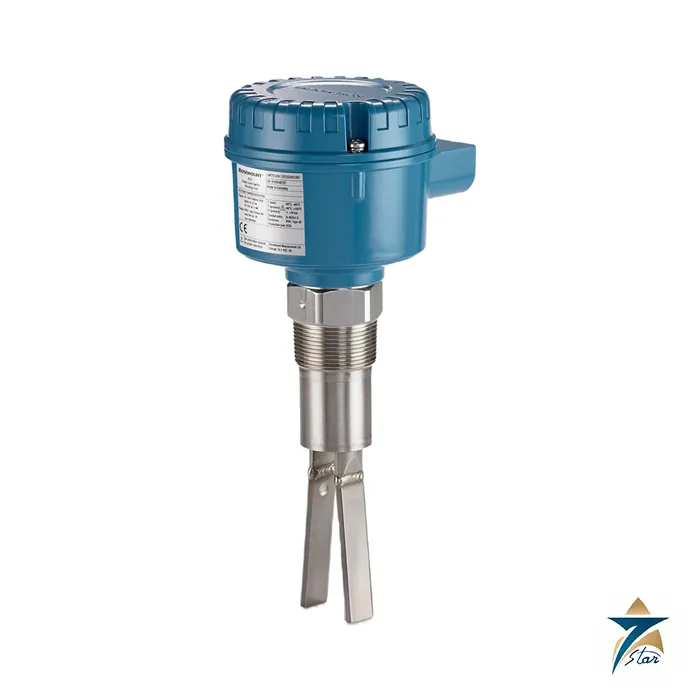
The Rosemount 2521 is the high-sensitivity member of the Rosemount vibrating-fork family for bulk solids. Where a standard fork loses the signal on fluffy, aerated or pneumatically filled powders, the 2521 offers fork profiles and sensitivity options that work down to below 5 g/l. Seven Star LLC supplies the Rosemount 2521 in Oman and the GCC as an independent supplier in Muscat.
The 2521 model code has more building blocks than its sibling the 2511, for example 2521 S M D 1 5 NN B E A 0000 NA Q4: fork profile, thermal profile, material, conduit entry, connection, electronics, fork length and approvals. The sections below explain the choices that matter.
Rosemount 2521 technical specifications
| Parameter |
Specification |
| Manufacturer / part number |
Rosemount (Emerson) / 2521 Solids Level Switch, Enhanced Vibrating Fork |
| Fork vibration frequency |
2521S: 350 Hz; 2521H: 125 Hz (standard) or 90 Hz (V2 and V3) |
| Minimum density, setting B |
2521S: 3 lb/ft³ (50 g/l); 2521H: 1.2 lb/ft³ (20 g/l); V1 option 0.3 lb/ft³ (5 g/l); V2/V3 below 5 g/l |
| Minimum density, setting A |
2521S: 9 lb/ft³ (150 g/l); 2521H: 4.5 lb/ft³ (75 g/l) |
| Process temperature |
-40 to +302 °F (-40 to +150 °C); cable-extended: -13 to +176 °F (-25 to +80 °C) |
| Process pressure |
-1 to +16 bar; cable-extended versions -1 to +6 bar |
| Fork length |
2521S 165 mm; 2521H 235 mm (260 mm for V2/V3); tube or cable extended on request |
| Fork material and finish |
316L (1.4404) stainless steel, polished Ra below 0.75 µm; PTFE on request |
| Housing and ingress |
Powder-coated aluminum, IP66 / NEMA Type 4X; remote housing available |
| Electronics |
SPDT or DPDT relay, PNP, 2-wire AC switch, NAMUR |
| Maximum lateral load |
600 N on the fork; 300 Nm torque (tube-extended); 2 kN pull (cable-extended) |
| Maximum grain size |
10 mm (0.39 in.) |
How the Rosemount 2521 reaches its sensitivity
The principle is the same tuning fork and piezo crystal as the 2511, but the fork geometry and drive frequency are changed. The standard-sensitivity S profile runs at 350 Hz and suits both dry and wet material at 50 g/l and above. The H profile is longer and runs at 125 Hz, giving 20 g/l on setting B.
Option codes V1, V2 and V3 push this further. V2 adds an aluminum fork with a larger vibrating surface and is more sensitive than V3. A separate option, V4, gives adjustable sensitivity for interface applications on the S profile, tuned with a potentiometer on the board.
Choosing between the 2521, 2511 and related Rosemount switches
Use the Rosemount 2511 when material is heavier than about 30 g/l and cost is the priority. Pick the 2521 when you handle fly ash, silica fume, powdered milk, talc, carbon black or similar lightweight powders, or when the vessel is filled pneumatically. For strongly caking product, the 2535 vibrating rod avoids bridging between tines, and for very hot service the 2555 capacitance probe reaches 500 °C.
Electronics modules are stocked as spares with part numbers such as 02500-1000-0073 (PNP), 02500-1000-0075 (2-wire without contact) and 02500-1000-0098 (NAMUR, intrinsically safe). Match the module to the fork sensitivity code, because several modules are labelled for 5 g/l or 20 g/l operation.
Ordering the Rosemount 2521 step by step
- Fork profile: S for standard sensitivity or H for high sensitivity.
- Thermal profile: M, E (extension tube), R (1500 mm remote cable), S (4000 mm remote cable) or C (cable extension for up to 80 °C process).
- Material: D for 304/321 or S for 316L stainless steel.
- Electronics: T (2-wire AC), G (PNP), V (DPDT relay), E (SPDT relay) or K (NAMUR, not with profile S).
- Fork length: A (165 mm, profile S), B (235 mm, profile H), E/M tube-extended, F/N cable-extended.
- Approvals: dust, flameproof, increased safety and intrinsically safe codes for ATEX, IECEx, China and North America, each tied to the conduit entry you select.
- Options: Q4 test certificate, P2 weather cover, S2 sliding sleeve, WR5 warranty, WT tag plate.
Rosemount 2521 installation and maintenance notes
Fit the switch where light powder can reach the fork but away from the direct fall of product. If lateral loads are high, protect the fork with an angled shield above it. In cable-extended versions the tractive force is limited to 2 kN, so check the silo geometry before specifying long cables.
The remote-housing versions use a silicone triaxial cable with a 50 mm minimum bend radius; keep it away from hot surfaces. After commissioning, the status LED confirms output state, and the unit needs no recalibration in normal service. Inspect polished forks occasionally for heavy build-up and replace electronics modules as plug-in spares.
Rosemount 2521 applications in Oman and the GCC
Typical uses include cement and lime silos, fly ash handling at power plants, plastics and polymer powder storage in petrochemical sites, flour and food powders, and dust collector hoppers. Polished stainless forks help in hygienic applications, while the hot ambient conditions of the region are handled by the extension tube or remote housing options.
2521 option summary
| Group |
Codes |
Notes |
| Fork profile |
S, H |
350 Hz standard or 125 Hz high sensitivity |
| Sensitivity options |
V1, V2, V3, V4 |
V1 to V3 on profile H; V4 on profile S, no approvals |
| Housing arrangement |
M, E, R, S, C |
Direct, tube, 1.5 m remote, 4 m remote or cable |
| Outputs |
T, G, V, E, K |
AC switch, PNP, DPDT, SPDT, NAMUR |
Information to send with a Rosemount 2521 RFQ
- Model code or powder name and bulk density in g/l
- Whether filling is pneumatic or aerated
- Process temperature, ambient maximum and pressure
- Required fork length or vessel wall thickness
- Output type and supply voltage
- Hazardous area zone and approval
- Quantity and spare electronics modules
Documents and quotation
The official 2521 datasheet is attached on this page for reference, so you can check model codes, materials and approvals against your specification before ordering.
Send us the full model code or the process data, and Seven Star LLC will prepare a quotation for the Rosemount 2521 as an independent supplier in Muscat, with delivery to Oman and the GCC.
Other Models in the Rosemount Solids Level Switch Range
Seven Star LLC supplies models from the Rosemount Solids Level Switch range in Oman and the GCC. Compare the related models below and request a quote for the one that matches your application.




















Reviews
There are no reviews yet.