Endress+Hauser FMX21 Waterpilot hydrostatic level probe for wells, tanks and wastewater
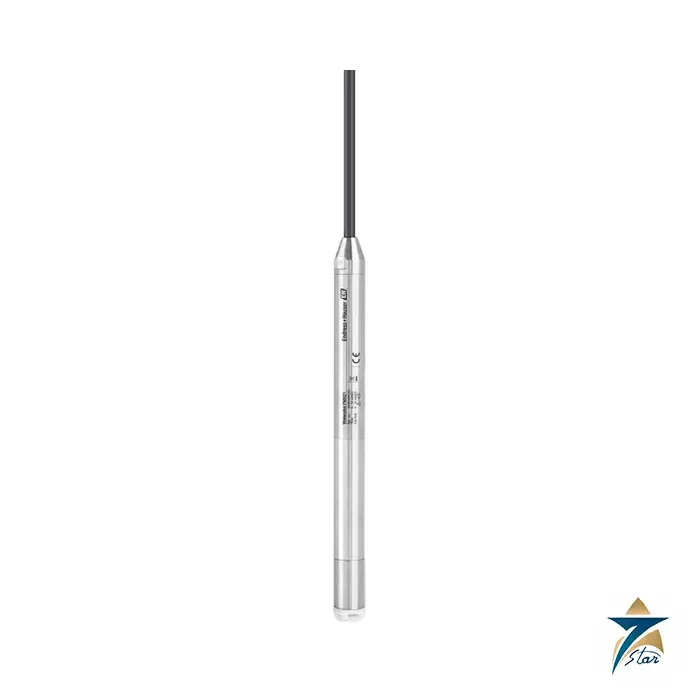
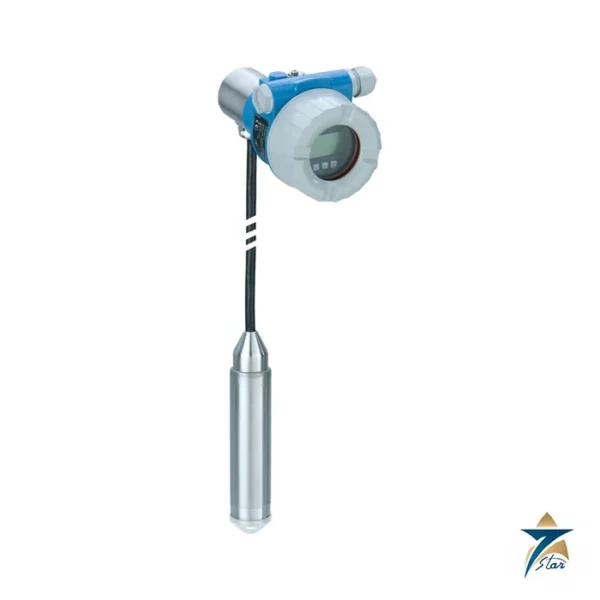
The Endress+Hauser FMX21 Waterpilot is a compact submersible pressure probe that converts the hydrostatic pressure of a liquid column into a level signal. It is lowered on its own cable into a borehole, well, sump, open channel or tank, and it gives a 4 to 20 mA signal, with HART on the digital version. The core is a dry ceramic measuring cell, and the electronics are fully potted, so the probe tolerates immersion, condensation and temperature swings. Seven Star LLC supplies FMX21 probes in Oman and the GCC as an independent supplier in Muscat.
The FMX21 comes in three body styles, selected by the application: a slim 22 mm stainless probe for clean water and small-diameter boreholes, a 42 mm heavy-duty stainless probe with a flush membrane for wastewater, and a 29 mm probe with plastic insulation for salt water and marine ballast tanks.
Reading the FMX21 version
- Diameter 22 mm: stainless steel 316L, general applications and fresh water.
- Diameter 42 mm: stainless steel 316L with flush membrane, waste water.
- Diameter 29 mm: PPS sleeve and polyolefin heat-shrink insulation, salt water.
- Measuring cell: gauge or absolute cell from 0.1 to 20 bar (10 mbar to 2 bar smallest spans).
- Cable: PE, FEP or PUR; 10 m, 20 m, 30 ft, 60 ft or custom length, shortenable on site.
FMX21 technical specifications
| Parameter |
Specification |
| Manufacturer / part number |
Endress+Hauser / FMX21 |
| Measuring principle |
Hydrostatic pressure with dry ceramic capacitive cell |
| Measuring ranges |
Gauge 0.1, 0.2, 0.4, 0.6, 1, 2, 4, 10, 20 bar; absolute 2, 4, 10, 20 bar (10 and 20 bar not for the 29 mm probe) |
| Maximum turn down |
10:1 at the factory; more on request or in the device (HART version) |
| Reference accuracy |
±0.2 % standard, ±0.1 % Platinum version |
| Long-term stability |
≤ 0.1 % of URL per year; ≤ 0.25 % per 5 years |
| Output |
4 to 20 mA analog or 4 to 20 mA with HART 6.0, two-wire |
| Supply voltage |
10.5 to 35 V (non-hazardous), 10.5 to 30 V (hazardous area) |
| Temperature measurement (optional) |
Pt100 class B, –10 to +70 °C |
| Medium temperature |
–10 to +70 °C (22 and 42 mm); 0 to +50 °C (29 mm) |
| Ingress protection |
IP68, permanently sealed to 20 bar (about 200 m H2O) |
| Process-wetted materials |
316L, ceramic Al2O3, EPDM or FKM seal; 29 mm: PPS and polyolefin |
| Maximum cable length |
300 m when freely suspended or with Ex approval |
| Probe weight |
344 g (22 mm), 1,376 g (42 mm), 394 g (29 mm) |
| Warm-up time |
Below 6 s |
How the FMX21 measures level
The ceramic process membrane is exposed to the liquid. Atmospheric pressure is led through a compensation tube inside the cable to the back of the membrane, so only hydrostatic pressure acts on the cell. Pressure moves the membrane, which changes the capacitance between electrodes on the ceramic carrier, and the electronics turn this into a signal proportional to pressure and linear to level.
The measured level is the product of density, gravity and height of the liquid column, so the signal is correct only if density is known. With the optional Pt100 temperature sensor, a temperature head transmitter and a suitable evaluation unit, density can be compensated for temperature to increase accuracy. Where condensation in the pressure compensation tube could be an issue, the datasheet recommends an absolute pressure probe with an external absolute sensor on the HART line to subtract atmospheric pressure.
Probe selection: 22 mm, 29 mm or 42 mm
| Body |
Diameter |
Medium temperature |
Best for |
| Stainless steel |
22 mm |
–10 to +70 °C |
Drinking water, narrow boreholes and wells |
| Stainless steel, flush membrane |
42 mm |
–10 to +70 °C |
Wastewater and treatment plants, easy to clean |
| Plastic insulated |
29 mm |
0 to +50 °C |
Salt water, ship ballast tanks |
FMX21 selection and ordering checklist
- Liquid type and density, to choose body style and elastomer (EPDM or FKM).
- Maximum level in metres of water column and the span, to pick the measuring cell; select a range slightly above the maximum head.
- Gauge or absolute cell, and vacuum resistance required.
- Standard or Platinum accuracy; analog or HART output.
- Whether a Pt100 and a TMT71 or TMT72 temperature head transmitter are needed.
- Cable material (PE, FEP or PUR), length and mounting hardware: suspension clamp, cable mounting screw G 1½ or NPT 1½, terminal box.
- Hazardous-area approval required, since the datasheet lists ATEX, FM and CSA among product approvals.
- Drinking water or marine approval needs; the datasheet lists KTW, NSF, ACS and GL, ABS, BV, DNV for the range, to be confirmed for the chosen version.
Installation and maintenance of the FMX21
Hang the probe on its cable, with a suspension clamp or a cable mounting screw, so that it stays below the lowest level and clear of inflow and sediment. Respect the minimum bending radius of the cable (120 mm) and the maximum tensile strength (950 N). Terminate the cable so that the pressure compensation tube stays open to the atmosphere; a blocked or water-filled tube causes drift, so keep the termination dry and vented, for example in an optional terminal box.
The datasheet specifies a long-term stability of 0.1 % of upper range limit per year, so a yearly check against a dip reference is usually enough. Clean the membrane gently, with no sharp tools, and use the protective cap during transport. Keep a spare probe on critical wells because replacement is quick.
Typical FMX21 applications in Oman and the GCC
In Oman and the GCC the FMX21 is a common choice for water wells and boreholes, aflaj and groundwater monitoring, sump and drainage pits, sewage lift stations, wastewater plants, desalination intake and brine pits, and ballast or bilge tanks on vessels. The 29 mm insulated probe suits warm seawater applications, while the hot ambient and the wet environment call for a sealed terminal box. Fuel and chemical tanks need compatibility checking against the wetted materials.
Information to send with an FMX21 RFQ
- Liquid, density and temperature range.
- Maximum and minimum level, and total depth of installation.
- Cable length and material.
- Output type and any HART or temperature option.
- Hazardous-area classification.
- Mounting hardware and display or evaluation unit.
Documents and quotation
The official Technical Information for the Waterpilot FMX21 (TI00431P) is attached on this page as a datasheet.
Send the FMX21 details above and Seven Star LLC will prepare a quotation for Oman and the GCC.


















Reviews
There are no reviews yet.