Rosemount TGU 53 Tank Radar Gauge for LNG and LPG cargo tanks
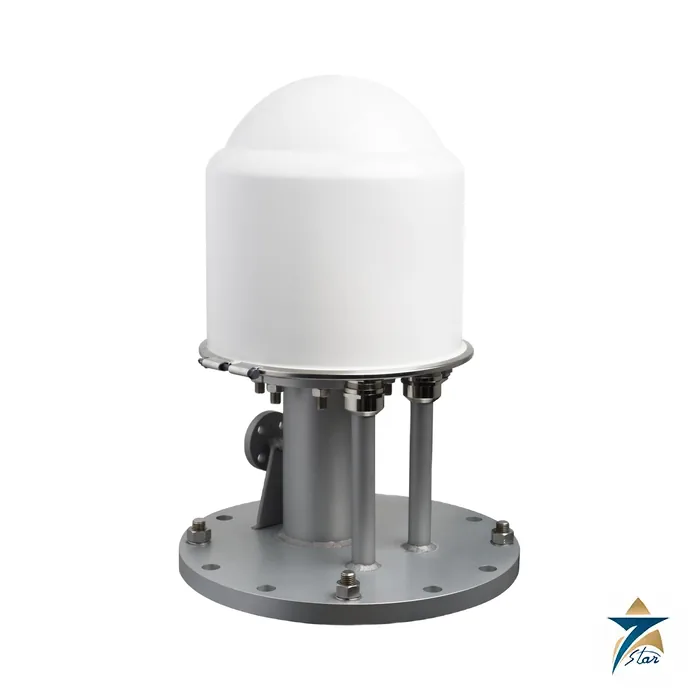
The Rosemount TGU 53 is a marine tank radar gauge with a still pipe antenna, made for liquefied gas tanks on ships. In one unit it measures level, temperature and vapor pressure, and it is part of the Rosemount Custody Transfer System used for cargo measurement. The gauge is intrinsically safe and works with 10 GHz FMCW radar, guiding the signal through a full-length still pipe to the liquid surface.
Seven Star LLC supplies the Rosemount TGU 53 in Oman and the GCC as an independent supplier in Muscat. Because the TGU 53 is delivered with its still pipe assembly and is project engineered for the tank type, please send the tank and vessel details with your enquiry.
What makes the TGU 53 different from a standard radar gauge
- Dual channel in one gauge. Two independent radar measurements run on separate electronic boards connected to the same antenna and still pipe. This gives primary and secondary custody transfer levels with one pipe installation. A single-channel unit can be upgraded later.
- Dual self-adjustment. Gas composition and density change the propagation speed of the radar signal. The TGU 53 uses measurable gas quantities to compensate continuously.
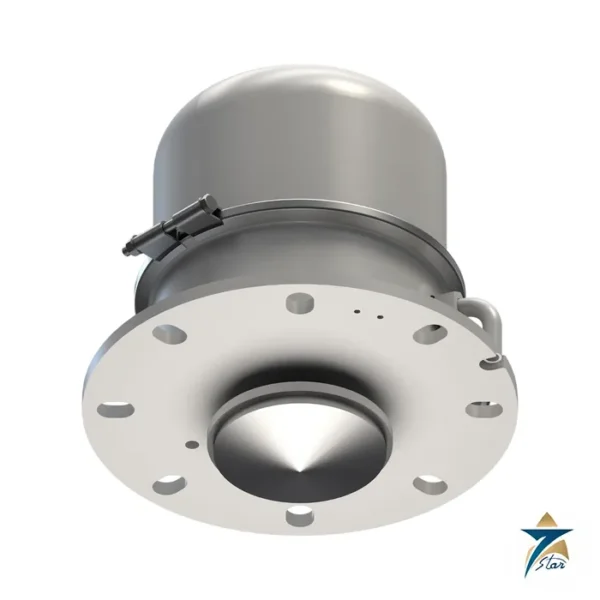
- Array attenuator. A patented device below the still pipe absorbs the reflection from the tank bottom, so levels very close to the bottom can be measured.
- Electronics outside the tank. All electronics sit under one cover on deck and can be exchanged without opening the tank to the atmosphere.
- Traceable calibration. The calibration follows the definitions of the international metrology bureau (BIPM), and a reference instrument is supplied to keep the system calibrated.
Rosemount TGU 53 technical specifications
| Parameter |
Specification |
| Manufacturer / part number |
Rosemount (Emerson) / TGU 53 |
| Antenna type |
Cone antenna with still pipe |
| Product range |
Liquefied gases according to the IMO IGC code |
| Measuring range |
Up to 52 m |
| Instrument accuracy |
±3 mm (±3σ conformance), shown at factory acceptance test |
| Typical CTS accuracy on site |
±5 mm (site acceptance test and operation) |
| Reduced accuracy zone |
0 to 16 mm above the bottom reference point, accuracy ±15 mm |
| Radar channels |
One or two, 10 GHz FMCW centre frequency |
| Tank temperature / pressure |
-170 to +100 °C; 0.8 to 8 bar absolute |
| Temperature measurement |
1 to 6 four-wire Pt 100 RTDs per temperature electronics, -165 to +100 °C, system accuracy ±0.1 °C |
| Vapor pressure (LNG) |
0.8 to 2 bar absolute, ±3 mbar |
| Vapor pressure (LPG) |
0.8 to 8 bar absolute, ±15 mbar |
| Cables |
Up to two cables with up to three twisted pairs and common shield; diameters 6 to 21 mm; proprietary intrinsically safe bus |
| Gauge weight |
33 kg |
| Ingress protection / ambient |
IP66; -40 to +70 °C; 0 to 100% humidity |
| Explosion protection |
Intrinsically safe: ATEX II 1 G Ex ia IIC T4 Ga; IECEx Ex ia IIC T4 Ga |
| Marine approvals |
ABS, BV, CCS, DNV-GL, KR, LR, NK, RINA |
How the TGU 53 measures inside the still pipe
The gauge sends a 10 GHz frequency sweep down the still pipe. The reflection from the liquid surface is mixed with the outgoing signal, producing a low-frequency signal that is proportional to the distance. Digital signal processing converts this to a level reading. The microwave output power is below 1 mW.
The complete in-tank assembly consists of a gauge socket, joined still pipe segments with equalizing holes and a verification pin. Two vented thermowells run alongside the still pipe and carry the temperature sensors. Brackets welded to the pump tower hold the pipe and thermowells while allowing vertical movement for thermal expansion, which matters at -165 °C. The verification pin, installed above the highest measurable level, allows periodic checks of the TGU 53.
Still pipe, deck socket and tank type for the TGU 53
| Item |
Spherical tanks |
Membrane tanks |
| Deck socket |
Stainless steel 316 / 316L; 12 in. flange 58 kg, 16 in. flange 89 kg |
Same |
| Still pipe |
Dia. 114.3 mm, 4 mm wall, aluminium 5083-0, segments up to 6 m |
Dia. 114.3 mm, 3.6 mm wall, stainless steel 304L, segments up to 6 m |
| Thermowell |
Dia. 34 mm, 3 mm wall, aluminium 5083-0 |
Dia. 33.4 mm, 2.77 mm wall, stainless steel 304L |
| Bracket |
Stainless 304 or aluminium 5083-0, UHMW PE gliding guides |
Same |
Where the TGU 53 fits in the Rosemount system
Each radar channel connects over a digital bus to a Rosemount SCU 51 Supply and Communication Unit. The TGU 53 belongs to the LNG custody transfer family, in contrast to the TGU 65 and TGU 68 gauges, which are designed for general cargo tanks and offshore tanks at up to 35 m (and 65 m on the TGU 65S option). The optional density profile measurement function extends the same system for stratification monitoring.
Selection checklist for the TGU 53
- State the tank type (spherical or membrane) and tank height, which sets still pipe material and length.
- Choose one or two radar channels, and whether an upgrade path is wanted.
- Select 12 in. or 16 in. deck flange according to the gauge socket design.
- Specify the temperature element count per electronics and one or two pressure sensors; choose the LNG or LPG pressure range.
- Confirm class society and custody transfer requirements for the vessel.
- Decide if the density profile function is needed.
Installation, commissioning and service of the TGU 53
The still pipe, thermowells and brackets are installed during tank construction with the pump tower and must be aligned carefully, as the interior of the pipe guides the radar wave. After assembly the gauge is mounted on the deck socket. Factory acceptance testing uses a moveable echo to simulate any liquid level in the tank, and site acceptance is then used to confirm the specified performance. Use the verification pin routine for periodic checks, and keep the calibration reference instrument with the vessel documents.
Because all electronics can be exchanged from deck, service does not require opening the tank. Seven Star LLC can quote spare parts and replacement electronics on request once the gauge serial number is known.
Typical applications of the TGU 53 in Oman and the GCC
The TGU 53 is intended for ships carrying LNG or LPG. In the Gulf region it is relevant to shipowners, shipyards and marine service companies that maintain gas carriers and floating storage units calling at regional terminals, and to custody transfer teams that need traceable level data for cargo measurement. Deck-mounted equipment must handle high ambient temperatures and humidity, and the rated -40 to +70 °C ambient range and IP66 enclosure address that.
Information to send with an RFQ for the TGU 53
- Vessel name or project, class society and tank type
- Tank height and number of tanks
- Number of radar channels and temperature or pressure options
- Deck flange size and socket design
- Whether the still pipe assembly and array attenuator are in scope
- Delivery location and required date
Documents and quotation
A manufacturer datasheet for the Rosemount TGU 53 is attached on this page, so you can check the model code, ratings and dimensions against your project documents before ordering.
To receive a quotation, send us the part number or the full model code from your nameplate, the quantity, and the delivery location. Seven Star LLC is an independent supplier in Muscat and replies with availability and lead time, and we confirm the details with you before anything is ordered.
Other Models in the Rosemount Marine Tgu Range
Seven Star LLC supplies models from the Rosemount Marine Tgu range in Oman and the GCC. Compare the related models below and request a quote for the one that matches your application.



















Reviews
There are no reviews yet.