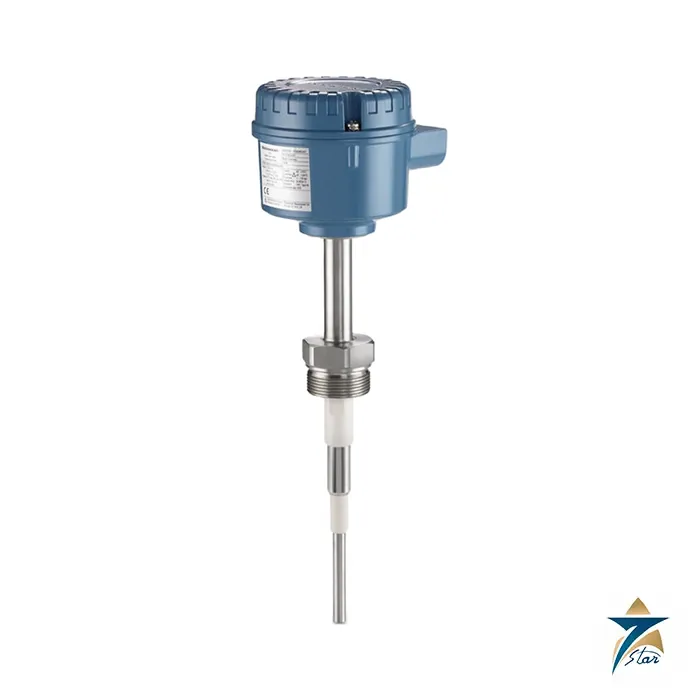
Rosemount 2555 capacitance probe solids level switch and its model code
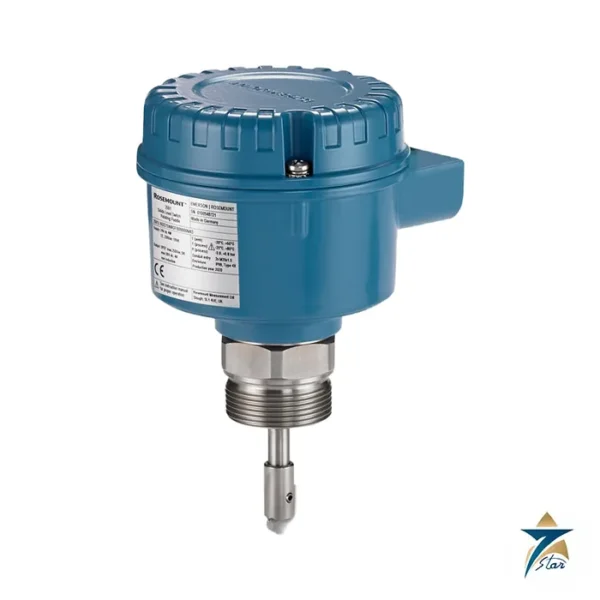
The Rosemount 2555 is a capacitance-type point level switch for bulk solids, built for heavy duty: process temperature up to 932 °F (500 °C), pressure up to 25 bar in standard builds and mechanical loads up to 10 kN. Seven Star LLC supplies the Rosemount 2555 in Oman and the GCC as an independent supplier in Muscat.
In the datasheet, the 2555 code starts with the probe thermal profile, a letter that fixes the probe diameter, whether it is a rod or a rope, and the temperature and pressure class. The rest of the code covers material, conduit entry, connection, electronics, active probe length, inactive extension and approvals.
Rosemount 2555 technical specifications
| Parameter |
Specification |
| Manufacturer / part number |
Rosemount (Emerson) / 2555 Solids Level Switch, Capacitance Probe |
| Principle |
RF capacitance, 100 kHz operating frequency, active shield against build-up |
| Bulk material |
Dielectric constant 1.5 and higher |
| Sensitivity range |
3 to 100 pF in 0.5 pF steps; 3 to 400 pF in 2 pF steps |
| Process temperature |
S, R, M, P: -40 to +464 °F (-40 to +240 °C); E, V: -40 to +932 °F (-40 to +500 °C), +445 °C with Ex approval |
| Process pressure |
-1 to +25 bar standard; -1 to +10 bar for the extreme profiles E and V |
| Probe length |
Rod 200 to 2500 mm (profile S); rope up to 20000 mm |
| Electronics |
DPDT relay 21 to 230 Vac/Vdc; 250 Vac 8 A or 30 Vdc 5 A |
| Signal delay |
Configurable 0.5 to 60 s |
| Display |
Four-digit LCD with tri-color LED to NE44 |
| Housing and ingress |
Powder-coated aluminum, IP67 / NEMA Type 4X |
| Hygiene |
EHEDG certificate option (QE) with 1½ in. BSPP connection |
| Maximum load |
Rod S: 125 Nm; rope R: 4 kN; rod M: 525 Nm; rope P: 40 kN; rope V: 10 kN |
How the Rosemount 2555 senses material
The probe forms one plate of a capacitor and the silo wall the other. When bulk solid covers the probe, the capacitance rises; when it uncovers, it falls. The electronics measure that change at 100 kHz and switch the relay. Active Shield technology guards against false signals from a coating of material along the inactive part of the probe.
Calibration is automatic: you press the push buttons, and the LCD shows the actual capacitance, output state and self-diagnostic messages. Fixed sensitivity options V1 to V4 calibrate the unit to 0.5, 1, 4 or 10 pF at the factory, for people who prefer a preset.
Probe profiles of the 2555
| Code |
Probe |
Temperature |
Pressure |
| S |
10 mm rod |
-40 to 240 °C |
-1 to 25 bar |
| M |
22 mm rod |
-40 to 240 °C |
-1 to 25 bar |
| E |
22 mm rod, extreme |
-40 to 500 °C |
-1 to 10 bar |
| R |
4 mm rope |
-40 to 240 °C |
-1 to 25 bar |
| P |
8 mm rope |
-40 to 240 °C |
-1 to 25 bar |
| V |
8 mm rope, extreme |
-40 to 500 °C |
-1 to 10 bar |
Where the Rosemount 2555 fits among solids switches
The vibrating Rosemount 2511, 2521 and 2535 are simple and low-cost for free-flowing powders. Choose the 2555 when the product is hot, heavy, coarse or has a low density but a measurable dielectric constant, or when the silo is very tall and a rope hangs from the roof.
Rope versions suit tall vessels but rely on tensile limits of 4, 40 or 10 kN depending on profile. Active probe extensions R0 to R9 add rigid, flexible or rope sections on site.
Selecting and ordering the Rosemount 2555
- Choose the probe profile (S, M, E, R, P, V) for temperature, pressure and load.
- Material D or S, with optional PFA coatings (E, F, G, T, U, V) for sticky media.
- Conduit entry 1, 2, 4 or 6, and process connection from ¾ in. to 4 in., thread, Tri Clamp or flange.
- Active probe length: standard 100, 200 or 300 mm, or a specified length; optional inactive extension.
- Approvals: ATEX, IECEx, American, INMETRO and China dust and flameproof codes, tied to material D or S.
- Options: Q4, QE, P2, V1 to V4, sliding sleeve S1, remote housing RVE / RVM, WR5 and WT.
Installation, commissioning and care
Rod versions can be installed vertically, horizontally or at an angle; rope versions hang vertically. Fit a protective shield if falling lumps can strike the probe. Run the automatic calibration with the vessel empty so the electronics learn the baseline, then confirm switching with material present.
In service, watch the LCD diagnostics for build-up warnings and check the gaskets (FKM or FFKM, or graphite in extreme versions). Ceramic probe isolation is used on the extreme profiles. For spare planning, keep the DPDT relay board and the cable glands for your entry type.
Rosemount 2555 applications in Oman and the GCC
Hot, abrasive or heavy bulk materials are common in cement clinker and kiln dust, power plant ash, catalyst and sand handling, and fertilizer plants. The extreme versions suit hot dust collectors and cyclones, while the rope versions fit tall silos at cement and aggregate sites. The wide ambient range handles summer heat on exposed silo roofs.
Information to send with a Rosemount 2555 RFQ
- Material name, dielectric constant and bulk density
- Process temperature and pressure range
- Silo height, nozzle size and mounting angle
- Probe length and any inactive extension
- Remote housing needed or not
- Hazardous area zone and approval
- Quantity
Site conditions in Oman for the 2555
Field instruments in Oman are exposed to strong sun, high ambient temperature, wind-blown dust and, on coastal plants, salt in the air. When you specify the 2555, check the ambient and process temperature limits, the enclosure rating and the wetted and housing materials against the actual installation point, and consider sunshades for transmitters mounted in direct sunlight. Cable entries should be sealed with suitable glands so that dust and moisture cannot enter the housing.
Calibration and verification planning matters as much as selection. Record the range, configuration and tag data of each 2555 at commissioning, define a check interval that suits the criticality of the loop, and keep the certificates with the plant documentation so that audits and shutdown work can proceed without delay.
Documents and quotation
The official 2555 datasheet is attached on this page for reference, so you can check model codes, materials and approvals against your specification before ordering.
Send us the full model code or the process data, and Seven Star LLC will prepare a quotation for the Rosemount 2555 as an independent supplier in Muscat, with delivery to Oman and the GCC.
Other Models in the Rosemount Solids Level Switch Range
Seven Star LLC supplies models from the Rosemount Solids Level Switch range in Oman and the GCC. Compare the related models below and request a quote for the one that matches your application.




















Reviews
There are no reviews yet.