
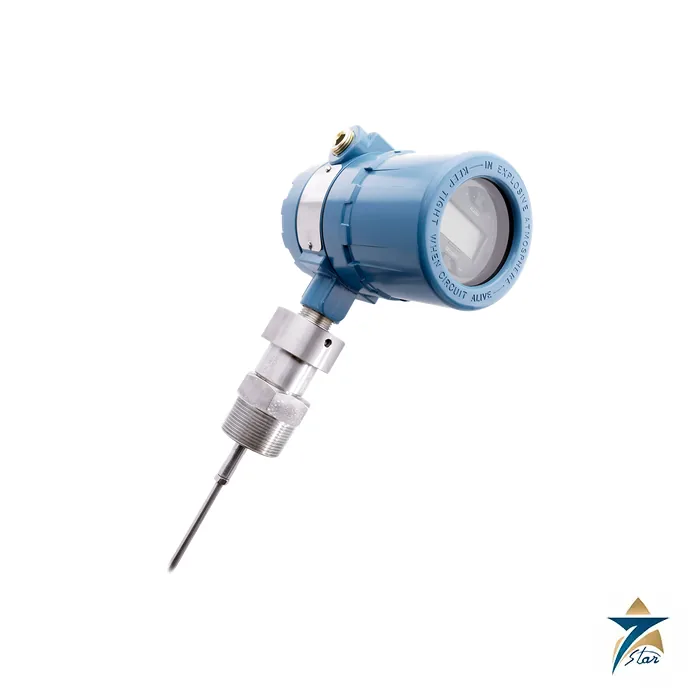
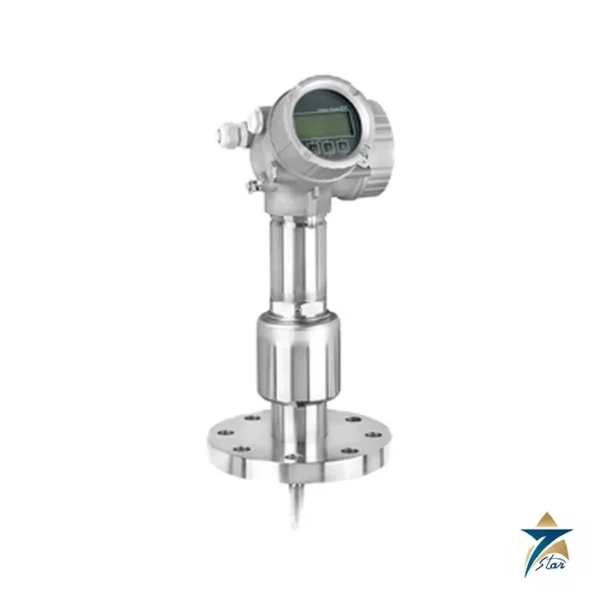
The Rosemount 3300 is a two-wire guided wave radar transmitter for level and interface measurement in liquids and semi-liquids. Emerson describes it as a proven, reliable and easy-to-use transmitter, the first two-wire level and interface transmitter of its type, with more than 120,000 units installed. It measures level directly, so no compensation is needed for changing density, conductivity, temperature or pressure, and it has no moving parts and needs no re-calibration. Two models are offered: the 3301 level transmitter and the 3302 MultiVariable level and interface transmitter.
Seven Star LLC supplies the Rosemount 3300 to oil and gas, refining, petrochemical, power and water customers in Oman and the GCC. Our engineering team in Muscat helps select model, probe type, length, material and process connection from the official Rosemount 3300 datasheet, including retrofits into existing displacer chambers and new installations on storage tanks and process vessels.
The transmitter uses time domain reflectometry. Low-power, nanosecond microwave pulses, nominally 50 µW, are guided down a probe submerged in the process medium. When a pulse reaches a medium with a different dielectric constant, part of its energy is reflected back to the transmitter. The time difference between the transmitted and reflected pulse is converted into a distance, from which the total level is calculated. The higher the dielectric constant of the product, the stronger the reflection.
For interface measurement, the Rosemount 3300 uses the residual wave that was not reflected at the upper product surface. This wave continues until it is reflected at the lower product surface, and because its speed depends on the dielectric constant of the upper product, the interface level can be calculated. Typical interfaces are between oil-like liquids with a dielectric constant below 3 and water-like liquids above 20. Because the energy is guided along the probe, the measurement handles vapor and turbulence well and suits small tanks, difficult geometry and internal obstacles.
The Rosemount 3300 transmitter head is detachable, so the tank stays sealed when the electronics are removed, and a dual-compartment housing separates the cable connections from the electronics. Housings are polyurethane-covered aluminum or CF8M stainless steel with 1/2-14 NPT, M20 adapter or metal cable gland entries. Wetted parts are 316/316L stainless steel as standard, with alloy C-276, alloy 400 and PTFE-covered probes available. The standard process seal is rated for –40 to 150 °C and –1 to 40 bar, with the final rating depending on the flange and O-ring selection.
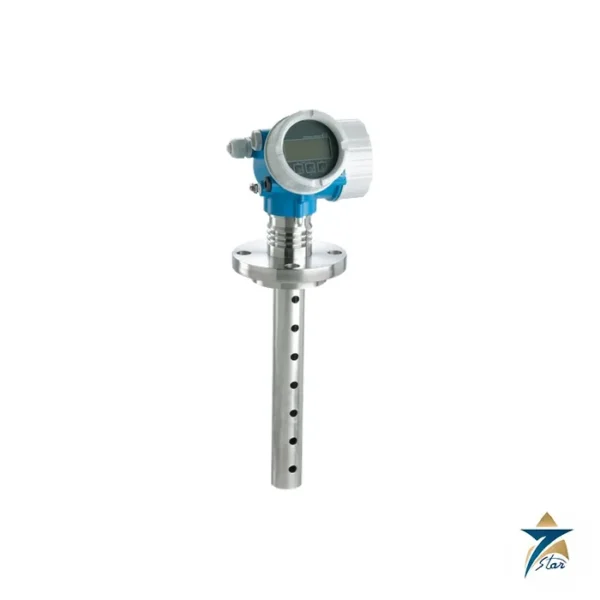
Rosemount 3300 probe choices cover coaxial probes for clean liquids and low dielectric media, perforated coaxial probes for level and interface, rigid single lead probes of 8 or 13 mm, a segmented rigid probe that makes long rigid lengths practical to ship and install, and flexible single lead probes with weight or chuck. Probes can be cut to fit. Single lead probes tolerate build-up and viscosities up to 8000 cP, while coaxial probes are limited to 500 cP. A remote housing kit of 1, 2 or 3 m is available for hot or hard-to-reach locations.
The Rosemount 3300 datasheet lists the following benefits.
The Rosemount 3300 fits most liquid storage and monitoring level and interface applications. Typical duties include level and oil-water interface in separators, desalters, knock-out drums and produced water tanks, condensate and chemical storage tanks, and replacement of mechanical displacers in bypass chambers where maintenance and calibration have been a burden. Its tolerance of vapor and turbulence makes it useful in small process vessels and chambers. In the Sultanate of Oman these applications are found across oil and gas production facilities, refineries and petrochemical complexes in Sohar and Duqm, gas-fired power and desalination plants, and tank terminals near Muscat and Salalah.
Seven Star LLC supports level measurement projects across Oman and the GCC with application review, probe selection and regional delivery. For higher-performance or higher-pressure guided wave radar duty, compare the Rosemount 3300 with the Rosemount 5300 level transmitter. For independent high-level alarms, pair it with the Rosemount 2140 vibrating fork level detector, and configure it in the field with the Emerson 475 Field Communicator.
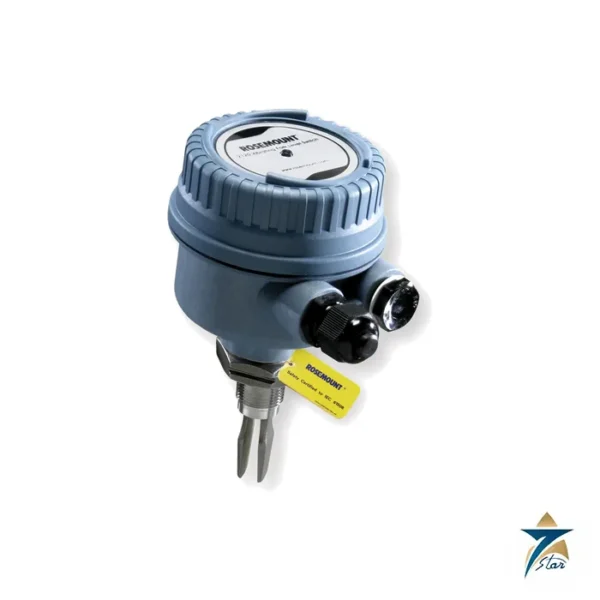
A cost-effective point alarm option is the Rosemount 2120 vibrating fork level switch.
The following Rosemount 3300 data is taken from Emerson product data sheet 00813-0100-4811.
| Parameter | Specification |
|---|---|
| Model | Rosemount 3300 (3301 level; 3302 level and interface) |
| Measurement principle | Time domain reflectometry (guided wave radar) |
| Output | 2-wire 4–20 mA with HART Revision 5; RS-485 Modbus (8–30 Vdc external supply) |
| Supply voltage (HART) | 11–42 Vdc (no approval); 11–30 Vdc (intrinsically safe); 16–42 Vdc (explosion-proof/flameproof) |
| Reference accuracy | ±5 mm (probes ≤5 m); ±0.1% (rigid) or ±0.15% (flexible) of distance beyond 5 m |
| Repeatability | ±1 mm |
| Update interval | Minimum 1 update per second |
| Maximum measuring range | 3 m (8 mm rigid); 6 m (13 mm rigid, coaxial); 23.5 m (flexible single lead) |
| Minimum dielectric constant | 1.5 (coaxial); 2.5 (single lead), 1.7 in metallic bypass |
| Process temperature / pressure | –40 to 150 °C; –1 to 40 bar (standard seal) |
| Wetted materials | 316/316L SST; alloy C-276; alloy 400; PTFE-covered |
| Housing | Polyurethane-covered aluminum or CF8M stainless steel, dual compartment |
| Maximum viscosity | 8000 cP (single lead); 500 cP (coaxial) |
| Microwave output power | Nominal 50 µW, maximum 2 mW |
| Start-up time | Less than 10 s |
For a formal RFQ on the Rosemount 3300, send Seven Star LLC the model (3301 or 3302), output, housing, probe type and length, wetted material, process connection, product dielectric constants, process pressure and temperature, hazardous area approval and any remote housing or THUM requirement. Our instrumentation division will confirm the model code against the Rosemount 3300 datasheet, confirm availability and lead time, provide the data sheet for download and give engineering support from Muscat for level projects across Oman and the GCC.
Browse Rosemount products by category: Pressure Instrumentation, Temperature Instrumentation, Level Transmitter, Liquid Analysis Sensors, Flowmeters.
Choose the option that best fits your needs to get the fastest response from our team.
Automatically fill the RFQ form with this product's details for a faster process.
Manually enter multiple part numbers, specific brands, or custom requirements.










Reviews
There are no reviews yet.