Rosemount 2501 rotating paddle solids level switch for silos and bins
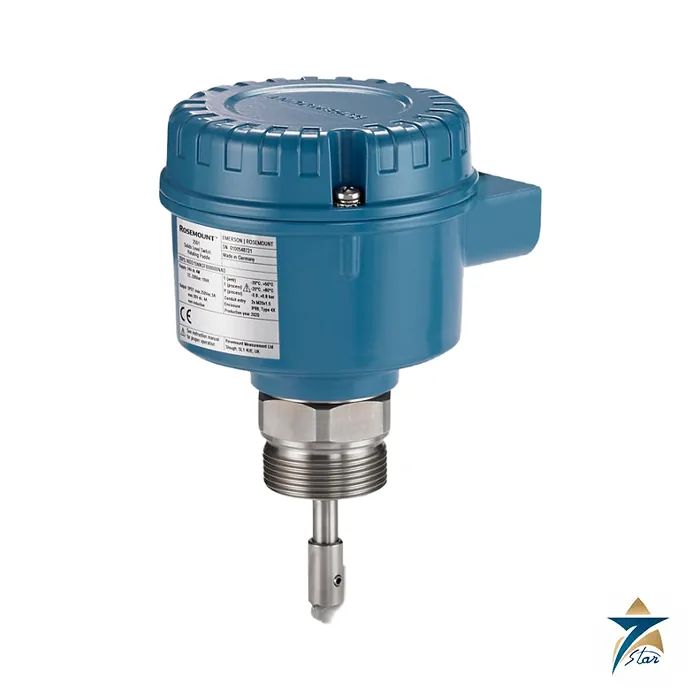
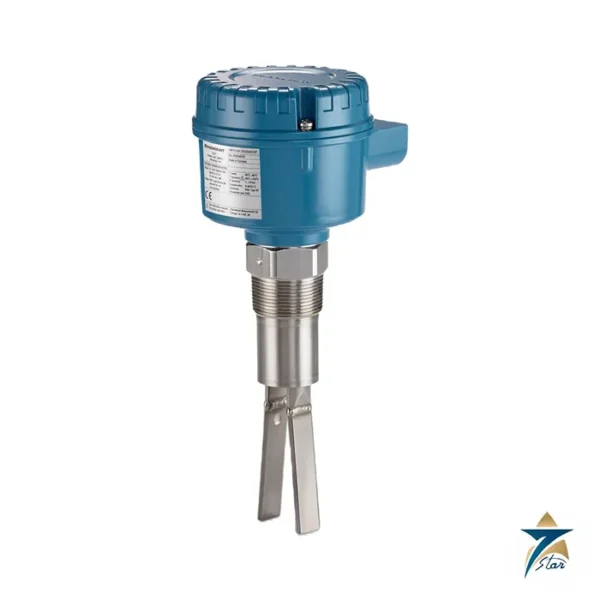
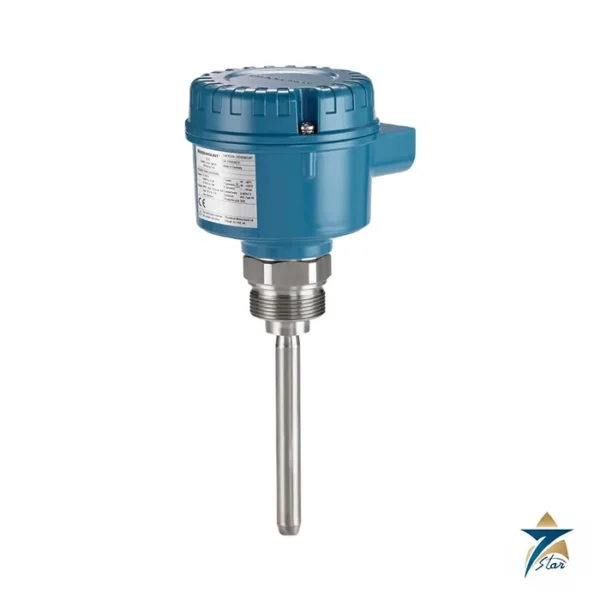
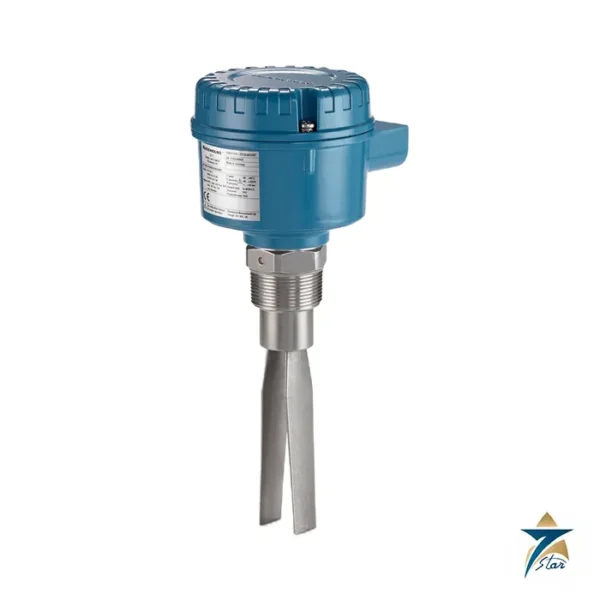
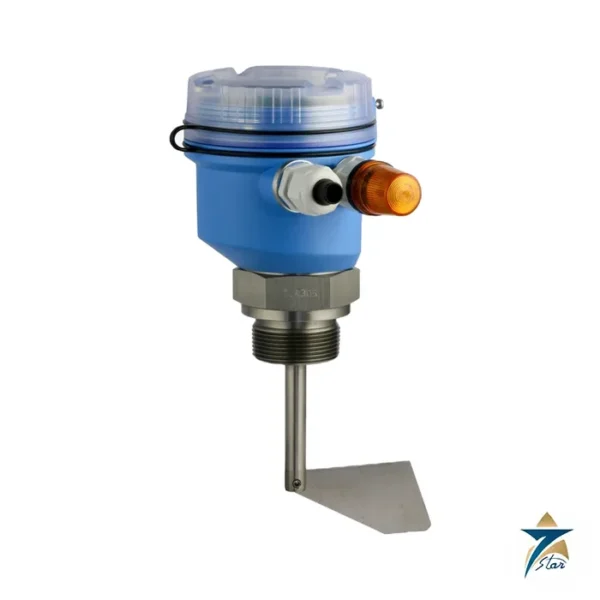
The Rosemount 2501 is a rotating paddle level switch for bulk solids. A synchronous motor turns a paddle (measuring vane) through 360 degrees; when the material covers the vane and stops the rotation, the switch changes state, and when the vane is free the motor runs again. Because the principle is mechanical, it is not upset by dust, electrostatic charge or caking. Seven Star LLC supplies the 2501 in Oman and the GCC as an independent supplier in Muscat.
The data sheet lists a process temperature range of -40 to 2012 °F (-40 to 1100 °C) across the range, with a modular design: six application profiles, many shaft and extension lengths, and a long list of paddle shapes.
Choosing the 2501 application profile
The letter after 2501 sets the mechanical design and where it can be used.
| Profile |
Use |
Notes |
| 2501L |
Full or empty detection, small vessel |
Low mechanical resistance; paddle lengths from 2.76 in. (70 mm) |
| 2501M |
Full detection, medium vessel |
Medium mechanical resistance |
| 2501R |
Full detection, large vessel |
Rope version, up to 4 kN load |
| 2501S |
Full detection, large vessel |
Reinforced rope, up to 28 kN load |
| 2501J |
Empty detection, medium or large vessel |
Low to medium resistance |
| 2501K |
Empty detection, high mechanical resistance |
Requires a 4-in./DN100 flange |
2501 technical specifications
| Parameter |
Specification |
| Manufacturer / part number |
Rosemount (Emerson) / 2501 |
| Measuring principle |
Rotating paddle with synchronous motor and friction clutch |
| Process temperature codes |
1: 176 °F (80 °C); 2: 302 °F (150 °C); 3: 482 °F (250 °C); 4: 662 °F (350 °C); 5: 1112 °F (600 °C); 6: 2012 °F (1100 °C) |
| Process pressure |
Code A: -13.1 to 11.6 psi (-0.9 to 0.8 bar); B: to 73 psi (5 bar); C: to 145 psi (10 bar); codes 5 and 6 limited to about 1.5 psi (0.1 bar) |
| Minimum bulk density |
Above 0.9 lb/ft³ (15 g/l) for the largest vanes; depends on vane and spring setting |
| Paddle speed |
1 or 5 revolutions per minute |
| Power supply |
24, 48, 115 or 230 Vac ±10%, 24 Vdc ±15%, or universal 24 Vdc / 22 to 230 Vac |
| Signal output |
SPDT micro switch (ac and dc versions) or DPDT relay (universal), 250 Vac 5 A / 30 Vdc 4 A |
| Output delay (universal) |
Covered up to 20 s, uncovered up to 60 s, adjustable |
| Cable entry |
M20 x 1.5 or ½-in. NPT |
| Enclosure |
Powder-coated aluminum housing, IP66, NEMA 4X or NEMA 4 depending on configuration |
| Noise level |
Maximum 50 dBA |
| Process connections |
Threads (BSPP, NPT, metric), Tri Clamp, DN and ASME flanges, rectangular flanges |
Working principle of the 2501
A spring pulls the motor and moves the switching lug when the paddle is uncovered, so the output shows an uncovered state while the motor drives the shaft. When bulk material blocks the vane, the motor housing rotates against the spring, the lug moves to the other position, a second switch stops the motor and the signal output indicates covered. When the level drops the spring returns the motor and rotation restarts. A friction clutch protects the gear unit from impacts on the vane, and the dust-tight ball bearing with shaft seal suits dusty service.
Sensitivity depends on bulk density and vane size. The data sheet gives minimum densities for each vane with fine and medium spring adjustment: for example a 40 x 98 mm boot-shaped vane needs about 200 g/l (fine) or 300 g/l (medium) when completely covered, while a 98 x 250 mm rectangular vane works from about 20 to 30 g/l. Housing heating multiplies those values by 1.5.
Options and spares for the 2501
Vane choices run from small boot-shaped vanes (26 x 77 mm up to 40 x 98 mm) through rectangular vanes up to 98 x 250 mm, to hinged vanes for fitting through small threads and a rubber vane for use to 176 °F (80 °C). Options include a fail-safe alarm (AF), weather cover (P2), pendulum or rope extensions, a sliding sleeve, PTFE or FPM shaft sealing, stainless ball bearings and housing heating down to -40 °C ambient. Spare motors are listed as 02500-1000-0001 to -0018 by voltage and speed, and paddles from 02500-1000-0021 upward. Carry a spare motor and a paddle for critical silos.
Selection checklist for the 2501
- Detection duty: full, on-demand or empty, and mounting direction (vertical, horizontal or angled).
- Vessel size and the mechanical load on the paddle from falling or flowing material.
- Bulk density and the vane that is sensitive enough for it.
- Process temperature, pressure and the shaft seal this requires.
- Material of connection and extension: aluminum, 304 or 316L.
- Supply voltage and speed, and whether you need SPDT, DPDT, adjustable delay or fail-safe alarm.
- Dust or flameproof approval code, noting that the high-temperature codes 4, 5 and 6 exclude these certifications.
Installing and servicing the 2501
Protect the paddle from direct impact of falling product with an angled shield or choose an extension tube where forces are high. The data sheet limits torque to 50 Nm for the 2501L and 500 Nm (stainless) for the M and J versions. The housing allows generous wiring space with a rotatable electronics module, and ventilation is not required. Check the vane for wrapping, material build-up and bearing wear at planned shutdowns, and remember that the safety function wiring on universal-voltage electronics uses terminals 4 to 7.
Where the 2501 is used in Oman and the GCC
Cement plants, grain and flour silos, fertilizer and mineral bins, power-station coal and ash handling, sand and aggregate hoppers and lime or gypsum storage depend on level alarms that survive dust, heat and humidity. A paddle switch with a motor-driven vane on a stainless extension handles those conditions and gives a clear contact signal to the control system.
Information to send with your 2501 RFQ
- Full model code, or profile, temperature, pressure, power supply and vane
- Bulk material name, density and particle size
- Silo height, wall thickness and mounting position
- Temperature of the material and the silo wall
- Hazardous dust approval needed, if any
- Quantity and delivery location
Documents and quotation
The manufacturer product data sheet for the 2501 is attached on this page, and it is the document to check for the full ordering table, dimensional drawings and approvals before you place an order. It lists the vane, density and torque tables used above.
Seven Star LLC is an independent supplier in Muscat serving Oman and the GCC. Send us the 2501 model code or your process data and we will reply with availability, lead time and a quotation.



















Reviews
There are no reviews yet.