Endress+Hauser FMG50 Gammapilot radiometric transmitter for non-contact measurement
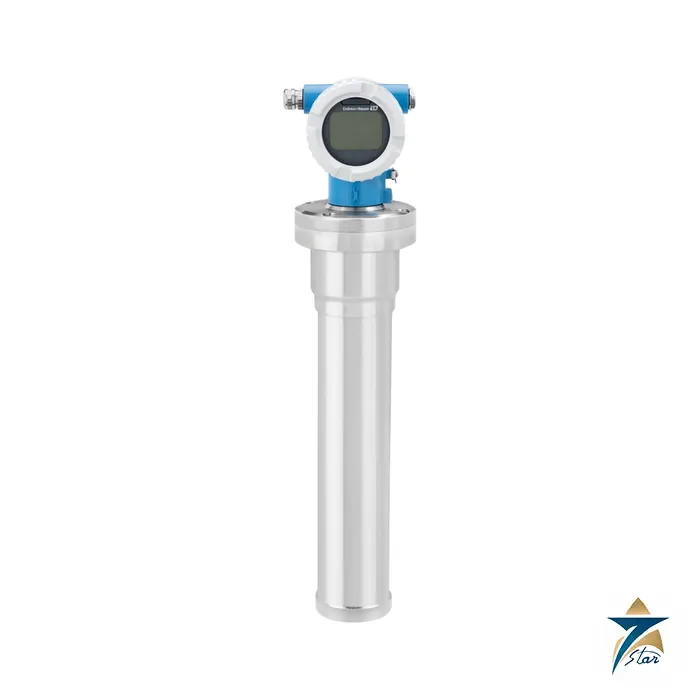
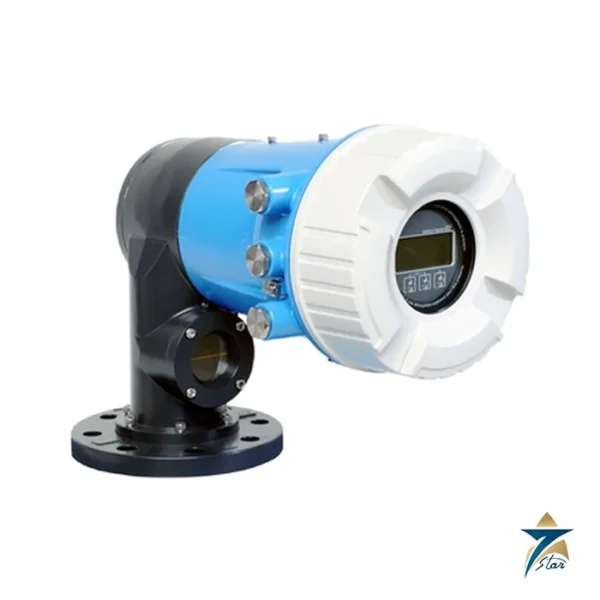
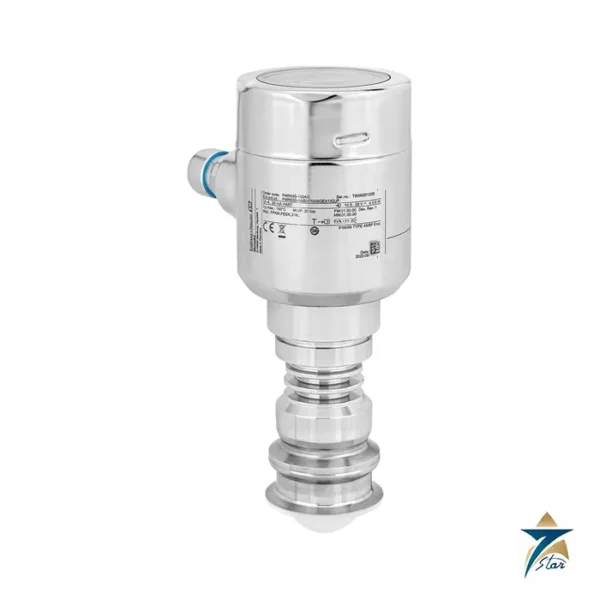
The Endress+Hauser FMG50 Gammapilot is a compact, loop-powered radiometric transmitter that measures through the vessel wall. A gamma source in a source container sits on one side of the vessel and the FMG50 receives the radiation on the other side, so nothing touches the process. That makes it the instrument of last resort, and often first choice, where temperature, pressure, abrasion, coating, crystallisation or toxicity make contact or radar methods unreliable. Seven Star LLC supplies FMG50 units in Oman and the GCC as an independent supplier in Muscat.
A single FMG50 transmitter covers level, interface, density, concentration and point level, so one spare device type can serve many tasks across a plant. It communicates with 4 to 20 mA and HART and can be operated from a smartphone over Bluetooth.
Reading the FMG50 configuration
- Detector: thallium-doped sodium iodide crystal in 50, 100 or 200 mm lengths, or standard or high-temperature PVT scintillator up to 4 m.
- Housing: plastic, coated aluminium, 316L hygienic or dual-compartment aluminium.
- Approval: non-hazardous, Ex d, Ex e or Ex i versions, which change the supply voltage window.
FMG50 technical specifications
| Parameter |
Specification |
| Manufacturer / part number |
Endress+Hauser / FMG50 |
| Measuring principle |
Radiometric: attenuation of gamma radiation through the medium |
| Measuring tasks |
Continuous level, point level, interface, density, concentration, density profile, mass flow of solids |
| Detector options |
NaI(Tl) crystal 50, 100, 200 mm; PVT scintillator (standard and high temperature) up to 4 m |
| Output |
4 to 20 mA with HART; NAMUR NE43 and US modes selectable |
| Supply voltage |
14 to 35 VDC (non-Ex) or 14 to 30 VDC (Ex i) at the device; terminal voltage 10.5 to 35 V in the electrical connection section |
| Power consumption |
Below 0.81 W |
| Ambient temperature |
NaI(Tl): –40 to +80 °C; PVT standard: –40 to +60 °C; PVT high temperature: –20 to +80 °C |
| Ingress protection |
IP66/IP68 (NEMA 4X/6P) with closed housing |
| Wireless |
Bluetooth with the SmartBlue app |
| Functional safety |
SIL 2, SIL 3 with homogeneous or diverse redundancy (IEC 61508) |
| Diagnostics |
Heartbeat Technology verification and monitoring |
| Operating altitude |
Up to 5,000 m |
How the FMG50 radiometric measurement works
Gamma radiation is attenuated as it passes through material. The FMG50 contains a scintillator, a photomultiplier and an evaluation unit. Incoming gamma photons create tiny light flashes in the scintillator, the photomultiplier converts them into a pulse stream, and the electronics count the pulses. The higher the level or density between source and detector, the fewer pulses arrive.
For level, a long PVT scintillator is mounted along the vessel so the measuring range is covered by the length of the detector. For point level, the transmitter signals 0 % when the beam path is free and 100 % when it is covered. For density and concentration, the source is arranged across a pipe, and the linearization function converts the pulse rate into the process value. Ranges above 4 m can be built with several FMG50 units whose results are summed by a separate unit such as an RSG45 or RMA42.
Where the FMG50 fits and related equipment
The FMG50 is one part of a radiometric measuring point. The source side is a source container (the datasheet lists FQG60, FQG61, FQG62, FQG63, FQG64 and FQG66) and, where interference radiation is a problem, the Gamma Modulator FHG65. A clamping device FHG51 is offered for density measurement on pipes. Treat the FMG50 as the detector and transmitter, and agree the source, activity and container design with the radiation protection officer of the plant.
Spares for existing installations are usually the transmitter itself, the detector variant and the housing. If you are replacing a Gammapilot of an older generation, send the nameplate so we can check the match before quoting.
Selection and ordering checklist for FMG50
- Measuring task: level, point level, interface, density, concentration or mass flow.
- Measuring range and vessel wall thickness, which decide the detector type and length.
- Process temperature around the detector, to choose NaI, standard PVT or high-temperature PVT, and whether a heat shield is needed.
- Hazardous-area approval: non-hazardous, Ex d, Ex e or Ex i.
- Housing material and compartment style, including the 316L hygienic housing.
- Cable entry or plug, and display requirement.
- Source container, isotope and activity, defined with the system integrator.
- SIL requirement and need for Heartbeat Technology and Bluetooth.
Installation, commissioning and maintenance of the FMG50
Mount the detector parallel to the beam path and follow the datasheet mounting rules for the measuring task, which differ for level, point level, density, interface and concentration. Insulate between hot vessel wall and detector, and fit a weather protection cover outdoors because direct sunlight raises the detector temperature. Include the transmitter in the local potential equalization.
Commissioning is guided from the display or over Bluetooth from a phone. Heartbeat Technology lets the device be verified in place without interrupting the process, and proof tests for SIL and WHG are simplified. Because the unit contains a battery that keeps the date and time, store spares at room temperature away from direct sunlight.
Typical FMG50 applications in Oman and the GCC
In Oman and the GCC the FMG50 suits reactors, separators, coker and cracker vessels, slurry tanks, high-pressure vessels and desalination brine or chemical lines where high temperature, pressure, coating or aggressive media rule out contact instruments. It is also used for density and concentration on pipes. Strong sun and heat are managed with weather covers and the high-temperature scintillator option.
FMG50 detector variants
| Detector |
Length / range |
Ambient temperature |
| NaI(Tl) 50 mm |
Measuring range 50 mm, tube length 292 mm |
–40 to +80 °C |
| NaI(Tl) 100 mm |
Measuring range 100 mm, tube 341 mm |
–40 to +80 °C |
| NaI(Tl) 200 mm |
Measuring range 200 mm, tube 451 mm |
–40 to +80 °C |
| PVT standard |
Long scintillator, up to 4 m |
–40 to +60 °C |
| PVT high temperature |
Long scintillator, up to 4 m |
–20 to +80 °C |
Information to send with an FMG50 RFQ
- Vessel type, diameter, wall thickness and insulation.
- Measuring task and range.
- Process medium, density and temperature.
- Existing source container and isotope, if any.
- Hazardous-area classification and approval needed.
- Housing and cable entry preference, SIL requirement.
Documents and quotation
The official Technical Information for the Gammapilot FMG50 (TI01462F) is attached on this page as a datasheet.
Send the FMG50 order code or your measuring task and Seven Star LLC will prepare the quotation. Radioactive sources are subject to national regulation, so we will confirm what is included in the offer.


















Reviews
There are no reviews yet.