Rosemount 770XA gas chromatograph for natural gas analysis
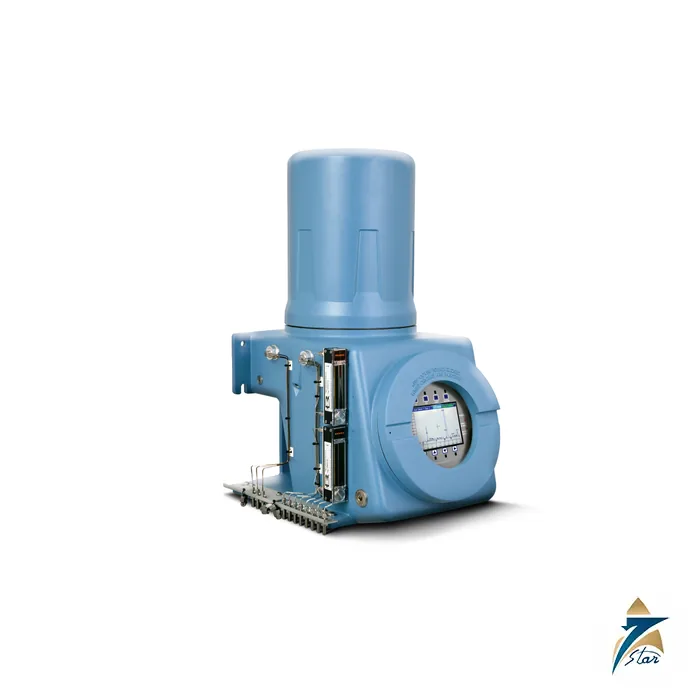
The Rosemount 770XA is a field-mounted gas chromatograph from Emerson designed for natural gas energy measurement and gas quality monitoring. It is built around a modular analytical oven that holds up to four 6- or 10-port diaphragm valves and two independent detectors, and it covers C6+, C7+ and C9+ analyses as standard applications. Seven Star LLC supplies the Rosemount 770XA in Oman and the GCC as an independent supplier in Muscat, and quotes it against the application data sheet you provide.
The model name is a single product family rather than a coded part: the application (for example C6+, C9+ with hydrocarbon dew point, or total sulfur), mounting, stream count and hazardous-area approval are defined during configuration with the manufacturer.
770XA technical specifications
| Parameter |
Specification |
| Manufacturer / part number |
Emerson Rosemount / 770XA |
| Product type |
Natural gas chromatograph, field mounted |
| Standard applications |
C6+ (3 minute cycle), C7+ (10 minutes), C9+ (5 minutes); C9+ with hydrocarbon dew point and cricondentherm; C6+ with H2S, oxygen, helium and hydrogen; total sulfur options |
| Detectors |
Thermal conductivity (TCD), flame ionization (FID), micro flame photometric (µFPD), in multiple configurations |
| Valves |
Diaphragm/piston valves, 6-port and 10-port, up to four; liquid sample injection and rotary valves possible by application |
| Streams |
Up to 8 internal streams (including calibration stream) or up to 20 with external control |
| Oven |
Air-free, maximum 248°F (120°C) |
| Ambient temperature (hazardous-area certified) |
-18 to 54°C (-4 to 140°F); TCD operating from -18 to 54°C, FID from 4 to 54°C |
| Humidity / enclosure |
0 to 95% RH non-condensing; IP66 |
| Hazardous area approvals (hardware dependent) |
Class I Zone 1 Ex/AEx db IIC Gb T6/T4/T3; Class I Div 1 Groups B, C, D; ATEX and IECEx Ex db IIC Gb T6/T4/T3 |
| Pressure limits |
Sample and calibration gas 0 to 2 barg (1 barg recommended); maximum inlet sample 6 barg, carrier 6 barg, actuation 8 barg |
| Carrier gas |
Application dependent: typically zero-grade helium, nitrogen or hydrogen |
| Power |
125 to 250 W; 120/240 VAC or 24 VDC options |
| I/O |
5 digital outputs, 5 digital inputs, 2 analog inputs, 6 analog outputs (4-20 mA); 3 serial Modbus ports; 2 Ethernet ports; 2 expansion slots |
| Software |
Rosemount MON2020, Windows based |
| Weight, mounting |
About 110 lb (50 kg) without sample system; floor (standard), wall or pipe mount |
| Enclosure finish |
Copper-free aluminum with industrial powder coat for high humidity and salt-laden environments; wetted parts stainless steel |
How the 770XA measures gas composition
A chromatograph separates a gas sample into its components before measuring each one. In the 770XA a fixed volume of sample is injected by a valve and carried by the carrier gas through columns, which release the components at different times. The detector responds to each component as it leaves the column and the controller turns the peak areas into mole percent values using calibration response factors. The micro-packed columns used in this unit combine fast analysis, sharp peaks and low carrier gas consumption, and standard capillary columns can be used where an application needs them.
The TCD is the usual detector because it responds to every component of interest in natural gas without needing fuel gases. For total sulfur work the µFPD adds a photomultiplier module and burner inside the oven and avoids instrument air. The datasheet standard ranges include methane 65 to 100 mol%, ethane 0 to 20%, propane 0 to 10%, butanes 0 to 5%, nitrogen and carbon dioxide 0 to 20%.
C6+, C7+ and C9+ applications of the 770XA
The choice of application decides what the chromatograph reports. A C6+ analysis lumps everything heavier than pentane into a hexane-plus group and finishes in three minutes, which suits most custody-transfer heating value work. C7+ extends the reporting to heptane and takes ten minutes. C9+ adds octane and nonane groups and is used where hydrocarbon dew point and cricondentherm are required. The unit calculates dew point at up to four user-defined pressures using the Peng-Robinson or Redlich-Kwong-Soave equation of state, taking line pressure from an analog or Modbus input.
Heating value repeatability for C6+ is stated as ±0.010% in temperature-controlled surroundings and ±0.20% in uncontrolled surroundings (-4 to 140°F) for the three-minute cycle. Calculations to GPA 2145/2172, AGA-8 and ISO 6976 are available.
Communications and data handling on the 770XA
The controller electronics sit in the lower section of the analyzer. Connectivity covers dual 10/100 Mbps Ethernet (one port can act as a DHCP host for a local laptop), Modbus over RS-232, RS-422 or RS-485, and 4-20 mA outputs, expandable from six to fourteen. A GC-OPC server option and the SIM-2251 flow computer Modbus map are supported. Results, alarms and event logs are archived in line with API 21.1 audit needs, and more than 31,000 analysis records are stored. An optional local operator interface with a colour display and infrared touch keys allows operation without a laptop.
Where the 770XA fits in a gas measurement system
The analyzer is normally supplied with a sample conditioning system with particulate filters and a filter/shutoff per stream, plus calibration gas, carrier gas and a flow computer or SCADA link. Emerson also builds complete analytical shelters and panels around the family. Related Rosemount chromatographs in the 700XA line serve the same role in other platforms, but a specific unit should be confirmed against your application sheet.
Selection checklist for the 770XA
- Application and cycle time: C6+, C7+, C9+, dew point, or contaminants such as H2S, oxygen or total sulfur.
- Number of sample streams and whether a calibration stream is shared.
- Detector set: TCD only, or with FID or µFPD.
- Area approval required (Zone 1 / Division 1 or ATEX/IECEx) and the temperature class.
- Mounting: floor, wall or pipe stand, and ambient range at the site.
- Power supply and communication protocol with the flow computer.
Installation and maintenance notes
The analytical valve uses a single-screw design for field service, and internal solenoids for stream selection and valve actuation are said to be replaceable in under five minutes. Diaphragm valves are serviced by replacing one diaphragm set. Position the cabinet with clear access to open the pivoting oven top, supply clean regulated carrier and calibration gases, and keep sample lines short and heated if the gas can condense. The unit needs no instrument air or shelter for the standard configuration.
Typical applications in Oman and the GCC
In the region the 770XA suits gas custody transfer stations, gas processing plants, pipeline compressor stations and power plants that buy pipeline gas by energy content. Wide ambient swings and salt-laden coastal air are handled by the powder-coated aluminum case and IP66 rating, with the 54°C ambient limit in mind for direct sun, where a sunshade or analyzer shelter is the practical answer.
Information to send with an RFQ
- Completed application data sheet: stream compositions, pressures, temperatures.
- Required analysis (C6+, C9+, dew point, sulfur) and cycle time.
- Hazardous-area classification, mounting and power.
- Quantity, delivery location, and accessories or spares wanted.
Related Rosemount products: Rosemount 8700 Series Magnetic Flowmeter, Rosemount 5900S Radar Level Gauge for Custody Transfer, Rosemount 2120 Vibrating Fork Level Switch, Rosemount 3144P Temperature Transmitter, Rosemount 3051 Pressure Transmitter and Rosemount 2051 Pressure Transmitter.
Documents and quotation
Send the part number 770XA and your application details and we will confirm available documents and the proposed configuration. Specifications above follow the manufacturer product data sheet revision of April 2022.
Seven Star LLC is an independent supplier in Muscat and quotes lead time and delivery to Oman and the GCC with the offer.




























Reviews
There are no reviews yet.