Intrinsically safe, self-calibrating hydrogen analysis for classified areas
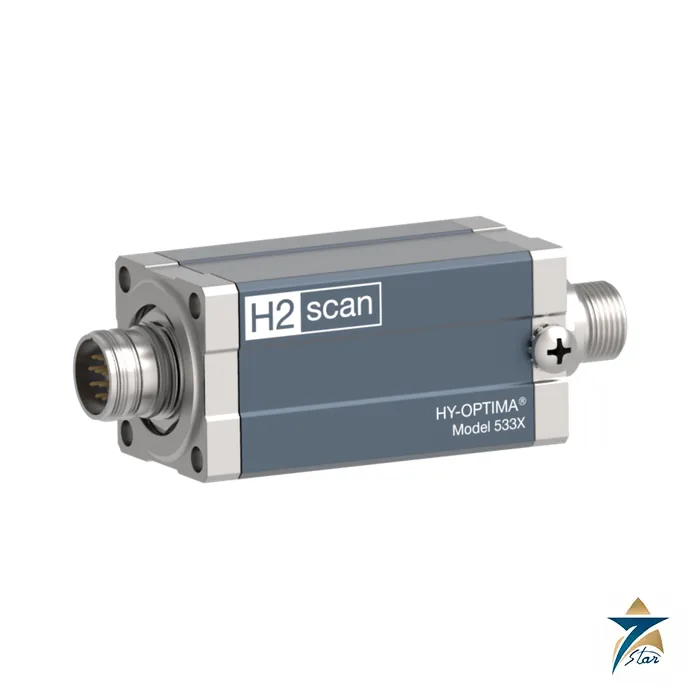
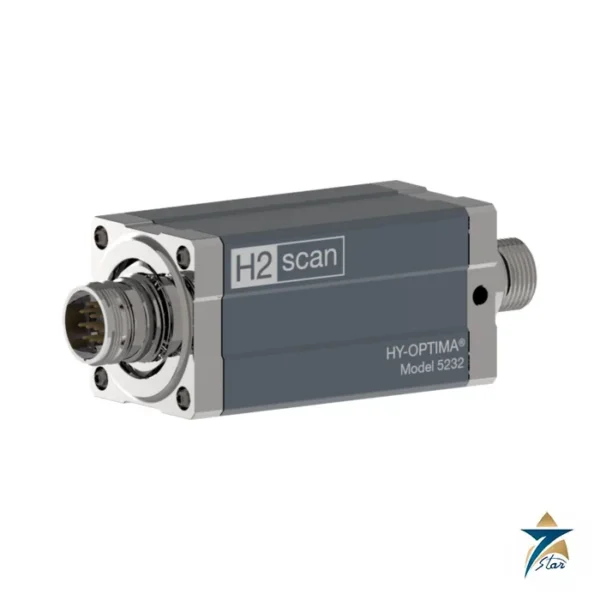
HY-OPTIMA 5330 is the intrinsically safe Gen 5 series of H2scan in-line hydrogen process analyzers. It combines the patented solid-state sensor, drift-correcting self-calibration and no-consumable operation with a 2 W electrical load and certifications for hazardous locations. The series has four models, 5331 to 5334, so the range and gas tolerance can be matched to the stream.
The datasheet claims no cross sensitivity to other gases, tolerance of various harsh background contaminants, and a total ownership cost more than 40% lower over the long lifespan. It is aimed at refineries, chemical facilities, gas manufacturing, hydrogen production and distribution, fuel cells and electrolyzers.
Technical specifications
| Parameter |
Specification |
| Operating pressure (hazardous location) |
0.95-1.1 ATM absolute |
| Survival pressure |
0.1 to 10 ATM absolute |
| Flow rate |
0.1 to 10 slpm (1/4 in tube) |
| Operating humidity |
Below 95% RH, non-condensing |
| Digital communication |
Modbus over RS-485, three-wire, half-duplex |
| Relays |
2 optically isolated open-collector switch circuits |
| Analog output |
4-20 mA |
| Input voltage / power |
10 to 15.6 VDC / 2 W |
| Dimensions |
144.4 x 50 x 50 mm (5.68 x 1.97 x 1.97 in) |
| Weight |
748.43 g (1.65 lbs) |
| Electrical fitting |
Twelve-pin, M23 |
| Sensor fitting |
M20 face seal, ISO 9974-1 |
| Ingress protection |
IP66 |
| Operating temperature |
-40 to 70°C (-40 to 158°F) |
| Storage temperature |
-40 to 85°C (-40 to 185°F) |
| US / Canada |
Class I, Div. 1 and Class I, Div. 2, Groups B, C, D |
| ATEX |
Ex II 1G + H2Ga |
| IECEx |
Ex ia (H2) Ga |
| SIL2 |
In process (per datasheet; not a granted rating) |
| Factory calibration |
At 1 ATM absolute |
Models 5331 to 5334 and their accuracy bands
The selection table gives the hydrogen range, the carbon monoxide and hydrogen sulfide limits and the allowed process gas temperature for each model. Model 5334 is marked as release pending in the datasheet, so confirm availability with the manufacturer before specifying it.
| Model |
H2 range |
CO limit |
H2S limit |
T90 response |
Process gas temperature |
Accuracy |
| 5331 |
0.03% to 10% |
100 ppm |
0 |
Below 90 s |
-20 to 60°C |
0.06% to 0.5% across four bands |
| 5332 |
0.4% to 5% |
0 |
0 |
Below 60 s |
-20 to 60°C |
0.3% |
| 5333 |
0.5% to 100% |
100 ppm |
1000 ppm |
Below 60 s |
10 to 50°C |
0.4% to 1.2% across four bands |
| 5334 |
0.5% to 100% |
10% |
3% |
Below 90 s |
10 to 50°C |
Release pending |
Accuracy for 5331 is 0.06% up to 0.5% H2, 0.15% from 0.5% to 2%, 0.25% from 2% to 5% and 0.5% from 5% to 10%. For the 5333 the bands are 0.4% to 10% H2, 0.7% for 10% to 30%, 1.0% for 30% to 70% and 1.2% for 70% to 100%, with repeatability between 0.2% and 0.5%.
Installation and use notes
Because the unit draws only 2 W from 10 to 15.6 VDC it is normally supplied through an intrinsically safe barrier or isolator in the control room; check barrier parameters against the certificate before design. Keep the sample within 0.95 to 1.1 ATM absolute at the analyzer in the hazardous location, and note that the unit survives 0.1 to 10 ATM absolute.
Typical placements are hydrogen purity checks on electrolyzer outlets, fuel cell anode and cathode lines, hydrotreater recycle gas and hydrogen blending stations. Explore the gas analyzer systems leaf for related products.
Barrier, wiring and range selection for 5330 projects
Because the 5330 is intrinsically safe the supply and signals normally pass through certified barriers or galvanic isolators, and the loop must be documented against the entity parameters on the certificate. The datasheet gives the supply window of 10 to 15.6 VDC at 2 W, which is lower than the 5232 (9 to 30 VDC at 5 W), so do not substitute one for the other without checking the supply.
For range selection use the oxygen-free and contaminant limits as the deciding factor. Model 5332 tolerates no CO or H2S, 5331 tolerates 100 ppm CO, and 5333 tolerates 100 ppm CO and 1000 ppm H2S at 10 to 50°C. Sour gas service therefore points to 5333 or 5334 rather than 5331. These are datasheet limits; confirm with the manufacturer if your stream contains other contaminants such as mercaptans or heavy hydrocarbons.
Note the narrower temperature window on 5333 and 5334 (10 to 50°C process gas) compared with 5331 and 5332 (-20 to 60°C); a heated sample line may be needed in cold desert nights.
Document control: the datasheet used here is H2scan document 90000231 with a 6.26 mark. It flags model 5334 as release pending and SIL2 as in process, so request written confirmation of availability, certificate copies and the operation manual from the manufacturer before specifying the 5330 series on a project.
Planning an intrinsically safe loop
An intrinsically safe analyzer is one part of an intrinsically safe system. General engineering note (not from the datasheet): the 10 to 15.6 VDC supply and the Modbus and 4-20 mA signals must pass through barriers or isolators that are compatible with the entity parameters in the certificate, and the cable parameters must be included in the loop calculation. Ask for the full certificate and control drawing with the quotation, because the system designer needs them to approve the installation.
Choosing between models 5331 and 5334 depends on the hydrogen range and background gas of the stream, so send a typical gas composition, the normal and upset hydrogen concentrations, and the line pressure with the enquiry. The low 2 W load is an advantage on long cable runs and in panels with limited power. As with other units in the range, condition the sample to 0.95 to 1.1 ATM absolute and keep it non-condensing to protect the sensor over its long service life.
Frequently asked questions
Is the HY-OPTIMA 5330 intrinsically safe? Yes, the datasheet lists Class I Div. 1 and Div. 2 Groups B, C, D, ATEX Ex II 1G + H2Ga and IECEx Ex ia (H2) Ga. SIL2 is listed as in process only.
Which models does the series include? 5331 (0.03 to 10%), 5332 (0.4 to 5%), 5333 (0.5 to 100%) and 5334 (0.5 to 100%, release pending).
Does it need calibration gas? No. The series uses self-calibration, with no consumables and no reference or carrier gas.
What power does it need? 10 to 15.6 VDC at 2 W.
What process connection does it use? An M20 face seal sensor fitting (ISO 9974-1) and a twelve-pin M23 electrical fitting.
Documents and quotation
The H2scan datasheet is attached to this page. Seven Star LLC is an independent supplier in Muscat; state the model (5331 to 5334), gas composition and hazardous-area requirements when requesting a quotation.













Reviews
There are no reviews yet.