
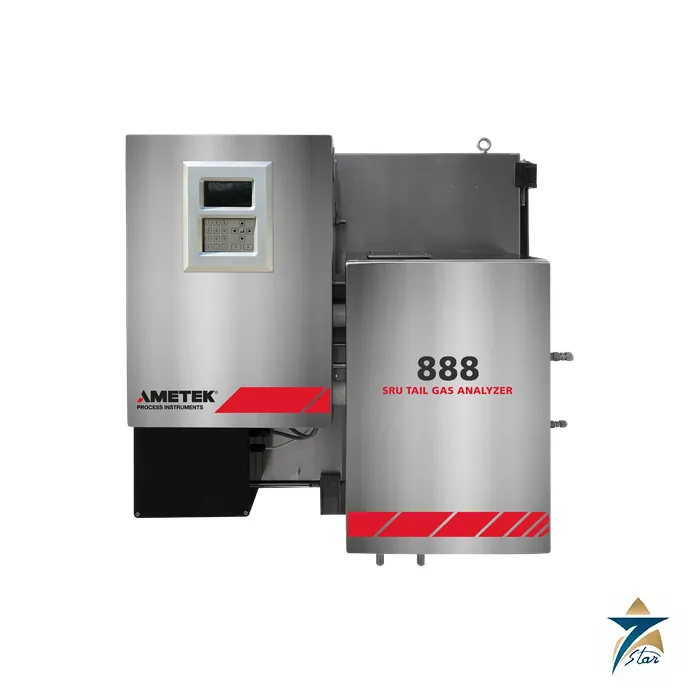
The AMETEK 888 Sulfur Recovery Tail Gas Analyzer, from the Western Research product line of AMETEK Process Instruments, measures hydrogen sulfide (H2S) and sulfur dioxide (SO2) in the tail gas of Claus sulfur recovery units. It is the next generation of the field-proven 880-NSL and uses ultraviolet spectroscopy to monitor both gases. The compact, rugged AMETEK 888 mounts directly on the process pipe, which AMETEK says eliminates the complexity and safety issues of fiber-optic coupled photometers, and it needs no sample line or analyzer shelter. Its main purpose is to provide the air demand signal that keeps the H2S to SO2 ratio at the point of maximum sulfur conversion.
Seven Star LLC supplies the AMETEK 888, spare parts and related sulfur recovery analyzers to refineries, gas processing plants and petrochemical complexes in Oman and the GCC. Our Muscat team supports buyers with application data, installation requirements and spares planning, and we provide model selection support from Muscat.
In a Claus unit, H2S is partly burned to SO2, and the two react over catalyst beds to form elemental sulfur. Recovery is highest when the ratio of H2S to SO2 in the tail gas is held at the stoichiometric value, so the air supplied to the reaction furnace must be trimmed continuously as feed gas composition changes. The AMETEK 888 measures both gases and outputs air demand, excess H2S or ratio signals for the control system. This general process background explains why a fast, reliable tail gas analyzer has a direct effect on sulfur recovery efficiency, emissions to the incinerator and the stability of downstream tail gas treating units.
AMETEK designed the analyzer with the technician in mind. The demister is close-coupled and easily accessible but isolated from the process, double block valves give complete process isolation during service, and a remote web-enabled PC interface reduces time spent at the analyzer in a hazardous area. Smart diagnostic models identify, communicate and react to potential problems before they affect control. The AMETEK 888 is certified to meet multiple ATEX, IECEx and CSA standards for hazardous areas, with Zone 1 and Class I Division 2 versions.
The AMETEK 888 measurement uses non-dispersive UV. Standard output ranges are SO2 from 0 to 1 percent and H2S from 0 to 2 percent, with air demand, excess H2S or excess SO2 available as control outputs. Accuracy and reproducibility are ±1 percent of full scale for both gases, and response is 90 percent in less than 15 seconds, typical. Calibration is by automatic multi-point photo span validation. Typical sample flow is 2 L/min at a process sample pressure of 2 to 7 psig.
The AMETEK 888 provides four self-powered 4-20 mA outputs (24 VDC, 1000 ohm load) proportional to H2S, SO2 and either excess H2S or ratio, four programmable relay contacts (30 VAC, 60 VDC, 10 VA resistive), an isolated digital input, and RS485, Ethernet and Modbus communications, with remote access through AMETEK web-enabled software. Electrical supply is 120 or 240 VAC, 50/60 Hz, 500 W single phase. Instrument air or nitrogen at 380 to 520 kPa (55 to 75 psig) is required, and steam at 517 to 690 kPa for the optional jacketed ball valve or 210 to 345 kPa for the optional blow back. The customer provides a 2 in. 150 lb or DIN equivalent RF stainless steel flange on the process line.
These points are general practice rather than AMETEK data. Before start-up, confirm that steam tracing, the flange heater and the demister drain work correctly, and verify analog outputs and relays loop by loop with the control system. During the first weeks of operation, compare the AMETEK 888 air demand signal with laboratory results and furnace behaviour to build confidence in closed-loop control. Train instrument technicians on the web interface and diagnostics so they can recognise early warnings, and agree a maintenance plan that covers lamp replacement, window cleaning and periodic validation. Recording these activities helps show that the AMETEK 888 is supporting sulfur recovery performance and environmental compliance.
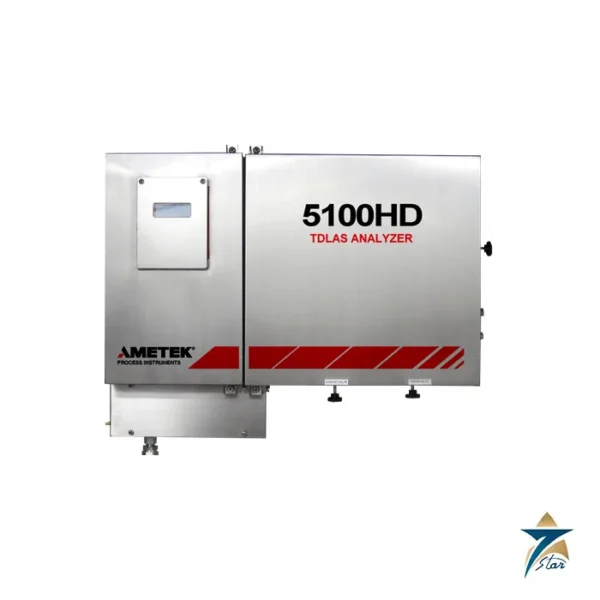
On the same unit, AMETEK offers the AMETEK 900 air demand analyzer and the AMETEK 930 H2S in sulfur pit analyzer, and for natural gas quality the AMETEK 5100HD TDLAS moisture analyzer is a related product line.
This guidance is general practice rather than AMETEK data. Locate the sample point on the tail gas line where the gas is well mixed and accessible for maintenance, and plan steam jacketing so that the sample path never falls below the sulfur freezing temperature. Provide shade, reliable instrument air and good steam trap maintenance. Integrate the air demand output carefully with the furnace air control loop, and keep a stock of critical spares such as the lamp and demister parts so the AMETEK 888 can be returned to service quickly.
| Parameter | AMETEK 888 (data sheet F-0461) |
|---|---|
| Methodology | Non-dispersive UV |
| Range | SO2 0-1%; H2S 0-2% (standard) |
| Accuracy / reproducibility | ±1% of full scale |
| Response | 90% in less than 15 s, typical |
| Outputs | Four 4-20 mA; four relays; RS485, Ethernet, Modbus |
| Ambient (shaded) | −20 to 60°C |
| Enclosure | 316 SS, IP65 / NEMA 4X |
| Dimensions (W x H x D) | Zone 1: 113.8 x 99.3 x 32.1 cm; Class I Div 2: 91.4 x 99.3 x 32.1 cm |
| Weight | Zone 1: 110 kg; Class I Div 2: 99 kg |
| Power | 120 or 240 VAC, 50/60 Hz, 500 W |
| Approvals | ATEX, IECEx and CSA hazardous area standards |
To order the AMETEK 888, send Seven Star LLC your process data, area classification, utility availability and the control outputs required. Our Muscat team will coordinate the application review and prepare a formal quotation. The AMETEK data sheet can be downloaded from this page, and we provide model selection support from Muscat for customers across Oman and the GCC.
Browse AMETEK products by category: Gas Analyzer Accessories, Gas Analyzer Systems, Liquid Analytical Accessories, Level Transmitter.
Choose the option that best fits your needs to get the fastest response from our team.
Automatically fill the RFQ form with this product's details for a faster process.
Manually enter multiple part numbers, specific brands, or custom requirements.










Reviews
There are no reviews yet.