Overview
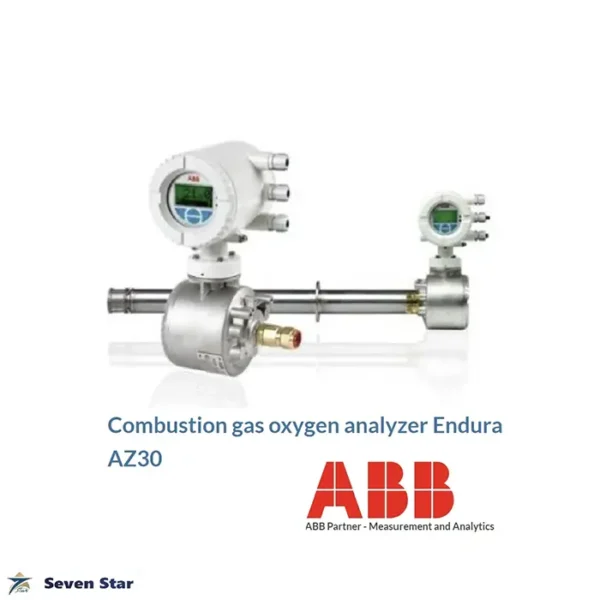
The ABB Endura AZ25 is a high-temperature in-situ zirconia oxygen analyzer built for continuous combustion-gas oxygen monitoring directly in the flue or duct, without extracting a gas sample. Its probe-mounted zirconia cell measures oxygen concentration at the source, giving fast, representative readings for combustion efficiency control in boilers, furnaces, and kilns.
As part of ABB’s Endura in-situ oxygen analyzer range, the AZ25 is engineered for demanding high-temperature combustion environments where a sample-extraction system would be slow, costly to maintain, and prone to condensation or particulate fouling. Seven Star LLC supplies the AZ25 as a trusted ABB instrumentation supplier to power, cement, and process-heating facilities across Oman and the GCC.
Operating Principle
The AZ25 uses a zirconia oxide cell mounted directly in the process gas stream; the cell generates a voltage proportional to the difference in oxygen partial pressure between the process gas and a reference air stream, following the Nernst principle. Because the measurement happens in-situ rather than after sample extraction and conditioning, the AZ25 delivers a fast response — an initial dead time of just 3 seconds and a T90 response under 10 seconds — letting combustion control loops react quickly to changing conditions.
Engineering Design of the ABB Endura AZ25
The AZ25 measures oxygen over a 0–25% O2 range with accuracy better than ±2.0% of reading or ±0.2% O2, whichever is greater. It is offered with three protective sheath material options to match process temperature and corrosivity: aluminous porcelain rated to 1250°C, Incoloy 800 rated to 850°C (horizontal) or 1000°C (vertical), and recrystallized alumina rated to 1400°C for the most demanding high-temperature applications. Outputs include a standard isolated 4–20 mA analog signal with HART communication, an optional second 0–20 mA output, two relay outputs rated 5A at 230VAC/30VDC, and optional digital inputs/outputs.
Key Features
- In-situ zirconia oxygen measurement, no sample extraction required
- Measurement range 0–25% O2
- Accuracy better than ±2.0% of reading or ±0.2% O2
- Fast response: 3-second dead time, sub-10-second T90
- Three sheath material options up to 1400°C process temperature
- HART-enabled 4–20 mA analog output as standard
- Two relay outputs rated 5A at 230VAC/30VDC
- Optional second analog output and digital I/O
- CE marked, conforms to EN61010-1:2001 safety standards
Industrial Applications
The AZ25 is specified for combustion efficiency monitoring in power generation boilers, process furnaces, and cement kilns across Muscat, Sohar, and Salalah, where tight oxygen control directly reduces fuel consumption and emissions. Its high-temperature sheath options make it suitable for the harshest flue-gas positions, including kiln exhausts and high-temperature furnace ducts where extractive analyzers would struggle.
Across the GCC’s power, cement, and heavy process industries, the AZ25 supports combustion trim control strategies that optimize air-to-fuel ratio in real time, reducing excess air, improving thermal efficiency, and helping facilities meet emissions targets without the maintenance burden of a sample-conditioning system.
Technical Specifications
| Parameter |
Specification |
| Measurement Technology |
In-situ zirconia oxide cell |
| Measurement Range |
0–25% O2 |
| Accuracy |
±2.0% of reading or ±0.2% O2, whichever greater |
| Response Time |
3s dead time, T90 <10s |
| Sheath Material Options |
Aluminous porcelain (1250°C), Incoloy 800 (850–1000°C), recrystallized alumina (1400°C) |
| Outputs |
4–20 mA HART, optional 0–20 mA, 2 relays (5A @ 230VAC/30VDC) |
| Compliance |
CE marked; EN61010-1:2001 (safety); EN61326-1:2006 (EMC) |
| Probe Lengths |
500, 700, 800, 900, 1,000 and 1,250 mm |
| Minimum Process Temperature |
600 °C (1,112 °F) |
| Process Pressure |
5 kPa (0.7 psi) positive or negative |
| Thermocouple Options |
Type R, K, S or B |
| Drift |
Less than ±1% of maximum O2 range value per month without calibration; less than ±0.2% typical |
| Ambient Temperature |
Transmitter -20 to 55 °C; probe standard cable -20 to 100 °C |
| Ingress Protection |
IP66 (NEMA 4), electronics and AutoCal enclosures |
| Power Supply |
100 to 240 V AC ±10%, 50/60 Hz; electronics below 10 W |
AZ25 Ordering Code and Probe Options
The AZ25 ordering code covers the transmitter and the probe in one string. Transmitter options are standard, standard with a second analog output, or standard with two digital inputs/outputs, with M20 or NPT cable entries and remote mounting. For the probe, the code sets the length (0.5, 0.7, 0.8, 0.9, 1.0 or 1.25 m), the protective sheath (aluminous porcelain, Incoloy 800 or recrystallised alumina) and the thermocouple type (R, K, S or B). Either part can be coded as not required, which allows a probe or a transmitter to be ordered alone.
Flange choices are the ABB standard flange, DIN 65, 80 or 100 mm, ANSI 2, 2.5, 3 or 4 in, JIS 65, 80 or 100 mm, 1 in NPT, 1 in BSP and the ZGP2 heritage flange for replacing older probes. Sensor cable is coded from 5 m to 100 m. Automatic calibration hardware is optional, with or without flow restrictors and with NPT or BSP connections, and its cable is coded from 5 m to 75 m. The combined cable run between probe and remote transmitter must not exceed 100 m.
Process Limits to Check Before Selecting the AZ25
ABB designs the AZ25 for flue gas and furnace atmospheres above 600 °C. The upper limit depends on the sheath: 1,250 °C for aluminous porcelain, 850 °C horizontal or 1,000 °C vertical for Incoloy 800, and 1,400 °C for recrystallized alumina. Process pressure must stay within 5 kPa positive or negative, and the probe can be mounted from horizontal to vertically down. Reference air is required, from an ABB pump or a regulated supply of clean, dry, oil-free instrument air, and test gas is applied at 1 L/min. Flange pressure ratings do not apply to the probe flanges.
Request a Quote for ABB Endura AZ25 Combustion Gas Oxygen Analyzer
Contact Seven Star LLC to request a quotation for the ABB Endura AZ25 in-situ oxygen analyzer and to confirm the correct sheath material for your process temperature and gas composition. Our engineering team, serving Oman and the GCC, can help specify the right AZ-series analyzer for your combustion control application.
Selecting and Specifying the AZ25
An in-situ analyzer has to suit the flue it is inserted into, so specification starts with the process rather than the analyzer. Have the following ready when requesting a quotation or a replacement probe:
- Flue gas temperature range at the measurement point, and the maximum excursion during upsets
- Fuel type and gas composition, including sulfur, dust loading and any corrosive components
- Duct dimensions, wall construction and the required insertion length
- Existing mounting flange details if replacing an installed probe
- Required outputs and communication to the DCS or combustion controller
- Model code and serial number from the existing probe and transmitter, for replacements
Installation and Commissioning
- Choose a measurement point with well-mixed flue gas, downstream of the combustion zone and upstream of any point where air can leak into the duct, as air in-leakage gives falsely high oxygen readings.
- Allow access space to withdraw the full probe length for maintenance.
- Provide clean, dry reference and test gas air as required, and route the connections so they are protected from heat.
- Allow the zirconia cell to reach its operating temperature before calibrating with certified test gases.
- Verify the output at the control system against the local reading before using it for trim control.
Maintenance and Troubleshooting
- Reading higher than expected: check for air in-leakage at the duct, a leaking probe flange or an open inspection door upstream.
- Slow response: review the cell quality and rate-of-response diagnostics recorded by the transmitter.
- Calibration fails: confirm test gas concentration, flow and tubing integrity before suspecting the cell.
- Temperature reading fault: check the probe thermocouple and cold junction (ACJC) wiring.
Scheduled test-gas checks and trending of cell diagnostics help plan cell replacement during outages rather than after a failure.
Applications in Oman and the GCC
In-situ oxygen measurement supports combustion trim on utility and HRSG boilers, refinery and petrochemical fired heaters, cement kilns and incinerators across Oman and the region, helping reduce fuel consumption and control emissions.
Sourcing Through Seven Star LLC
Send your process data or existing model code to Seven Star LLC for a quotation on genuine ABB oxygen analyzers and spares, supplied with available documentation to sites across Oman and the GCC.
Browse the full ABB range or see more Gas Analyzer Systems products supplied by Seven Star LLC in Oman and the GCC.














Reviews
There are no reviews yet.