- Automation & ControlView all 2,895 products
- Automation Accessories
- AC Drives
- PLC & I/O Cards
- Industrial Communications
- Vibration Monitoring
- Controllers & Data Acquisition
- Isolator & Barrier
- Safety Switches & Guard Locking
- Motor Soft Starters
- CCTV & Security
- Encoders
- Pneumatic Cylinders
- HMI Displays
- Servo Drives
- Industrial Computers
- Machine Vision
- Automation Software
- Robotics
Brand: ABB
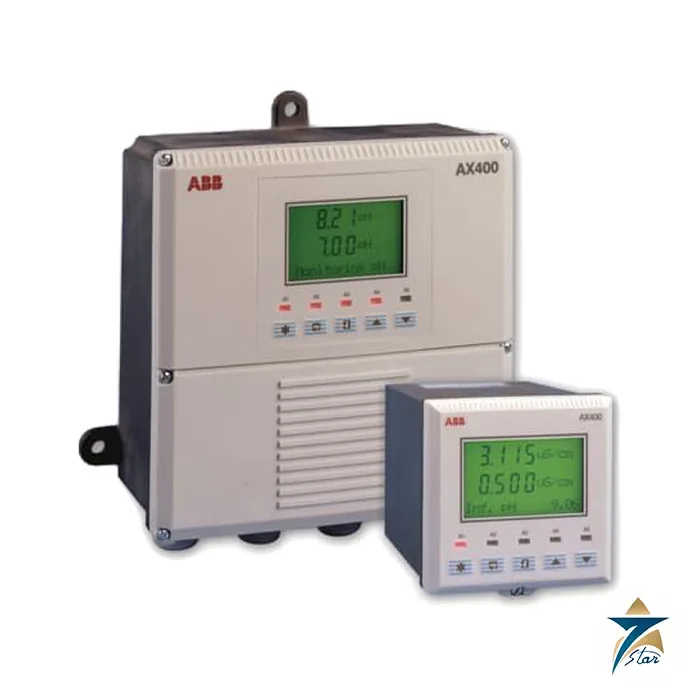
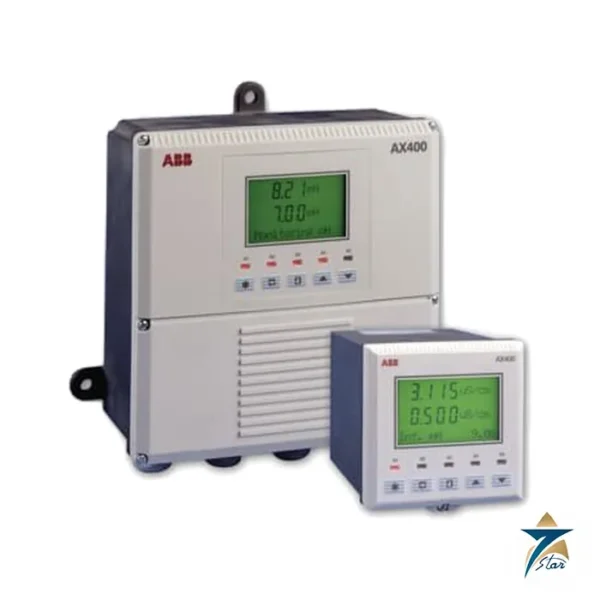
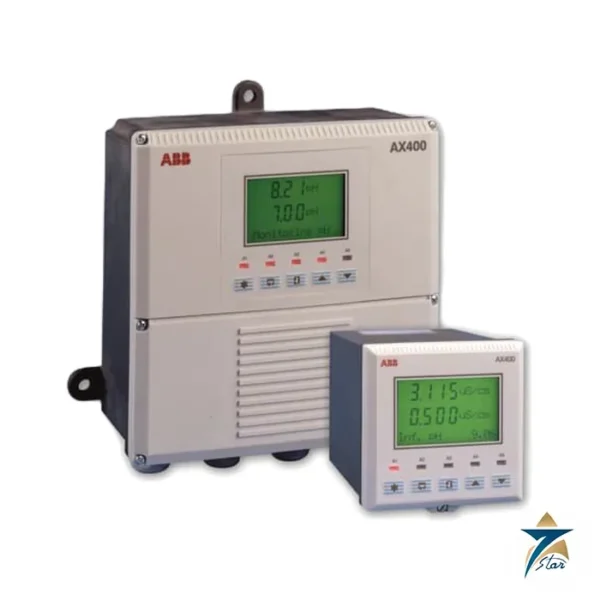
ABB AX416 Dual-Channel Conductivity Transmitter
Description
Overview
The ABB AX416 is a dual-channel conductivity transmitter engineered for facilities that must monitor two independent conductivity measurement points from a single, unified instrument. By combining two fully isolated measurement channels into one housing, the AX416 reduces panel space, simplifies wiring, and lowers the total instrumentation cost compared to installing two separate single-channel transmitters – a configuration especially valuable in reverse osmosis trains, multi-stage boiler feedwater systems, and CIP (clean-in-place) loops where several conductivity checkpoints exist close together.
Seven Star LLC supplies the ABB AX416 to industrial, utility, and process operators across Oman and the wider GCC with genuine ABB instrumentation. Every unit is supplied on request with manufacturer documentation, and supported locally with calibration guidance and help sourcing spare parts – with lead time and availability confirmed at quotation.
Operating Principle
Each of the AX416’s two channels independently drives either a contacting (electrode-based) or inductive (electrodeless) conductivity sensor, depending on the process fluid’s fouling tendency and conductivity range. Contacting sensors are typically selected for lower-conductivity, cleaner streams such as demineralized water, while inductive sensors are preferred for high-conductivity or coating-prone fluids such as concentrated CIP chemicals, since the toroidal sensing method is immune to electrode fouling.
The transmitter applies real-time automatic temperature compensation to both channels simultaneously, referencing readings to a standard temperature (typically 25°C) so that comparisons across the process remain meaningful even as fluid temperature fluctuates. Advanced signal processing continuously filters noise and detects sensor or cable faults, triggering diagnostic alerts before a measurement drifts far enough to compromise product quality or equipment protection.
Engineering Design of the ABB AX416
The AX416 is built around a bright, high-resolution backlit LCD display capable of showing both channels’ readings simultaneously, along with configurable multilingual menus that simplify commissioning and day-to-day operation for multinational plant teams. The rugged housing is rated for demanding industrial environments, protecting the electronics from dust, moisture, and vibration typical of process areas.
Output flexibility is a core design strength: the AX416 provides isolated analog outputs, digital relay outputs for alarm or control interlocks, and HART communication for integration with asset management and DCS/SCADA systems. Automatic sensor-cleaning routines, where paired with compatible cleaning accessories, extend the interval between manual maintenance visits on fouling-prone streams.
Key Features
- Dual-channel design monitors two independent conductivity points from one transmitter
- Compatible with both contacting and inductive (toroidal) conductivity sensors
- Simultaneous dual-channel display on a bright, high-resolution backlit LCD
- Real-time automatic temperature compensation on both channels
- Advanced diagnostics with sensor and cable fault detection
- Analog, digital relay, and HART outputs for SCADA/DCS integration
- Rugged, IP-rated enclosure suited to harsh industrial environments
- Multilingual configuration menus for simplified commissioning
Industrial Applications
The AX416 is widely applied in reverse osmosis and multi-stage water treatment systems, where product-water and reject-stream conductivity must be tracked together; in boiler feedwater and condensate polishing systems across power generation plants; and in CIP (clean-in-place) circuits within food, beverage, and pharmaceutical processing, where cleaning-solution strength must be verified before and after each cycle. Its dual-channel architecture is particularly valuable where two checkpoints on the same skid or loop need synchronized monitoring.
Across Oman’s desalination, petrochemical, and district-cooling sectors, and throughout the wider GCC, Seven Star LLC supplies the AX416 to plants in Muscat, Sohar, and Salalah that require dependable, factory-genuine conductivity monitoring with full local technical support and calibration guidance.
Technical Specifications
| Model | ABB AX416 |
| Measurement Channels | 2 (independent, isolated) |
| Sensor Compatibility | Contacting and inductive conductivity sensors |
| Temperature Compensation | Automatic, real-time, per channel |
| Display | Backlit high-resolution LCD, dual-channel simultaneous view |
| Outputs | Analog, digital relay, HART |
| Diagnostics | Sensor/cable fault detection, alarm relays |
| Enclosure | Rugged, industrial IP-rated housing |
| Menu Language | Multilingual configuration support |
Planning a Dual-Channel Installation
The main advantage of a dual-channel transmitter is that two related measuring points share one display, one power supply and one set of outputs. Before ordering, list both measuring points and decide the sensor type for each channel separately: a contacting cell for clean, low-conductivity water, or an inductive sensor for concentrated or coating chemistry. Check that the cell constant or sensor model chosen for each channel covers its expected conductivity range, and agree the output and alarm assignments with the control system team.
- RO trains: permeate and feed conductivity on one instrument to calculate salt rejection trends.
- Boiler systems: feedwater and condensate return monitored side by side.
- CIP circuits: detergent strength and rinse water quality on separate channels.
Installation and Commissioning
Mount the transmitter close enough to both sensors to respect the recommended cable lengths, and in a position shaded from direct sun where site conditions demand it. Install sensors where the process is fully wetted and free of trapped air. During commissioning, enter the sensor data and temperature compensation settings for each channel independently, verify each channel against a calibrated reference or standard solution, and test the outputs and alarm relays end to end with the DCS or PLC.
Maintenance and Troubleshooting
If one channel drifts while the other remains stable, the cause is almost always at the sensor or cable of that channel rather than in the transmitter. Contacting cells can foul or scale and need cleaning; inductive sensors are more tolerant but should be checked for deposits that change the flow path around the toroid. Unexpected temperature values point to a faulty temperature element or wiring, which in turn distorts the compensated reading. Keep a log of calibration results for each channel to support audits.
Applications in Oman and the GCC
The ABB AX416 is well suited to desalination and RO plants, power and water utilities, dairy and beverage CIP systems and refinery boiler houses in the region, where several conductivity checkpoints are often grouped in the same area.
Sourcing from Seven Star LLC
Seven Star LLC supplies ABB analytical transmitters and sensors to clients in Oman and the GCC. Share the model code of your existing unit or your two measuring point duties and our team will confirm a suitable configuration.
Request a Quote for ABB AX416
Contact Seven Star LLC for a quotation on the ABB AX416 dual-channel conductivity transmitter, with manufacturer documentation and local support across Oman and the GCC.
Related Products
Datasheets & Documents
- Datasheet ABB AX411 Conductivity Transmitter Datasheet Download
Reviews (0)
How would you rate this product? Cancel reply
About brand
ABB is the Swiss-Swedish engineering group for electrification and automation: low voltage drives, motors, circuit breakers and motor control, process instruments and analysers, control systems and robots. It was formed on 5 January 1988 by the merger of two older companies. ASEA was founded in Västerås, Sweden, in 1883 by Ludvig Fredholm to make electric lighting and generators. BBC Brown Boveri was founded in Baden near Zurich in 1891 by Charles E. L. Brown and Walter Boveri. ABB Ltd is incorporated in Switzerland, headquartered in Zurich and listed on the SIX Swiss Exchange and Nasdaq Stockholm.
ABB company profile
| Formed | 5 January 1988, by the merger of ASEA (Sweden) and BBC Brown Boveri (Switzerland), each holding 50% |
|---|---|
| ASEA | Founded 1883 in Västerås, Sweden, by Ludvig Fredholm; first products electric lighting and generators |
| Brown, Boveri & Cie | Founded 1891 in Baden, Switzerland, by Charles E. L. Brown and Walter Boveri |
| Headquarters | Zurich, Switzerland; ABB Ltd became the group holding company in 1999 |
| Ownership | Public company listed on SIX Swiss Exchange and Nasdaq Stockholm |
| Brands in the group | Baldor (US motors, acquired 2011), B&R (machine automation, acquired 2017), K-TEK level instruments, Endura and Navigator analysers, SACE breakers |
| Product families | Low and medium voltage drives (ACS series), motors, SACE Tmax and Emax breakers, contactors and soft starters, flow, pressure, temperature and level instruments, liquid and gas analysers, Contrac actuators, AC500 PLCs, Ability System 800xA and S800 I/O, protection relays, robots |
Milestones
- 1883: ASEA is founded in Västerås, Sweden.
- 1891: Brown, Boveri & Cie is founded in Baden, Switzerland.
- 1987–1988: The merger is announced on 10 August 1987; ABB Asea Brown Boveri starts operating on 5 January 1988.
- 1999: ABB Ltd, incorporated in Switzerland, becomes the single holding company of the group.
- 2011 and 2017: Baldor Electric and B&R join ABB.
- 2020: ABB sells its power grids business to Hitachi, focusing on electrification, motion, process and machine automation.
Choosing an ABB drive
ABB's ACS drive codes are easy to read once you know the pattern. In ACS580-01-046A-4, "ACS580" is the drive family, "01" means a wall-mounted single drive, "046A" is the rated output current (about 46 A) and "-4" means a 380–480 V supply. The family is chosen by application: ACS355 for compact machinery, ACS310 for simple pumps and fans, ACS580 as the general-purpose drive, ACQ580 for water and wastewater with pump functions such as pipe fill and dry-run protection, and ACS880 for heavy industrial duty with direct torque control. Size the drive on the motor's full-load current, not only its kW rating, and allow derating for the high ambient temperatures common in Gulf electrical rooms.
Where ABB products are used
In Oman and the GCC, ABB drives and motors run pumps, fans and compressors in water and wastewater plants, district cooling, oil and gas and industry. ABB flowmeters, level instruments and analysers are used in water utilities, power and desalination plants and refineries, and SACE breakers protect switchboards in buildings and plants.
ABB products we list
| Family | Examples |
|---|---|
| AC drives | ACS580, ACS580-01-046A-4, ACQ580, ACS355, ACS310, ACS880-01, FEN-31 encoder module |
| Breakers, motor control and protection | SACE Tmax XT, XT3N 250, SACE Emax 2, AF09 contactor, PSR soft starter, REM615 relay |
| Flow measurement | ProcessMaster FEP300, AquaMaster4, CoriolisMaster FCB430, VortexMaster FSV430, SwirlMaster FSS430, OriMaster FPD500 |
| Pressure, temperature and level | 266DRH, 267CS multivariable, TTH300, K-TEK AT100, LMT200, MT5000 GWR, KM26 gauge |
| Analysers | Endura AZ20, AK100 hydrogen purity, Navigator AW641 silica, AW402 chlorine, AWT210 |
| Control systems and actuators | AC500, AC500-S, S800 AI810, AC 800F SA 811F, Contrac RSD50, Contrac RHD4000 |
Ordering ABB products: what we need
Send the full type code from the nameplate (for example ACS580-01-046A-4 or 266DSH...) and, for spare parts, the ABB ID number (such as 3BSE008508R1 or 1SBL176001R3010). For drives, add the motor power and current and any option codes (+...). For instruments, send the complete order code, which sets range, materials and approvals. Baldor motors are listed on their own brand page.
Frequently requested ABB models: ABB FENA-21 Two-Port Ethernet Adapter Module, ABB AHM550.
Facts checked against ABB company filings and published histories of ASEA and Brown, Boveri & Cie, October 2026.
FAQ
Questions about the ABB AX416 Dual-Channel Conductivity Transmitter
Answers from our engineering team on installation, compatibility and integration.
01What makes the ABB AX416 different from a single-channel conductivity transmitter?
The AX416 monitors two independent conductivity measurement points simultaneously from one housing, each with its own isolated channel, temperature compensation, and diagnostics, reducing panel space and wiring versus two separate transmitters.
02Can the AX416 be used with both contacting and inductive sensors?
Yes. The AX416 supports contacting (electrode) sensors for cleaner, lower-conductivity streams and inductive (toroidal) sensors for higher-conductivity or fouling-prone fluids, with either type usable on either channel.
03Does the AX416 support integration with SCADA or DCS systems?
Yes. It provides isolated analog outputs, digital relay outputs, and HART communication, allowing both channels to be integrated into plant SCADA, DCS, or asset management systems.
04What industrial applications typically use the ABB AX416?
Common applications include reverse osmosis and multi-stage water treatment, boiler feedwater and condensate polishing, and CIP circuits in food, beverage, and pharmaceutical processing where two checkpoints need synchronized monitoring.
05Is Seven Star LLC an experienced supply partner for ABB products?
Yes. Seven Star LLC supplies ABB products to customers in Oman and the GCC and can provide the manufacturer documentation and technical support on request.


Reviews
There are no reviews yet.