Overview
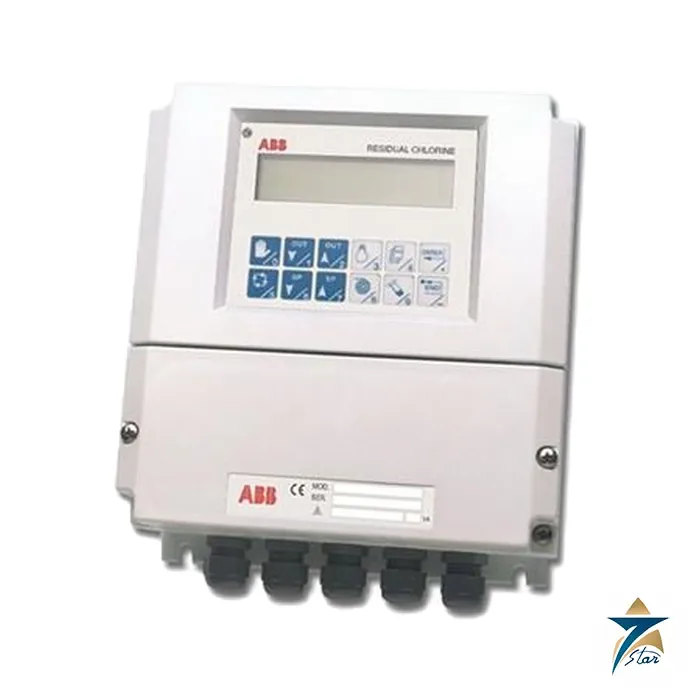
The ABB AW401 is a residual chlorine monitor built around amperometric sensor technology, designed for continuous, fast-responding measurement of free or total chlorine in disinfection processes. Its rapid response allows operators to detect a chlorine excursion – either a dosing failure that risks inadequate disinfection or an overdose that wastes chemical and creates taste/odor issues – and correct it before it affects downstream water quality.
Seven Star LLC supplies the ABB AW401 to municipal water utilities, food and beverage processors, and industrial water treatment operators across Oman and the wider GCC as an experienced supply partner for genuine ABB analytical instrumentation. Every unit is supplied on request with manufacturer documentation, and supported locally with calibration and technical support.
Operating Principle
The AW401 uses an amperometric sensor, in which a small polarizing voltage drives a current proportional to the concentration of chlorine species reacting at the sensor’s membrane or electrode surface. Because the current response is near-instantaneous to changes in chlorine concentration, the AW401 delivers a fast-responding signal well suited to tight closed-loop dosing control, in contrast to slower colorimetric methods.
A self-cleaning sensor mechanism – typically a mechanical wiper or constant-flow design – keeps the electrode surface free of biofilm and scale buildup that would otherwise bias the reading over time, extending the interval between manual sensor maintenance. Built-in diagnostics continuously monitor sensor health and flag fouling or drift conditions before they compromise measurement accuracy.
Engineering Design of the ABB AW401
The AW401 integrates the amperometric sensor, flow-cell, and electronics into a compact, field-mountable analyzer suited to installation directly at the point of measurement in a treatment train. Analog and digital outputs allow the chlorine reading to feed directly into SCADA or DCS systems, supporting both monitoring and automated dosing-pump control without an intermediate data-collection step.
The self-cleaning sensor design minimizes the operator attention required for day-to-day operation, while the analyzer’s diagnostic reporting gives maintenance staff early warning of sensor wear or fouling, reducing the risk of an undetected drift compromising disinfection performance.
Key Features
- Amperometric sensor technology for fast-responding chlorine measurement
- Self-cleaning sensor mechanism resists biofilm and scale fouling
- Analog and digital outputs for SCADA/DCS integration
- Built-in diagnostics for sensor fault and drift detection
- Compact, field-mountable analyzer design
- Suited to closed-loop chlorine dosing control
- Low-maintenance operation between service intervals
- Reliable performance across municipal and industrial water applications
Industrial Applications
The AW401 is widely used in municipal water treatment for disinfection monitoring and chlorine dosing control, ensuring treated water meets residual chlorine targets throughout the distribution network. It is also applied in beverage and food processing facilities that use chlorine for sanitation and must verify residual levels are within safe, regulated limits before product contact.
Across Oman’s municipal water and desalination sector, and throughout the wider GCC, Seven Star LLC supplies the AW401 as a trusted supplier of ABB products to treatment plants and processing facilities in Muscat, Sohar, and Salalah that require dependable, factory-genuine chlorine monitoring with full local support.
Technical Specifications
| Model |
ABB AW401 |
| Measurement Parameter |
Residual chlorine (free or total) |
| Sensing Principle |
Amperometric |
| Sensor Maintenance |
Self-cleaning mechanism |
| Outputs |
Analog and digital, SCADA/DCS compatible |
| Diagnostics |
Sensor fault and drift detection |
| Enclosure |
Compact, field-mountable |
| Application |
Municipal and industrial disinfection monitoring |
Request a Quote for ABB Residual chlorine monitor AW401
Contact Seven Star LLC for a quotation on the ABB AW401 residual chlorine monitor, with manufacturer documentation and local support across Oman and the GCC.
Installation and Commissioning of the AW401
Most measurement problems with amperometric chlorine analyzers trace back to the sample, not the sensor. Take the sample from a point where chlorine has fully mixed with the water – well downstream of the dosing point and away from dead legs – and keep the sample line short so the reading reflects the process in near real time. A long, slow sample line adds transport delay that can make a closed-loop dosing controller hunt.
- Mount the analyzer close to the sample point, at a height that allows easy access to the flow-cell and sensor.
- Fit an isolation valve and, where the water carries sand or debris, a strainer upstream of the flow-cell.
- Route the drain to an open tundish so the flow-cell is never back-pressured.
- Allow the new sensor to polarize and stabilize before the first calibration; calibrating too early locks in a drifting zero.
- Calibrate against a grab sample measured with a reliable DPD test kit, taken from the same point at the same time.
Before handing the loop to operations, check the analog output scaling at the SCADA or DCS end and confirm alarm set points for both low and high chlorine.
Maintenance and Troubleshooting
The self-cleaning design reduces routine work, but a simple schedule keeps readings trustworthy. Compare the analyzer against a DPD grab sample at a fixed interval, inspect the flow-cell for sediment, and replace consumable sensor parts according to the manufacturer’s manual.
Common symptoms and likely causes
- Reading slowly drifts low: fouled electrode, falling sample flow or a sensor at the end of its service life.
- Noisy or erratic signal: air bubbles in the flow-cell, unstable sample flow or poor cable screening.
- Reading disagrees with the grab sample after a process change: a pH shift changes the free chlorine balance and can affect amperometric response; check pH before recalibrating.
- Sudden zero reading: sample supply interrupted or blocked strainer.
Applications in Oman and the GCC
In Oman, residual chlorine monitoring runs through the whole water chain: post-treatment at desalination plants, reservoir and pumping-station outlets, and remote points in the distribution network where residual can decay in warm conditions. High ambient temperatures in summer speed up chlorine decay, so continuous monitoring with quick response is valuable for keeping residual within target at the far end of the network. Outdoor analyzers should be installed under a sunshade or in a ventilated kiosk to protect the electronics and keep the sample from heating up in the line.
Sourcing from Seven Star LLC
When you request a quotation, include the sample conditions (pH range, temperature, free or total chlorine), the output signals your control system expects and whether spare sensors are needed. Seven Star LLC confirms the configuration, lead time and delivery to sites in Muscat, Sohar, Duqm, Salalah and across the GCC.
Related Products










Reviews
There are no reviews yet.