FSL100 series flame detectors: UV, UV/IR and IR3
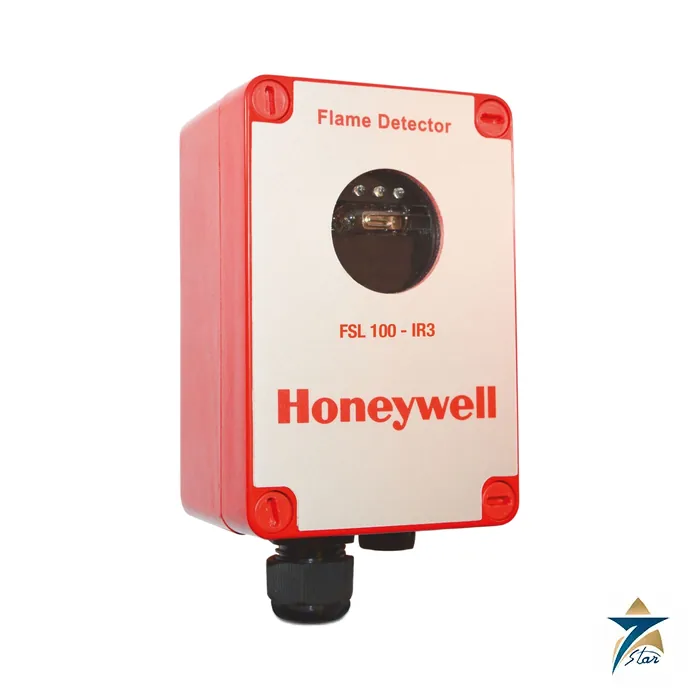
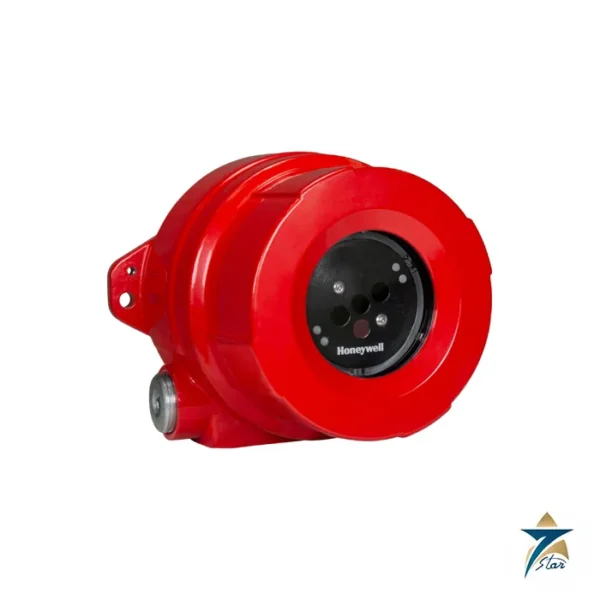
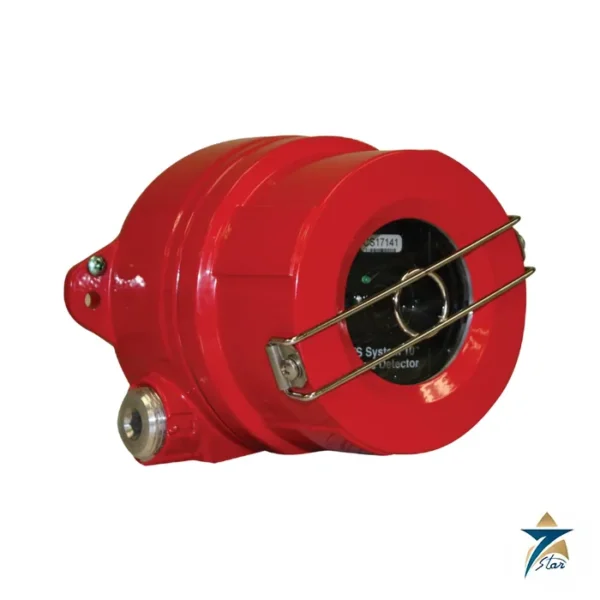
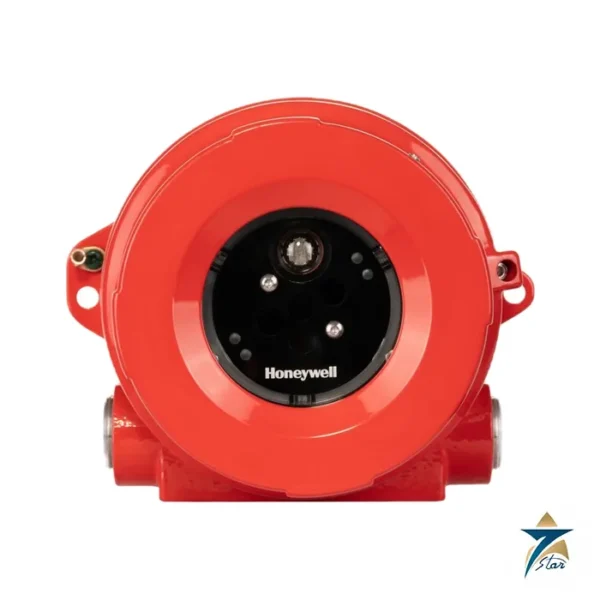
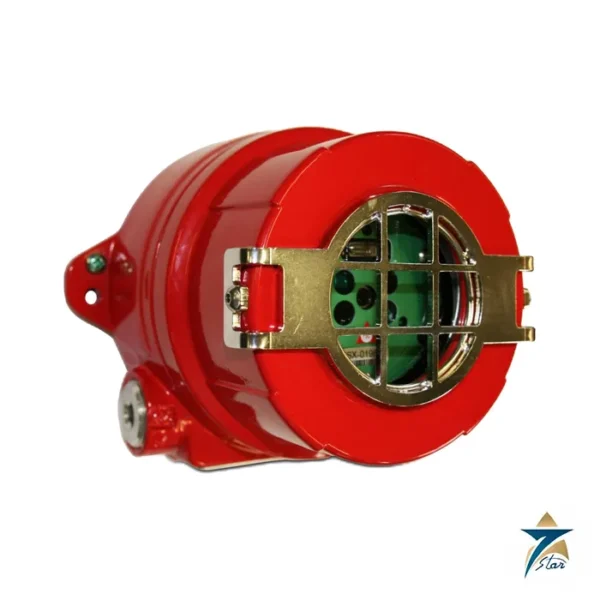
The Honeywell FSL100 is a small, lightweight flame detector series for indoor and outdoor areas, including zones with potentially explosive atmospheres. It is a family rather than a single device, offered as FSL100-UV, FSL100-UVIR and FSL100-IR3, so the part number tells you the sensing technology. Seven Star LLC supplies the FSL100 series in Oman and the GCC as an independent supplier in Muscat.
All versions use high-speed sensors, a microprocessor with flame-flicker analysis, continuous health monitoring and an automatic self-test. The housing is glass-reinforced polyester in a bright red colour, with pre-formed knockouts and a gland supplied, which keeps installation simple compared with heavy flameproof metal detectors.
Decoding the FSL100 part numbers
| Part number |
Sensing |
Range (0.1 m² n-heptane) |
Best suited to |
| FSL100-UV |
Ultraviolet |
25 m (80 ft) |
Cold storage, laboratories, fume hoods, hydrogen storage, low-temperature burning materials such as sulphur, clean rooms |
| FSL100-UVIR |
Ultraviolet plus infrared with flicker-frequency analysis |
25 m (80 ft) |
General indoor fuel and chemical storage, engine rooms, loading terminals, laboratories, gas cabinets |
| FSL100-IR3 |
Three-band infrared with flicker analysis |
35 m (110 ft) |
Liquid hydrocarbon and dirty or smoky fires, outdoor storage, pipelines and pumping stations, spray booths, aircraft hangars |
FSL100 technical specifications
| Parameter |
Specification |
| Manufacturer / part number |
Honeywell / FSL100 (FSL100-UV, FSL100-UVIR, FSL100-IR3) |
| Cone of vision |
90° minimum, horizontal and vertical |
| Supply voltage |
10 to 28 Vdc (12 to 24 Vdc nominal) |
| Operating current |
25 mA at 24 Vdc normal; about 75 mA in alarm |
| Current output |
4-20 mA stepped, sinking, non-isolated: 0 mA power or microprocessor fault, 2 mA optical fault, 4 mA normal, above 20 mA alarm |
| Relays |
Alarm relay (SPDT, de-energised in normal operation) and fault relay (SPDT, energised in normal operation); each 30 Vdc, 2 A, 60 W maximum |
| Alarm outputs |
LEDs and relays selectable latching or non-latching; factory setting latching |
| Start-up time |
Below 10 s |
| Alarm response time |
8 to 30 s |
| Cable entry |
M20 clearance with gland for cable 5.5 to 13 mm; terminals for 0.5 to 1.5 mm² |
| Housing |
Glass-reinforced polyester, UV resistant, self-extinguishing V-0 (UL-94) |
| Dimensions |
125 x 80 x 57 mm |
| Weight |
465 g (1.05 lb) |
| Ingress protection |
IP65 |
| Operating temperature |
-40 to +70 °C; -25 to +70 °C for ATEX and FM Class 3611 |
How the FSL100 tells a fire from a false source
The UV version looks at ultraviolet radiation, which flames emit strongly and which is little affected by smoke inside a clean room or storage area. The UV/IR and IR3 versions add infrared and analyse the flicker frequency of the flame, so steady heat sources, arcs, and sunlight are less likely to trigger an alarm. The datasheet notes good resistance to direct and reflected sunlight and artificial lighting, plus arcs and electric discharges on UV/IR and IR3, and electric welding provided it takes place more than 10 feet from the detector.
A pressure-compensating element in the housing prevents moisture build-up when ambient pressure changes, and the automatic sensor test runs continuously. A remote manual self-test option is also available.
Where the FSL100 sits in a fire detection system
The FSL100 can connect to three kinds of equipment: fire control panels using end-of-line and alarm resistors for a current increase, devices that work from relay-switched outputs, and PLCs with 4-20 mA inputs. The alarm and end-of-line resistors must each be rated at least 2 W, and their combined dissipation must not exceed 2 W. For heavier-duty outdoor or offshore flame detection, Honeywell offers the FS20X and FS20X Plus, which are enclosed in flameproof metal housings with wider ranges; the FSL100 is the compact option.
Selecting an FSL100: checklist
- Choose the technology: UV for cold, clean or hydrogen areas; UV/IR for mixed indoor risks; IR3 for hydrocarbon fires, smoky or dirty conditions and the longest range.
- Check required approvals: the datasheet lists EN54-10 (Class 2 for UV and UV/IR, Class 1 for IR3 marked pending), ATEX Zone 2/22 and FM 3260, with FM 3611 marked pending.
- Decide the output path: relays, 4-20 mA to a PLC, or resistor-based alarm signalling to a fire panel.
- Order a swivel mount, FS1000-SM21, because it is not included.
- Plan testing: the FSL100-TL test lamp and its spares (battery FSL100-TLBT, H3 bulb FSL100-TLBU, charger kit FSL100-TLCH).
Installation and maintenance of the FSL100
Mount the detector so its cone covers the hazard with no obstruction, and use the swivel mount to aim it. Wire the supply within 10 to 28 Vdc, route the cable through the supplied gland, and set latching or non-latching behaviour for LEDs and relays before commissioning. Green means normal, yellow means fault, and red means alarm; a flashing yellow points to a repeat self-test after a failure.
Periodic testing with the test lamp confirms that the detector responds. Clean the window as part of site routine, and avoid placing the unit where it looks directly at arc welding or at strong flickering light sources within the stated distance.
Typical FSL100 applications in Oman and the GCC
The application matrix in the datasheet covers aircraft hangars, engine and diesel rooms, engine test cells, battery storage and communication rooms, chemical, fuel and solvent storage, laboratories, loading terminals, paint spray booths, pipeline pumping stations and waste processing. In Oman and the GCC these map to aircraft hangars, standby generator rooms, workshop and utility buildings, fuel storage depots, and petrochemical support areas. For outdoor use the high ambient temperature is covered by the +70 °C upper limit, and IP65 protection helps with dust and humidity.
Information to send with an FSL100 RFQ
- Which version you need: FSL100-UV, FSL100-UVIR or FSL100-IR3.
- Application, indoor or outdoor, and the fuels or materials at risk.
- Hazardous-area zone and any EN54-10 or FM requirement.
- Interface type: fire panel with resistors, relay logic or PLC 4-20 mA.
- Accessories: swivel mounts and a test lamp.
- Quantity and delivery requirements.
Documents and quotation
The Honeywell FSL100 series datasheet is attached on this page, and covers all three versions with their approvals, outputs and accessories.
Tell us the version (UV, UV/IR or IR3), accessories and quantity, and Seven Star LLC will confirm availability and send a quotation.























Reviews
There are no reviews yet.