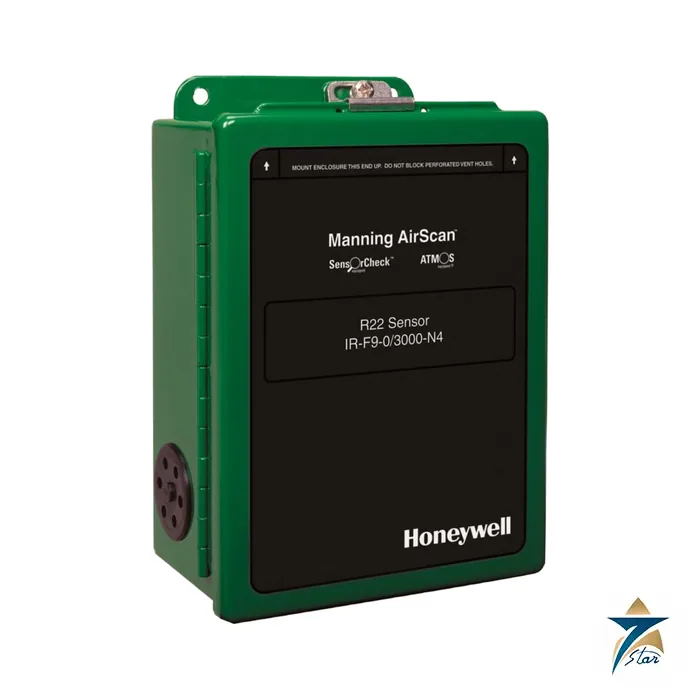
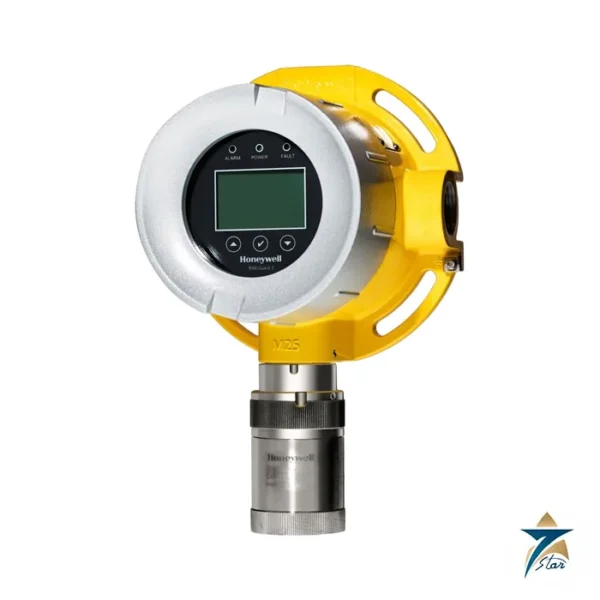
Honeywell Manning AirScan IR-F9 infrared refrigerant gas sensor and transmitter
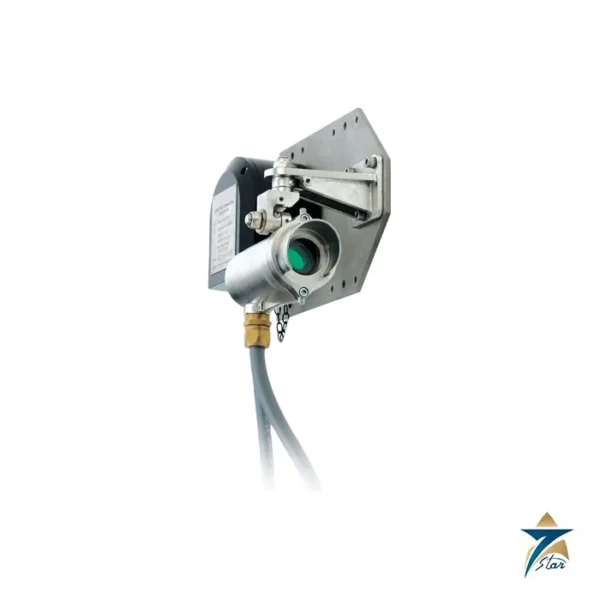
The Manning AirScan IR-F9 from Honeywell is an infrared sensor and transmitter for refrigerant gas leaks. Instead of an electrochemical cell, it measures the gas optically, using an infrared source and detector with a reference channel. It responds to a long list of refrigerants plus ammonia and carbon dioxide, so one housing style can protect machinery rooms, cold stores and process areas that use different working fluids.
Seven Star LLC supplies the AirScan IR-F9 in Oman and the GCC as an independent supplier in Muscat. Because the sensor is configured for a specific refrigerant and range, we always confirm gas and scale with you before quoting.
What the AirScan IR-F9 detects
The manufacturer lists rapid response to R-404a, R-22, R-507a, R-134a, R-407a, R-410a, R-422d, HFO-1234yf, NH3 and CO2. The standard range is 0 to 3,000 ppm and can be rescaled for lower trip points. The page also lists these measuring ranges: CO2 0-1% and 0-3%; NH3 0-2% and 0-4%; and for the R gases 0-500 ppm, 0-1,000 ppm and 0-3,000 ppm.
AirScan IR-F9 technical specifications
| Parameter |
Specification |
| Manufacturer / part number |
Honeywell (Manning) / AirScan IR-F9 |
| Sensing method |
Infrared, refrigerant specific, diffusion type with no moving parts |
| Measuring range |
CO2: 0-1%, 0-3%; NH3: 0-2%, 0-4%; R gases: 0-500, 0-1,000, 0-3,000 ppm |
| Accuracy |
±3% of full scale |
| Repeatability |
±1% of full scale |
| Signal output |
Linear 4 to 20 mA into a load of 500 Ω maximum |
| Communication |
RS485 |
| Power supply |
24 VDC |
| Humidity range |
0 to 100% RH, condensing |
| Minimum operating temperature |
-30 °C |
| Storage temperature |
-28 to +60 °C |
| Enclosure |
Stainless steel, NEMA 4 |
| Audible alarm |
85 to 103 dB horn |
| Weight |
4.4 lb |
| Operating life |
10 years (listed) |
| Hazardous location listing |
UL, CSA (as listed on the product page) |
How the AirScan IR-F9 works
Gas diffuses into the sensing path by itself, so there are no pumps, filters or moving parts to wear. Infrared light is absorbed at wavelengths specific to the target molecule, and the amount of absorption indicates concentration. A unique internal reference channel compensates for dust deposits, source ageing, humidity and temperature swings, food odours and cleaning chemicals, which is why this type of detector is trusted in washdown and food environments.
ATMOS technology lets the unit adapt to its surroundings and work down to -60 °F (-51 °C) in condensing humidity or during washdown, as stated in the brochure. SensorCheck monitoring tests the sensor electrically every 24 hours and sends a notification output if it finds an anomaly, and the 4 to 20 mA loop is continuously monitored internally, so a failure does not look like a healthy zero reading.
Where AirScan IR-F9 fits in a refrigeration gas system
The transmitter can be used with any Honeywell Analytics readout, or it can feed a PLC directly through its linear 4 to 20 mA output. A readout adds visual and audible alarms and relays for ventilation fans and central alarms. For ammonia-only plants, the electrochemical EC-FX-NH3 on a separate page is an alternative with ranges as low as 0-100 ppm. For commercial building gases such as CO and NO2 the E3Point is more typical.
Selection and ordering checklist for the AirScan IR-F9
- Refrigerant or gas to be detected: one of the R gases, NH3 or CO2.
- Measuring range and scale, for example 0-3,000 ppm standard or a lower rescaled range.
- Readout or controller the transmitter will connect to, or PLC input details.
- Alarm trip points required by site rules and local regulation.
- Mounting point: near the floor for heavy refrigerants, higher for ammonia, which is lighter than air.
- Ambient temperature, humidity and washdown exposure at the detector location.
- Cable length and loop resistance against the 500 Ω maximum load.
Installation, calibration and maintenance
Mount the unit where refrigerant is expected to collect or where leaks from compressors, valves, coils and flanges would reach it. Keep it clear of direct blasts from fans or defrost air and out of the path of washdown jets. Use shielded cable for the 4 to 20 mA loop, check the 24 VDC supply, then perform the initial setup and zero according to the instruction manual.
The brochure notes that the simple real-time calibration reduces downtime, and that the design needs fewer calibrations than many sensors. Even so, regular bump or span checks with the correct gas remain good practice and are often a regulatory expectation for refrigerant monitoring. Keep the optical windows free of ice, grease and heavy dirt, and log every test result.
Typical applications in Oman and the GCC
The manufacturer lists banana and produce rooms, beverage plants, wineries and breweries, food processing, gas bottling plants, ice rinks, product coolers, rack houses, refrigeration systems, supermarkets and confined space entry. In Oman and the GCC the closest fits are cold stores for fish and food distribution, supermarket and hypermarket plant rooms, dairy and beverage plants, ice rinks in malls and district cooling or chiller machinery rooms. High ambient heat and humidity on the coast make the stainless steel NEMA 4 housing and condensing-humidity rating relevant.
Gas coverage summary
| Gas group |
Examples listed |
Listed ranges |
| Gas group |
Examples listed |
Listed ranges |
| HFC and HCFC refrigerants |
R-404a, R-22, R-507a, R-134a, R-407a, R-410a, R-422d |
0-500, 0-1,000, 0-3,000 ppm |
| HFO refrigerant |
HFO-1234yf |
0-500, 0-1,000, 0-3,000 ppm |
| Ammonia |
NH3 |
0-2%, 0-4% |
| Carbon dioxide |
CO2 |
0-1%, 0-3% |
Information to send with an RFQ
- Refrigerant or gas name and required range.
- Number of sensing points and location type (machinery room, cold store, duct).
- Readout, controller or PLC details.
- Alarm and relay requirements.
- Environmental data: lowest temperature and washdown exposure.
- Delivery location and project timeline.
Documents and quotation
A manufacturer brochure for the Manning AirScan IR-F9 is attached on this page. It covers the sensing technology, features and the application list used above.
Send the refrigerant, range and quantity and we will confirm the exact configuration and available documents before quoting. Seven Star LLC is an independent supplier and not the manufacturer.


























Reviews
There are no reviews yet.