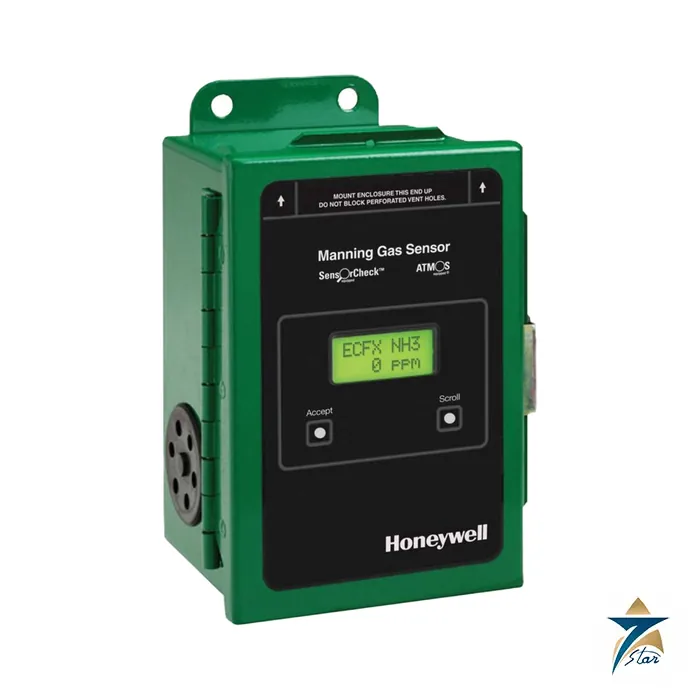
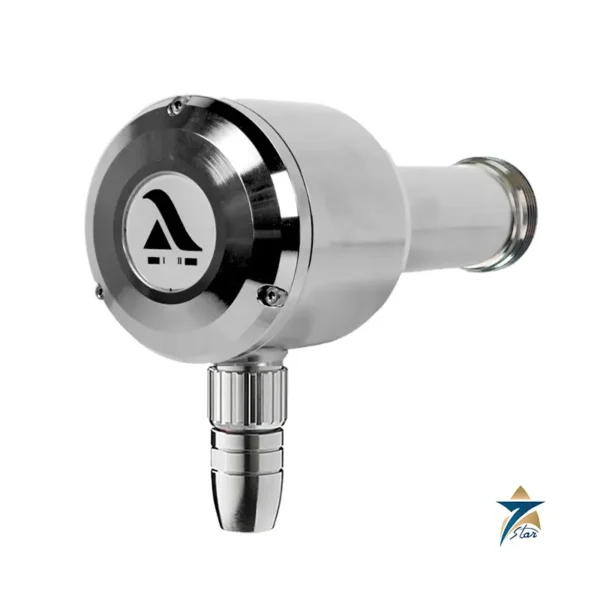
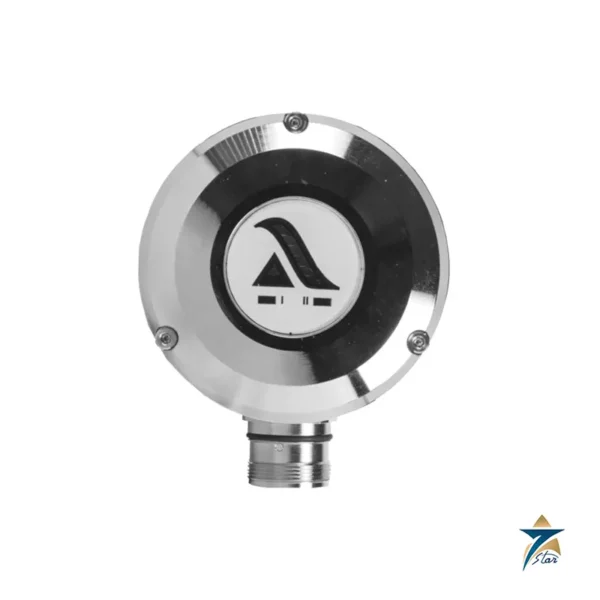
Honeywell Manning EC-FX-NH3 ammonia gas sensor and transmitter
The Manning EC-FX-NH3 from Honeywell is an electrochemical ammonia sensor and transmitter designed for industrial refrigeration. It is an evolution of the earlier Manning EC-F9-NH3, with a new ammonia cell that uses a proprietary electrolyte aimed at surviving the conditions that normally shorten the life of ammonia cells: deep cold, hot engine rooms, hot-water washdown and fast changes in humidity and pressure.
Seven Star LLC supplies the EC-FX-NH3 in Oman and the GCC as an independent supplier in Muscat. Below we summarise the verified specifications, the range choices and the points to settle before ordering.
EC-FX-NH3 range options: low range and high range
The EC-FX-NH3 is available in a low-range (LR) form with 0-100 ppm as the standard scale, plus 0-200 ppm and 0-250 ppm, and in a high-range (HR) form with 0-500 ppm and 0-1000 ppm. The range is a part of the order, because it sets the response time and the accuracy figure that applies. Low-range versions have T90 below 30 seconds, while high-range versions have T90 below 75 seconds.
EC-FX-NH3 technical specifications
| Parameter |
Specification |
| Manufacturer / part number |
Honeywell (Manning) / EC-FX-NH3 |
| Gas |
Ammonia (NH3) |
| Measuring principle |
Electrochemical, diffusion type |
| Ranges |
LR: 0-100 ppm (standard), 0-200, 0-250 ppm; HR: 0-500, 0-1000 ppm |
| Response time T90 |
Below 30 s for LR ranges; below 75 s for HR ranges |
| Accuracy |
±5% of full scale at calibration temperature |
| Repeatability |
Below 10% of full scale |
| Output |
Isolated 4 to 20 mA, 700 Ω maximum at 24 VDC; falls to 0.5 mA to signal a fault |
| Digital |
RS-485, Modbus RTU protocol |
| Power |
24 VDC, 0.5 A maximum |
| Operating temperature |
-50 to +120 °F (-45 to +49 °C) |
| Humidity |
5 to 100% RH, condensing |
| Pressure |
Sensor limit 0-10 psig; sensor operates at atmospheric ±10% |
| Storage |
-40 to +176 °F (-40 to +80 °C), 20 to 80% RH non-condensing |
| Enclosure |
NEMA 1 gasketed 16-gauge steel as standard; stainless steel and modified enclosures available |
| Ingress rating |
IP44 to EN 60529, indoor use |
| Display |
Optional 2 x 8 character backlit LCD with Accept and Scroll buttons; LEDs without LCD |
| Weight |
3 lb (1.36 kg) |
| Sensor warranty |
Three years from date of shipment |
How the EC-FX-NH3 works
Ammonia diffuses through a membrane into the electrochemical cell, where it reacts and produces a current proportional to concentration. The transmitter converts this to a 4 to 20 mA loop signal and to Modbus data. ATMOS technology is the manufacturer name for the environment-adaptive compensation that keeps readings sensible across wide swings of temperature and humidity.
SensorCheck technology runs an internal electrical viability test on the sensor every 24 hours. If the test fails, the output drops to 0.5 mA so the controller sees a fault instead of a flat zero, and an internal indicator light shows whether the cell has dried out or been disconnected. That behaviour is important in safety circuits because a silent failure of an ammonia sensor is a larger risk than a nuisance alarm.
Where the EC-FX-NH3 fits in the plant
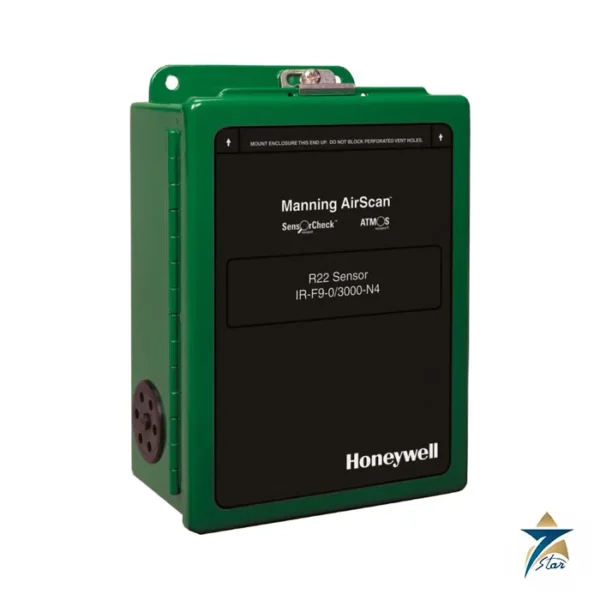
The sensor works with any Honeywell Analytics readout or alarm unit, which supplies visual and audible alarms and relays for ventilation fans and central alarm tie-in. Alternatively the 4 to 20 mA loop can go straight to a PLC input. Compared with the infrared AirScan IR-F9 covered on another page, which has NH3 ranges in percent, the EC-FX-NH3 is optimised for low ppm ammonia detection and personnel protection. For general building gases, the E3Point is a different product class.
Selection and ordering checklist for the EC-FX-NH3
- Range: LR 0-100, 0-200 or 0-250 ppm, or HR 0-500 or 0-1000 ppm.
- Display: with or without the LCD module.
- Enclosure: standard steel, stainless steel, or a modified enclosure for low temperature or duct use.
- Output use: 4 to 20 mA into a PLC or Honeywell readout, and whether Modbus RTU is needed.
- Location: cold store, blast freezer, engine room or refrigerated processing area.
- Cable runs against the manufacturer limits listed below.
- Spare NH3 cells for the maintenance stock.
Wiring, cable limits and installation
The brochure recommends 18/3 shielded cable (Belden 8770 or equal) for the 4 to 20 mA output with runs under 1,500 ft, 24 AWG shielded twisted pair (Belden 9841 or equal) for RS-485 with runs up to 2,000 ft, and 14 AWG power cable (Belden 5100UE or equal) for runs up to 1,000 ft. Mount the unit in the breathing zone for personnel protection or near the likely leak points, avoiding spray from washdown hoses where the housing is not rated for it.
The IP44 rating is for indoor use, so outdoor or heavily splashed positions need suitable protection or a different enclosure. Avoid exposing the sensor to high concentrations of solvent vapours during storage, fitting or operation.
Calibration, bump testing and maintenance
The manufacturer states that function must be confirmed by exposing the device to target gas, a bump check, and that failing to do this regularly can endanger people and property. Set a routine that suits the plant risk assessment, record each result and replace the ammonia cell when it can no longer meet span. The cell is the listed replacement part, so one spare per site makes sense.
Typical applications in Oman and the GCC
Listed applications are cold storage, engine rooms and refrigeration systems, and the brochure also names fruit and vegetable processing, bakeries, meat and poultry processing, and beverage and bottling plants. In Oman and the GCC that points to fish processing and cold chain warehouses, dairy and food factories, ice plants and large ammonia chillers. Engine rooms in hot climates are the harsh case the new cell is designed for, since high temperatures dry out standard electrolytes, while blast freezers test the low end of the temperature range.
Information to send with an RFQ
- Required range, low or high, and any special scale.
- LCD option and enclosure type.
- Number of sensing points and where they are mounted.
- Readout or PLC the unit will report to.
- Cable lengths and power supply details.
- Delivery location and project timeline.
Documents and quotation
A manufacturer brochure for the EC-FX-NH3 is attached on this page and contains the specification table summarised above.
Send the range, enclosure and quantity and we will confirm the exact configuration and available documents before quoting. Seven Star LLC is an independent supplier and not the manufacturer.
Other Models in the Manning Refrigerant Gas Range
Seven Star LLC supplies models from the Manning Refrigerant Gas range in Oman and the GCC. Compare the related models below and request a quote for the one that matches your application.


























Reviews
There are no reviews yet.