Honeywell AutoRAE 2 automatic test and calibration system: what it does
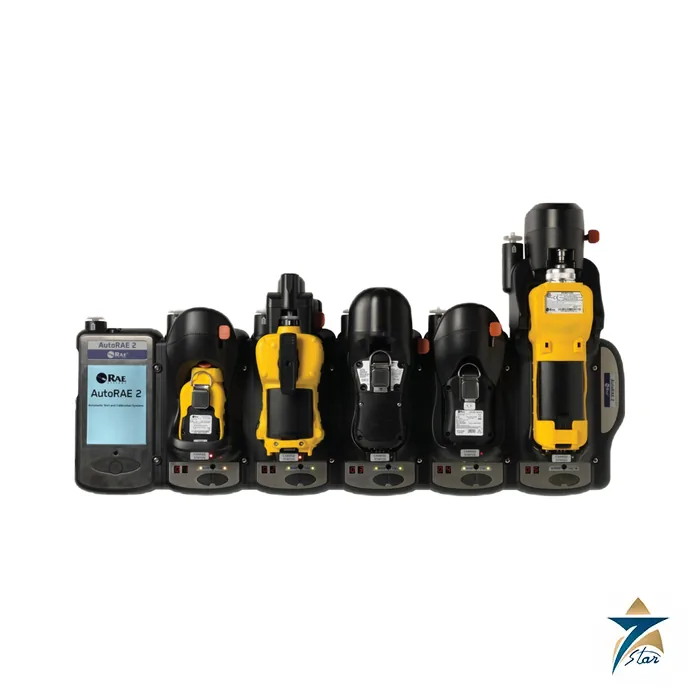
The AutoRAE 2 is an automatic bump test, calibration, charging and records system for Honeywell RAE Systems portable gas monitors. Instead of an operator applying gas manually, the monitor is placed in a cradle and the system supplies the calibration or test gases, reads the instrument response, adjusts or fails the instrument as needed, charges the battery and stores the result. The datasheet presents it as flexible and modular: it can be a single cradle working alone for one instrument at a time, or a controller-based system with up to ten instrument cradles and five distinct calibration gases or gas mixtures. Seven Star LLC supplies AutoRAE 2 components in Oman and the GCC as an independent supplier in Muscat.
For safety departments with a fleet of portable detectors, this removes a large amount of repetitive work and gives an auditable record that every detector was bump tested before the shift.
AutoRAE 2 technical specifications
| Parameter |
Specification |
| Manufacturer / part number |
Honeywell RAE Systems / AutoRAE 2 (controller T02-0107-000) |
| System architecture |
Stand-alone cradle, or controller with up to 10 cradles (any mix, any order) |
| Calibration gases |
Up to 5 gas cylinders on controller-based configurations; 6 inlets (1 fresh air plus 5 configurable) and 1 exhaust port |
| Controller display |
5.7 inch TFT (320 × 240) graphical backlit colour LCD; 3 buttons |
| Cradle display |
Two seven-segment LEDs; tri-colour LED lights; 2 buttons (Bump and Cal) |
| Controller dimensions |
143 × 265 × 44 mm (5.63 × 10.43 × 1.73 in); 0.86 kg |
| Data storage |
Standard 2 GB SD card with security lock on the controller |
| PC connection |
USB (Type B) port; RJ-45 10/100 Base-T network; Wi-Fi module accessory for the controller |
| Pump / regulator |
Built-in controller pump 500 ml/min; demand-flow regulator rated 0 to 1,000 psig (70 bar) |
| Mounting |
Bench-top or wall-mounted; standard TS35 DIN rail accessory |
| Power |
AC adapter 110 to 240 V input, 12 V 7.5 A for the controller (charges up to 10 instruments); 12 V 1.25 A for a stand-alone cradle |
| Operating conditions |
0 to 50 °C; 5 to 95 % RH non-condensing |
| Alarm |
90 dB at 30 cm (12 in) |
| Compliance / warranty |
CE; 2-year limited warranty |
Specifications are from the AutoRAE 2 datasheet DS-1083, April 2018 issue.
Supported instruments and the cradle part numbers
| Item |
Part number |
Notes |
| AutoRAE 2 Controller (includes terminal adapter) |
T02-0107-000 |
Controls up to 10 cradles |
| Cradle for ToxiRAE Pro models |
T02-0003-000 |
Includes adapters for all ToxiRAE Pro models |
| Cradle for QRAE 3 models |
T02-0203-000 |
QRAE 3 |
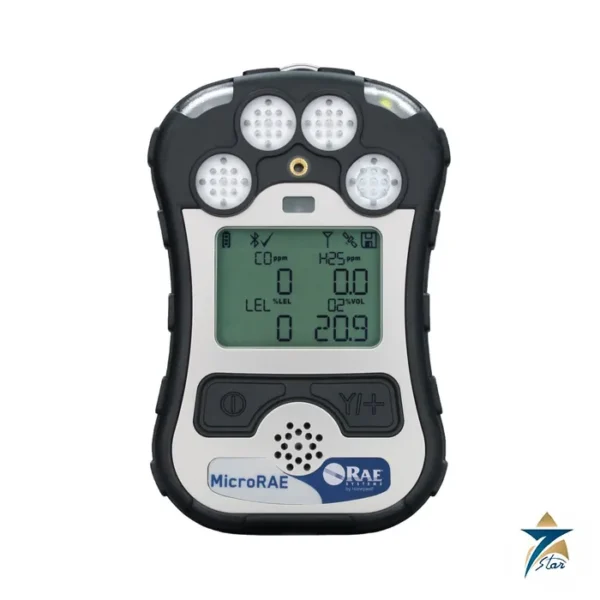
| Cradle for MicroRAE models |
T02-0503-000 |
MicroRAE |
| Cradle for MultiRAE pumped models |
T02-0103-000 |
MultiRAE series, except the diffusion model |
| Cradle for handheld PID models |
T02-0403-000 |
Supports MiniRAE Lite, MiniRAE 3000, UltraRAE 3000 and ppbRAE 3000 |
| Wi-Fi module for the controller |
T02-0303-000 |
Networking accessory |
Cradle dimensions differ by instrument; the handheld PID cradle also has an extended version of about 516 mm length. Check that the cradle matches the exact instrument model before ordering.
How an AutoRAE 2 session works
In a controller-based configuration the operator docks the monitor, and the controller runs the bump test or full calibration through its internal pump and regulator, shows pass or fail on the colour screen and the cradle lights, and charges the battery at the same time. Results are written automatically to a datalogging file on the controller SD card, and the datasheet describes device management with Honeywell SafetySuite for fleets that need centralised records. In stand-alone mode a cradle does the same for one instrument without a computer, which suits field offices and small sites.
Selecting an AutoRAE 2 configuration
- Fleet makeup. List the monitor models in use. Each model family needs its own cradle, but any mix of cradles can be connected to one controller.
- Gas list. Count the calibration gases needed across all instruments. The controller accepts up to five cylinders, so combine gases into mixtures where practical.
- Networking. Choose a direct USB or RJ-45 link, or the Wi-Fi accessory, depending on how records are collected.
- Location. The controller can be bench-mounted or fixed to a wall, and cradles can be mounted on standard DIN rail. Provide AC power and a clean, dry area.
- Software. Firmware is field-upgradeable, and the system is designed to work without a computer.
Installation and routine care of the AutoRAE 2
- Connect cylinders with the supplied tubing to the 200-series barb connectors, using 1/8 inch (3.18 mm) ID tubing, and leave the fresh-air inlet open to clean air.
- Use the demand-flow regulator on the cylinders so that gas is only drawn when needed; this extends cylinder life.
- Keep the exhaust port vented to a safe place, because test gases such as H2S or CO are hazardous.
- Keep a log of cylinder expiry dates and replace gas on schedule, because an out-of-date gas can cause a failed calibration.
- Download records from the SD card regularly and keep copies for inspection and audit.
Typical AutoRAE 2 applications in Oman and the GCC
Large turnaround contractors, drilling and well-service companies, refineries, terminals and utilities typically run dozens of portable detectors, and the datasheet names oil and gas, industrial, environmental, fire service and national security among target industries. A centrally managed AutoRAE 2 station at a muster point or gas-testing room lets each crew collect a bump-tested detector in seconds. In hot climates keep the system in an air-conditioned room, because cylinder pressure, cradle electronics and battery charging all prefer ambient below the 50 °C maximum stated in the datasheet.
Information to send with an AutoRAE 2 RFQ
- List of monitor models to be serviced and quantities, so the correct cradles can be quoted.
- Number and composition of calibration gases and regulators.
- Whether a controller or stand-alone cradles are needed, and how many cradles per controller.
- Wi-Fi or Ethernet needs, and any SafetySuite integration.
- Power supply requirements and mounting method.
Documents and quotation for the AutoRAE 2
The AutoRAE 2 datasheet is attached on this page, including the ordering table.
Send us the instrument list and gas requirements and we will confirm availability and lead time for the quotation.




















Reviews
There are no reviews yet.