Honeywell BW Max XT II pumped portable gas detector
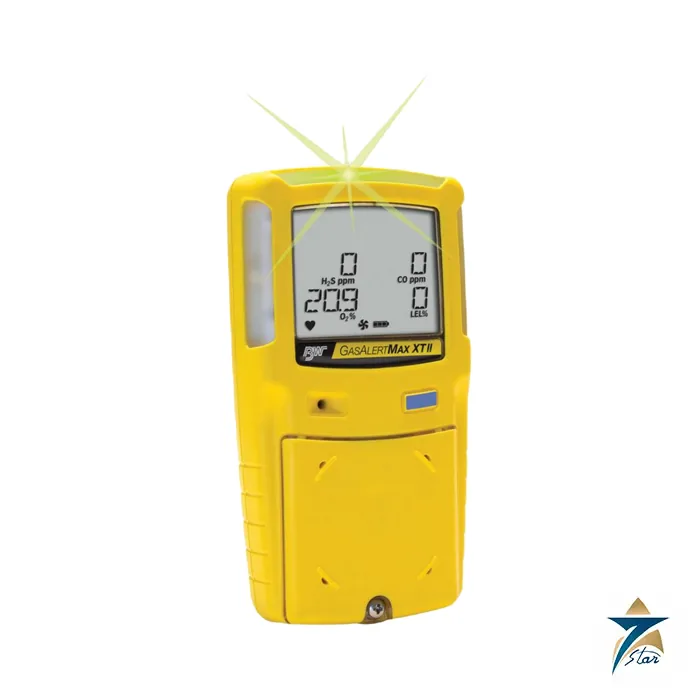
The Honeywell BW Max XT II is a portable detector that monitors up to four gas hazards and pulls its sample through a built-in motorised pump. That pump is the main reason to choose it over a diffusion-only personal monitor: it lets an entrant check the air in a tank, pit, vessel or manhole before anyone goes in, using a hose from outside. Seven Star LLC supplies the BW Max XT II in Oman and the GCC as an independent supplier in Muscat.
The instrument combines one-button operation with continuous LCD readings, a wide-angle visual alarm bar, a vibrating alert and a 95 dB audible alarm. It carries a built-in boot for impact resistance and is described as water resistant, so it copes with ordinary site handling without a separate case.
The measured gases are hydrogen sulfide, carbon monoxide, oxygen and combustible gas, which cover the classic confined-space entry list. Because a four-gas configuration is the usual choice, you should confirm which sensors are fitted when you order the BW Max XT II.
BW Max XT II technical specifications
| Parameter |
Specification |
| Manufacturer / part number |
Honeywell / BW Max XT II |
| Type |
Portable pumped multi-gas detector, up to four gases |
| Size |
13.1 x 7.0 x 5.2 cm (5.1 x 2.8 x 2.0 in) |
| Weight |
328 g (11.5 oz) |
| Operating temperature |
-20°C to 50°C (-4°F to 122°F) |
| Humidity |
10% to 100% RH, non-condensing |
| Ingress protection |
IP66/67 |
| Alarms |
Visual, vibrating, audible (95 dB); Low, High, TWA, STEL, OL (over limit), Low Battery, Pump |
| Self-test |
On activation and continuously for sensors, battery, pump and circuitry |
| Battery life |
13 hours at 0°C; 8 hours at -20°C; recharge in 6 hours |
| Pump draw |
Sample from up to 23 m (75 ft) |
| Languages |
English, French, German, Spanish, Portuguese |
| Approvals listed |
Class I Div 1 Gr A-D; IECEx Ga Ex ia IIC T4; ATEX II 1 G Ga Ex ia IIC T4 |
| Warranty |
Two years, including all sensors |
Standard sensor ranges of the BW Max XT II
| Gas |
Standard measuring range |
Resolution |
| Hydrogen sulfide (H2S) |
0 to 200 ppm |
1 ppm / 0.1 ppm |
| Carbon monoxide (CO) |
0 to 1,000 ppm |
1 ppm |
| Oxygen (O2) |
0 to 30% vol |
0.1% vol |
| Combustible gas (LEL) |
0 to 100% LEL and 0 to 5.0% v/v |
1% LEL / 0.1% v/v |
Alarm set points can be changed by the user for every sensor, and the set points are shown automatically during start-up so the wearer can see what the instrument is configured to do.
How the BW Max XT II samples and detects
The sample is drawn by a diaphragm pump, which the datasheet calls SmartSample technology. A semiconductor pressure sensor performs the block detection, so if the inlet or hose is pinched, flooded or blocked the instrument raises a pump alarm instead of reporting a false clean reading. This is the most important safety function for anyone who samples through long tubing.
At start-up a full-function self-test checks the sensors, battery state, circuit integrity and the audible and visual alarms. The IntelliFlash indicator then gives a continuous visual confirmation that the detector is working and in compliance, which a supervisor can see at a glance across a work area.
BW Max XT II in a fleet: docking, software and accessories
The datasheet lists the MicroDock II automatic test and calibration station, a multi-unit cradle charger, a concussion-proof boot and optional BW Connect real-time monitoring, the last subject to availability from the manufacturer. Fleet Manager II software handles configuration and records, and the detector carries standard datalogging and event logging.
Related Honeywell portables that Seven Star LLC supplies include the BW Icon fixed-life multi-gas detector, the BW Solo and BW Clip single-gas detectors, the BW RigRAT area monitor and the ToxiRAE Pro. Many sites issue single-gas units to general staff and keep the BW Max XT II with entry supervisors and permit holders.
Selection checklist for the BW Max XT II
- Decide whether remote sampling is needed; if not, a diffusion detector may be simpler.
- Confirm the gas set: H2S, CO, O2 and LEL, and compare ranges with your alarm levels.
- Note the 8-hour battery figure at -20°C and the 13-hour figure at 0°C when planning shift length.
- Keep sampling hose within the 23 m limit and use only the supplied tubing for calibration.
- Check the approval markings (Class I Div 1, IECEx, ATEX) against the zone you work in.
- Choose how the fleet will be bump tested: manually or on a MicroDock II.
Commissioning, calibration and upkeep of the BW Max XT II
On receipt, charge the unit fully, power it up and read the set points shown at start-up. Run a bump test and then a calibration with the supplied tubing, record the result and set the confidence-beep and lock options according to your procedure. The user options include forced bump tests when overdue, forced calibration when overdue, latching alarms, a sensor lock and detector identification.
In service, replace pump inlet filters and hoses when they are dirty or damaged, keep the water barrier clean, and never sample liquid. Spare sensors and batteries should be ordered by instrument model so that the correct parts are fitted, and any unit that fails a bump test should be removed from use until it passes.
Where the BW Max XT II is used in Oman and the GCC
Typical uses include pre-entry checks of tanks and vessels during refinery and petrochemical turnarounds, sewer and manhole work, desalination plant maintenance, power station boiler and condenser entries, and routine hot-work checks on oil and gas facilities. The 10% to 100% humidity tolerance is useful in humid coastal plants, while the 50°C operating limit means a unit left in a parked vehicle in summer should be cooled before use.
Dust and sand are a fact of life in the region, so use the pump filters, and wipe the instrument after dusty work so the inlet and alarm lenses stay clear.
Information to send with an RFQ for the BW Max XT II
Please send the exact model and part number, the gas or gases to be monitored with the required ranges, the work area classification and the number of units. If the detectors will be docked, bump tested or calibrated by an automatic station, tell us which system you use. Mention the site, the delivery timing and whether you need spare sensors, chargers or accessories alongside the instrument.
- Gases and alarm limits required
- Sampling hose length and probe needs
- Docking station and software preference
- Quantity and any spare filters, hoses or batteries
Documents and quotation
The manufacturer datasheet for the BW Max XT II is attached on this page. Please read it with your confined-space and permit procedures.
Send the quantity and gas configuration and we will quote for delivery to Oman and the GCC.
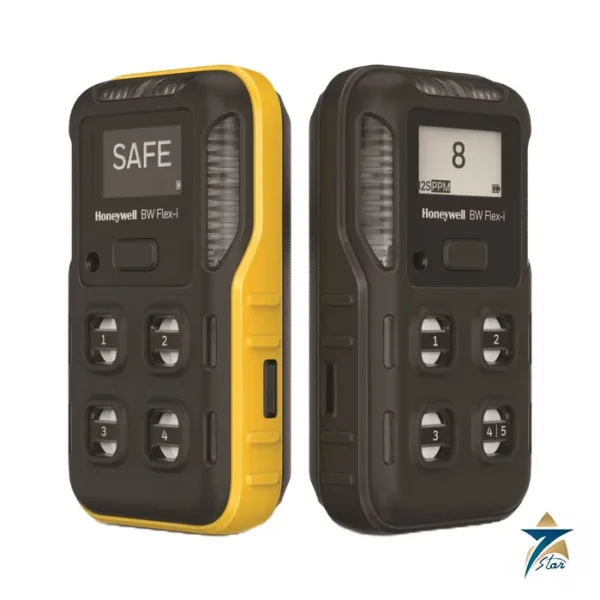
Other Models in the Honeywell Bw Portable Range
Seven Star LLC supplies models from the Honeywell Bw Portable range in Oman and the GCC. Compare the related models below and request a quote for the one that matches your application.





















Reviews
There are no reviews yet.