Honeywell ModRAE modular portable gas detection platform: what makes it modular
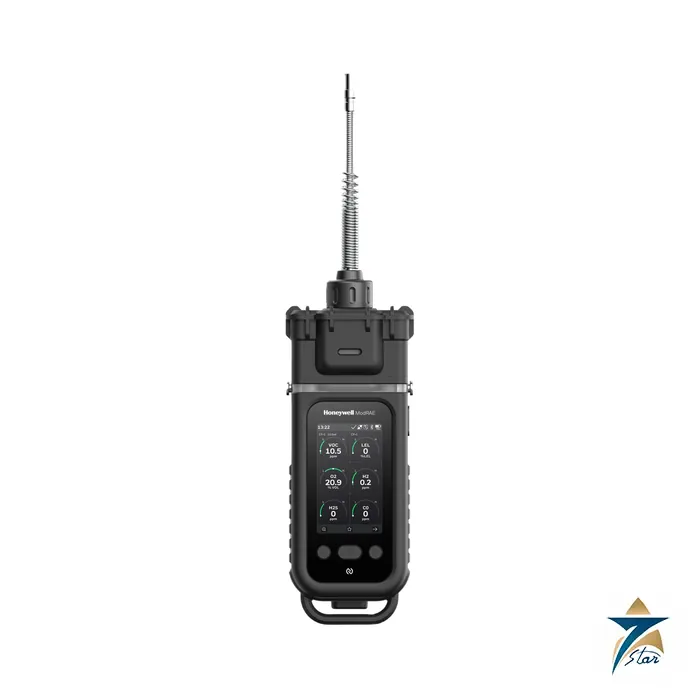
ModRAE is a newer portable gas detection platform from Honeywell RAE Systems in which the sensing part is a plug-in smart cartridge rather than a fixed set of sensors inside the housing. The base unit carries the pump, the 3.5 inch colour display, the battery and the radio, while each SensorRAE cartridge carries its own sensing element and electronics. Swapping a cartridge changes what the instrument can detect, so one base unit can be used for total VOC screening one day and a compound-specific measurement such as benzene the next. Seven Star LLC supplies ModRAE in Oman and the GCC as an independent supplier in Muscat.
The datasheet used here is dated August 2026, so the platform is current at the time of writing. Because it is a configurable platform, confirm the exact cartridge, wireless module and approval configuration when you request a quotation.
ModRAE technical specifications
| Parameter |
Specification |
| Manufacturer / part number |
Honeywell RAE Systems / ModRAE |
| Platform concept |
Base unit with interchangeable smart sensor cartridges (SensorRAE technology) |
| Dimensions |
375 × 83 × 48/60 mm including probe and rubber boot |
| Weight |
About 975 g including base unit, sensor cartridge, strap, clip and boot |
| Ingress protection |
IP66 and IP68 for the whole product |
| Operating conditions |
–20 to +60 °C; 80 to 120 kPa; 0 to about 95 % RH |
| Display |
3.5 inch TFT colour LCD, 480 × 800 resolution |
| Controls |
3 front-panel buttons and 1 configurable side button |
| Standard connectivity |
Bluetooth Low Energy and NFC on every unit |
| Optional wireless modules |
Cellular (LTE-FDD and LTE-TDD bands, nano SIM, GNSS) and LoRa (868/915 MHz, line of sight 600 m to external antenna) |
| Built-in sensors |
Ambient light, flow, temperature/humidity/pressure and accelerometer for man-down alarm |
| Alarms |
95 dB buzzer at 30 cm, six LEDs, two vibration motors; side-button SOS option |
| Pump |
Serviceable diaphragm pump, 300 cm3/min, automatic flow adjustment, sampling distance up to 45 m |
| Datalogging |
Sampling interval 1 to 3,600 s; up to 180 days at 60 s |
| Battery |
3.7 V, 5,700 mAh Li-ion; over 12 hours worst case at room temperature; charge time under 5.5 hours at 10 to 30 °C |
| Approvals |
IECEx Ex ia IIC T4 Ga; ATEX II 1G Ex ia IIC T4 Ga; US/Canada Class I Div 1 Groups A-D, Class I Zone 0 AEx ia IIC T4 Ga; ambient –20 to 60 °C |
Certificates are listed with the datasheet numbers; verify the marking of the delivered unit and cartridge, because the sensor certificate is listed separately as IECEx Ex ia IIC Ga.
How the ModRAE cartridge system works
Each smart cartridge integrates the sensing element and its electronics, and a small coin cell keeps the sensor biased while the cartridge is outside the instrument. This means that a cartridge can be stored, calibrated or transported independently and then fitted with a quick-release slide-and-lock action in the field. The datasheet describes the pump as supporting a single separation-tube cartridge and a water trap, for compound-specific work. A photoionisation cartridge can be fitted with a 10.6 eV, 9.8 eV or 11.7 eV lamp, according to the cartridge table, and the PID cartridges list a response time of five seconds or less at 100 ppm isobutylene.
The practical benefit for a plant is spares logic. Instead of buying a complete detector for each gas hazard, a fleet might hold a few base units and a rack of calibrated cartridges, and issue the combination each job needs.
Operating modes of the ModRAE
- Health Mode. Continuous monitoring with exposure metrics such as TWA and STEL, aimed at personal and area exposure assessment.
- Safety Mode. Targeted investigation with survey detection, real-time graphing and object measurement, so repeated sampling of equipment surfaces is done in a consistent way.
- Guided workflows. On-screen guidance and colour-coded alerts reduce variation between operators.
- Man-down and SOS. The accelerometer supports a man-down alarm and the side button can trigger an SOS alarm by default.
Connectivity and Safety Suite integration for the ModRAE
All units have Bluetooth Low Energy and NFC. Optional cellular and LoRa modules are fitted in the field, so an instrument bought without wireless can be upgraded later without replacing it. The datasheet lists Wi-Fi and Mesh among the supported approaches and states that ModRAE is designed to integrate with Honeywell Safety Suite 2.0 for centralised device management and data visibility. Where live data from remote crews matters, such as isolated pipeline or well-site work, the cellular or LoRa module provides that link; the LoRa module is listed for line of sight of 600 m to an external antenna.
Selecting a ModRAE configuration
- Target gas or compound. This determines the cartridge: total VOC with a PID lamp, or a compound-specific measurement using a separation tube.
- Lamp energy. 10.6 eV is the general-purpose choice; 9.8 eV narrows the response; 11.7 eV extends it, with a shorter stated lamp life in the cartridge table.
- Connectivity. Standard BLE/NFC only, or add a LoRa or cellular module.
- Approvals. Confirm zone and group requirements; the base unit is listed to Ex ia IIC T4 Ga.
- Battery and charger. Charging is suspended automatically below 0 °C and above 40 °C, so charge in a conditioned room, not in a hot vehicle.
Care, calibration and maintenance of the ModRAE
- Calibrate cartridges with the gas stated for their sensor type; zero calibration in fresh air can be assigned to the side button.
- Use the flow sensor warnings: below 210 cm3/min the unit signals a low-flow warning, and below 150 cm3/min a pump-block alarm.
- Replace the serviceable diaphragm pump; the datasheet cites a pump life of more than 200 calendar weeks at 8 hours per day, five days per week.
- Keep spare cartridges charged in storage logic and rotate stock so no cartridge sits uncalibrated for long.
- Download logs by BLE or the central software, and keep calibration records for audit.
Typical ModRAE applications in Oman and the GCC
The manufacturer lists soil remediation, fumigation, industrial hygiene and confined space as use cases. In Oman and the GCC this covers tank cleaning and decommissioning, site investigation and remediation of hydrocarbon-contaminated soil, fumigation of stored commodities, HSE surveys in refineries, gas plants and terminals, and pre-entry screening of confined spaces. The IP66/IP68 housing copes with dust, rain and decontamination washdown. Because the instrument accepts different cartridges, contractors who move between industrial hygiene and environmental jobs can use a single platform.
Information to send with a ModRAE RFQ
- Target gases or compounds and measuring ranges for each cartridge.
- Cartridge type and lamp energy; pump or diffusion mode and any separation tube need.
- Wireless modules required (LoRa, cellular) and Safety Suite 2.0 use.
- Approval requirements and country of use.
- Quantity of base units and cartridges, and calibration gas arrangements.
Documents and quotation for ModRAE
A ModRAE datasheet is attached on this page.
Send us the configuration you need and we will confirm availability, lead time and any further documents for the quotation.




















Reviews
There are no reviews yet.