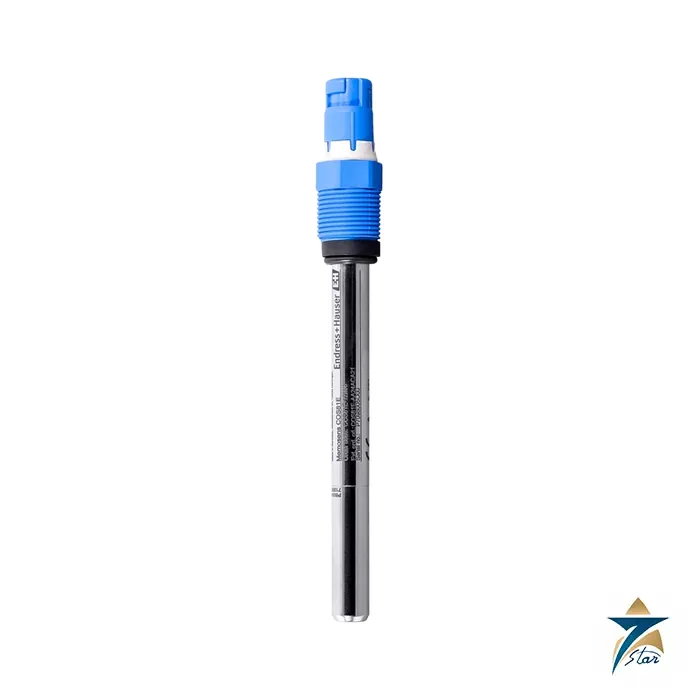
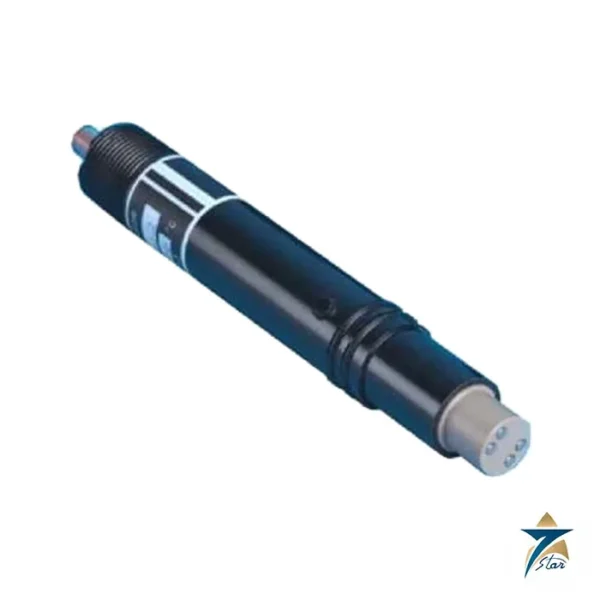
Endress+Hauser COS81E Memosens optical oxygen sensor for sterile and hygienic processes
The Endress+Hauser COS81E is a digital optical oxygen sensor based on luminescence quenching, with a stainless steel 1.4435 (AISI 316L) body and a Memosens 2.0 plug-in head. It has no electrolyte and no membrane that is consumed, and it keeps its stability through repeated steam sterilisation and autoclaving. Seven Star LLC supplies the COS81E in Oman and the GCC as an independent supplier in Muscat.
The sensor is built for oxygen control in fermenters in the pharmaceutical and biotechnology sectors, for quality control in food production, and for monitoring gaseous oxygen in explosive atmospheres at concentrations of 2 % by volume and above. Its order code includes a spot-cap shape letter: C for a c-shaped cap and U for a u-shaped cap, a spot-cap material and an installed length of 120, 160, 220, 320 or 420 mm.
The two cap shapes behave differently, in range, temperature and mounting, and the next sections explain where each fits.
COS81E technical specifications
| Parameter |
Specification |
| Manufacturer / part number |
Endress+Hauser / COS81E (Memosens 2.0) |
| Measuring principle |
Optical, luminescence quenching, Stern-Volmer evaluation |
| Measured variables |
Dissolved oxygen (mg/l, µg/l, ppm, ppb, %SAT, hPa), gaseous oxygen (hPa, %Vol), temperature |
| Range, c-shaped cap |
0.004 to 26 mg/l; 0.05 to 285 %SAT; 0.1 to 600 hPa (at 25 °C, 1013 hPa) |
| Range, u-shaped cap |
0.004 to 30 mg/l; 0.05 to 330 %SAT; 0.1 to 700 hPa (at 25 °C, 1013 hPa) |
| Maximum sensor range |
Up to 1000 hPa |
| Process temperature, normal |
c-shaped 0 to 60 °C; u-shaped 0 to 80 °C |
| Sterilisation |
Maximum 140 °C at 6 bar (87 psi), up to 45 minutes; autoclavable to 140 °C; CIP compatible |
| Process pressure |
0.02 to 13 bar (0 to 190 psi) absolute |
| Response time |
t90 below 10 s; t98 below 20 s (air to nitrogen) |
| Measurement error |
±1 % or ±8 µg/l of reading, whichever is greater, in the optimum range |
| Detection / quantification limit |
4 ppb / 10 ppb; repeatability 2 ppb |
| Wetted materials |
Shaft 1.4435 (AISI 316L); spot cap 1.4435, titanium or Hastelloy; silicone spot layer; FKM process seal; EPDM or FFKM seals |
| Surface roughness |
Ra below 0.38 µm |
| Temperature sensor |
Pt1000, Class A to DIN IEC 60751 |
| Process connection |
Pg 13.5, maximum torque 3 Nm; shaft diameter 12 mm |
| Installed lengths |
120, 160, 220, 320 or 420 mm; 120 mm version weighs about 0.1 kg |
| Degree of protection |
IP 68 (2 m water column, 21 °C, 24 h) and IP 69 |
| Ambient / storage temperature |
−5 to 100 °C / −25 to 50 °C at 95 % humidity, non-condensing |
| Ex certification (order dependent) |
ATEX II 1G Ex ia op is IIC T6 to T3 Ga and II 1D Ex ia op is IIIC T90°C to T200°C Da; CSA C/US, IECEx, NEPSI, Japan Ex, Korea Ex, INMETRO, EAC Ex, UK Ex |
| Documentation options |
Inspection certificate EN 10204 3.1, ASME BPE CoC, cGMP compliance, FDA 21 CFR, EU 1935/2004, GB 4806, surface roughness test, EHEDG certificate, CRN |
How the COS81E measures oxygen by luminescence
The sensor tip carries a thin layer that contains oxygen-sensitive marker molecules. The optics inside the sensor send orange light pulses to the layer from behind, and the markers answer with dark-red light. When there is no oxygen, the response lasts longer and is stronger. Oxygen molecules in contact with the layer shorten and weaken the response. The sensor evaluates intensity and decay time with the Stern-Volmer equation and reports partial pressure and temperature.
The raw value corresponds to the decay time, about 14 µs in air and about 56 µs in an oxygen-free medium. Because the response does not consume oxygen or electrolyte, there is no membrane to replace in the field and there is no polarisation wait as with an amperometric cell.
For correct results the transmitter should be told the actual air pressure during calibration, the humidity if it is not 100 % rh air, the salinity for high-salt media, and the operating pressure when units of %Vol or %SAT are used.
COS81E c-shaped and u-shaped spot caps
| Feature |
c-shaped (COS81E-*****C***) |
u-shaped (COS81E-*****U***) |
| Normal process temperature |
0 to 60 °C |
0 to 80 °C |
| Maximum dissolved O2 range |
26 mg/l |
30 mg/l |
| Mounting angle |
Any angle, 0 to 360°; self-draining at recommended angles, so suited to hygienic use |
0 to 180° inclination, recommended 0 to 45° or 135 to 180°; never upside-down |
| Retractable assembly |
Upside-down position possible |
Upside-down position unsuitable |
Choose the c-shaped cap for hygienic vessels and where flexible mounting matters, and the u-shaped cap where the higher temperature or range is needed and the mounting angle can be controlled.
Where the COS81E fits in the measuring system
A complete system consists of the COS81E, a Memosens cable (CYK10, CYK20 laboratory, CYK11 extension) and a transmitter such as the Liquiline CM42, CM44x/R, CM44P, Liquiline Compact CM72 or CM82, or the mobile CML18. For fermenters with an analogue controller, the Memosens analog converter CYM17 allows connection.
Assemblies in the datasheet are the Unifit CPA842 permanent installation assembly, the Cleanfit CPA875 and CPA450 retractable assemblies, the CYA680 hygienic flow assembly for CIP and SIP, the Flowfit CYA21 compact stainless flow assembly for residual oxygen in water treatment and boiler feedwater, and the Flowfit CPA240. The 220 mm length suits assemblies that need a 225 mm installation length.
The COS51E is the membrane-covered amperometric sibling for water and wastewater, while the COS81E is chosen where sterilisation, long stability and low trace ranges matter.
COS81E selection and ordering checklist
- Spot-cap shape: c-shaped or u-shaped, per temperature, range and mounting.
- Spot-cap material: 1.4435 stainless steel, titanium or Hastelloy, matched to the medium.
- Length: 120, 160, 220, 320 or 420 mm.
- Seals: EPDM or FFKM, matched to cleaning chemicals.
- Hazardous area: gas zone, dust zone or both, and the scheme required.
- Certificates: EN 10204 3.1, ASME BPE, cGMP, EHEDG or FDA documents.
- Medium compatibility: the datasheet warns that halogenated solvents, ketones and toluene falsify the signal or can disable the sensor, so these must be absent.
Installing and commissioning the COS81E
Do not hang the sensor from its cable. Fit it in a suitable assembly, tightening the Pg 13.5 thread to no more than 3 Nm. Avoid air pockets and bubbles at the spot, and clean build-up at regular intervals.
For a retractable assembly, an ascending pipe is the best position and the pipe diameter should be at least DN 80. Horizontal pipes with the sensor pointing down, and down-pipes, are not permitted. Install the u-shaped sensor so that bubbles cannot collect on the spot, as angles of 45 to 135 degrees can raise the measured value.
A zero-point gel, COY8, is offered for oxygen-free verification and adjustment.
Maintenance and spares for COS81E
The sensor stores calibration history, sterilisation count and operating hours at high temperature, so replacement can be scheduled from real data. The spot cap is a wear item. Cleaning is done with the normal CIP routine, and sensors can be checked with air and the zero-point gel. Keep a second sensor of the same length and cap type and a spare cable for critical fermenters.
Typical COS81E applications in Oman and the GCC
Regional uses include pharmaceutical and biotechnology production, dairy and beverage plants with sterilisable vessels, and utility systems where trace oxygen has to be controlled in boiler feedwater and deaerated water, using the Flowfit CYA21 compact assembly. Gas-phase oxygen monitoring in explosive atmospheres at 2 % by volume and above is another listed use, for which the Ex versions apply. The lack of electrolyte and membrane suits sites where the visits of service staff have to be kept short.
What to send with a COS81E request for quotation
- Spot-cap shape and material, installed length, and quantity
- Medium, oxygen range, temperature, pressure, and cleaning or sterilisation routine
- Hazardous-area classification
- Required certificates
- Assembly, cable and transmitter model, and delivery location
Documents and quotation
The manufacturer’s datasheet for the COS81E is attached on this page, including the temperature and pressure diagram and installation diagrams.
Send the spot-cap type, length and application details and Seven Star LLC will quote the COS81E with lead time for Oman and the GCC.
Other Models in the Eh Memosens Sensor Range
Seven Star LLC supplies models from the Eh Memosens Sensor range in Oman and the GCC. Compare the related models below and request a quote for the one that matches your application.

























Reviews
There are no reviews yet.