CCS51E Memosens free chlorine sensor and what the model code tells you
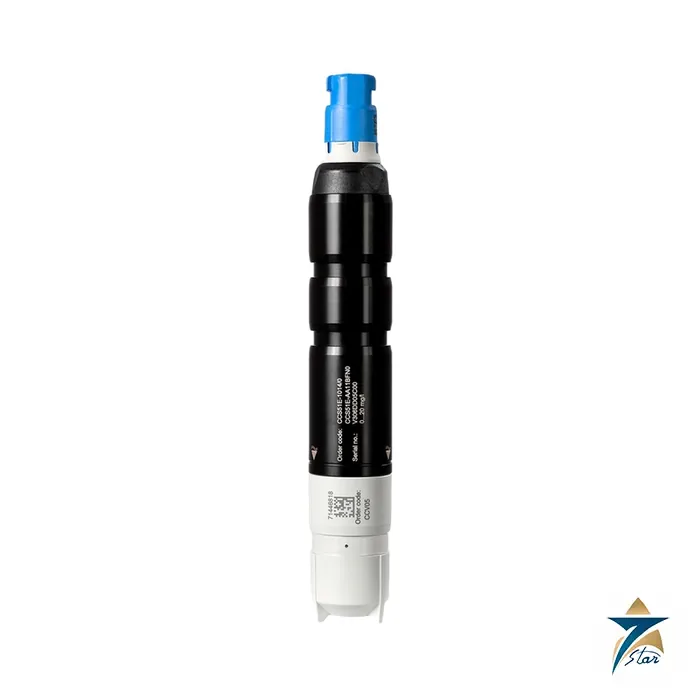
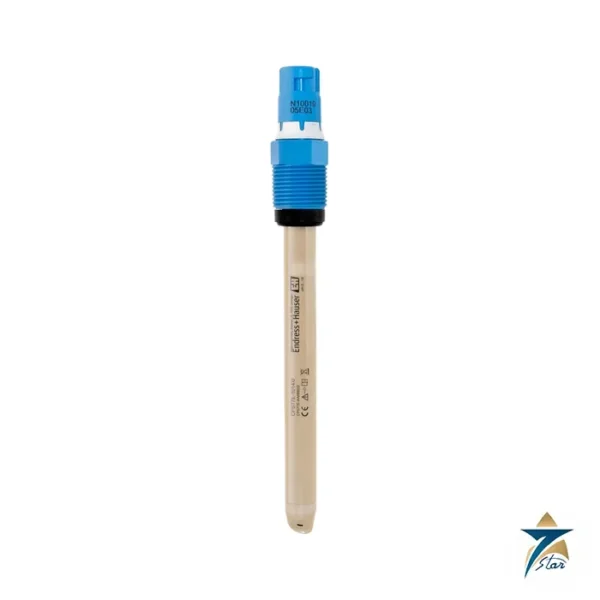
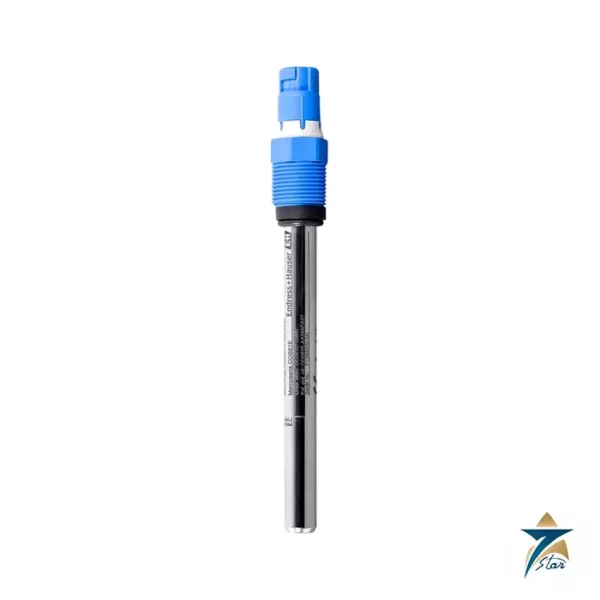
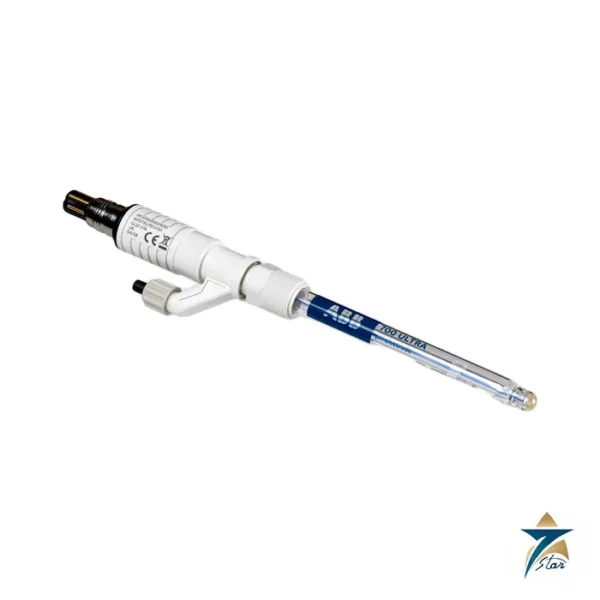
The Endress+Hauser CCS51E is a digital amperometric sensor that measures free chlorine in water. It is a membrane-covered, 25 mm cell that talks to a Liquiline transmitter through the Memosens plug-in connection, so the sensor can be pre-calibrated away from the plant and swapped in a few minutes. Seven Star LLC, an independent supplier in Muscat, supplies the CCS51E and related liquid analysis parts in Oman and the GCC.
The sensor reads free chlorine through hypochlorous acid (HOCl), which is the active disinfecting species in the water. Three measuring-range versions exist, and the manufacturer identifies them by a code segment inside the order code. In the CCS51E-**11AD** version the range is 0 to 5 mg/l (ppm) HOCl, the 11BF version covers 0 to 20 mg/l, and the 11CJ version covers 0 to 200 mg/l. The range is the main decision when you order, because the trace version, the standard version and the high version use different cell designs and give different signal currents and resolution.
| Order code segment |
Version |
Measuring range |
Signal current |
| 11AD |
Trace |
0 to 5 mg/l (ppm) HOCl |
33 to 63 nA per 1 mg/l |
| 11BF |
Standard |
0 to 20 mg/l (ppm) HOCl |
9 to 18 nA per 1 mg/l |
| 11CJ |
High |
0 to 200 mg/l (ppm) HOCl |
9 to 18 nA per 1 mg/l |
CCS51E technical specifications
| Parameter |
Specification |
| Manufacturer / part number |
Endress+Hauser CCS51E |
| Measured variables |
Free chlorine as HOCl (mg/l, µg/l, ppm, ppb) and temperature |
| Measuring principle |
Amperometric, closed two-electrode cell behind a PVDF membrane |
| Measuring range |
0 to 5, 0 to 20 or 0 to 200 mg/l (ppm) HOCl, by version |
| Response time |
T90 below 25 s after polarization is complete |
| Polarization time |
45 min at first commissioning, 20 min when recommissioning |
| Resolution (AD / BF / CJ) |
0.03 / 0.13 / 1.10 µg/l (ppb) HOCl |
| Limit of detection (AD / BF / CJ) |
0.002 / 0.002 / 0.008 mg/l (ISO 15839 basis, includes sensor and transmitter) |
| Repeatability (AD / BF / CJ) |
0.0031 / 0.0035 / 0.062 mg/l |
| Long-term drift |
Below 1 % per month under reference conditions |
| Process temperature |
0 to 55 °C (32 to 130 °F), non-freezing |
| Process pressure |
Up to 1 bar relative (14.5 psi); free outlet recommended |
| Effective pH range |
pH 4 to 9; calibration pH 4 to 8 |
| Minimum flow |
15 cm/s; 5 l/h or 30 l/h in the Flowfit CYA27 versions |
| Degree of protection |
IP68 (1.8 m water column for 7 days at 20 °C) |
| Ambient temperature |
-20 to 60 °C (-4 to 140 °F) |
| Materials |
Shaft PVC; membrane and membrane cap PVDF; sealing ring FKM; coupling PPS |
| Size and weight |
25 mm diameter, 161 mm overall length, approx. 95 g with cap and electrolyte |
| Cable length |
Max. 100 m including extension |
How the CCS51E measures free chlorine
Hypochlorous acid in the sample diffuses through the membrane and is reduced to chloride at the gold working electrode. At the silver counter electrode, silver is oxidized to silver chloride. The electron exchange produces a current that is proportional to the free chlorine concentration when conditions are constant. The Liquiline transmitter converts the nanoampere signal into mg/l or ppm.
Two practical consequences follow. First, HOCl and hypochlorite exist in a pH-dependent balance, so a pH measurement in the same flow cell is normally added to compensate the reading. Second, the sensor responds to other oxidants. The manufacturer lists cross-sensitivity to chlorine dioxide, ozone and free bromine, and no cross-sensitivity to hydrogen peroxide or peracetic acid. If a stream can contain ozone or chlorine dioxide, the CCS51E reading must be judged with that in mind.
The electrolyte inside the cell is consumed slowly. At 20 °C the manufacturer quotes about 2 years at 10 % of range, 1 year at 50 % of range, and 60 days at maximum concentration and 55 °C. Plan electrolyte and membrane-cap changes against the real concentration, not only against the calendar.
Where the CCS51E fits in a measuring system
A complete free chlorine measuring point contains the CCS51E sensor with its mounting adapter, a flow assembly such as the Flowfit CYA27 or an immersion assembly such as the Flexdip CYA112, a Memosens cable (CYK10 or CYK20, with CYK11 as extension), and a Liquiline transmitter. The manufacturer names CM44x and CM44xR transmitters with firmware 01.13.00 or higher for this sensor. An optional pH sensor such as the CPS31E can share the same assembly for pH compensation.
Other Liquiline transmitters such as the CM448 field unit, the CM442R DIN-rail unit and the single-channel CM42B are separate products; check the transmitter firmware and the sensor documentation before mixing them with the CCS51E. Adapter kits are needed to seat the CCS5x sensor in CYA27 (order no. 71372027) or CYA112 (71372026), and the PF-3 hand-held photometer (71257946) is listed for the DPD reference measurement.
Selection checklist for a CCS51E
- Concentration band: choose the 5, 20 or 200 mg/l version from the real dosing set-point and the highest peak, not from a typical value.
- Water quality: drinking water, process water, utility water and pool water are in scope. Heavily loaded water should be filtered upstream to avoid membrane fouling.
- pH window: confirm the sample stays between pH 4 and 9 and plan a pH sensor if it moves.
- Interfering oxidants: check for ozone, chlorine dioxide or free bromine in the same stream.
- Assembly: decide between a flow cell (CYA27) and an immersion assembly (CYA112) and order the matching adapter kit.
- Transmitter: verify the Liquiline model and firmware; Memosens 2.0 sensors need a compatible transmitter.
- Cable run: keep the total Memosens cable, including any extension, within 100 m.
Installing and commissioning the CCS51E
Mount the CCS51E at an angle of at least 15 degrees to the horizontal and never upside down, because the electrolyte film on the working electrode will not form correctly otherwise. The immersion depth must be at least 50 mm, matching the mark on the sensor. Keep a minimum flow of 15 cm/s and a maximum of 80 cm/s; in the CYA27 flow cell the volume flow is 5 to 30 l/h for the 5 l version and 30 to 60 l/h for the 30 l version. Back-pressure from the outlet must stay constant and not exceed 1 bar relative, and a vacuum at the sensor, for example from returning water to a pump suction, must be avoided.
Allow the polarization period before trusting any reading: 45 minutes the first time and 20 minutes after a re-start. Then calibrate against a DPD colorimetric comparison, such as one made with a hand-held photometer, and enter the reference in the transmitter. Because Memosens stores calibration data in the sensor head, a pre-calibrated CCS51E can be exchanged on site without a new wet calibration of the plant.
Maintenance and spares for the CCS51E
The delivered kit includes the sensor with protective cap, a 50 ml electrolyte bottle, a spare membrane cap and a manufacturer certificate. During service, store the sensor with electrolyte at 0 to 35 °C for up to 2 years, and avoid freezing. Without electrolyte the permitted storage range is -20 to 60 °C. Do not leave the sensor in chlorine-free water for long periods, because the response then lags when chlorine returns.
Keep a spare membrane cap and electrolyte on the shelf, and record each cap change and calibration. Memosens also logs operating hours at extreme values and high temperature, which helps decide when a preventive replacement is justified. A zero-point gel such as COY8 is listed for zero checks.
CCS51E applications in Oman and the GCC
In Oman and across the GCC, free chlorine control matters wherever desalinated or brackish source water is disinfected. Typical places for the CCS51E are post-chlorination lines in seawater reverse osmosis and thermal desalination plants, potable water storage and distribution points, cooling and utility water loops at power and petrochemical sites, hotel and resort pools, and food and beverage process water. High ambient temperatures put the sample temperature close to the 55 °C limit on hot days, so shade and short sample lines are worth planning. Dust and humidity are less of a problem for the sensor itself, which is IP68, but the transmitter location should be chosen accordingly.
CCS51E range versions compared
| Version |
Typical use |
Detection and resolution |
Remark |
| Trace (11AD) |
Final polished drinking water, low-dose control |
0.002 mg/l LOD, 0.03 µg/l resolution |
Most sensitive; high slope per mg/l |
| Standard (11BF) |
Typical potable, pool and process water |
0.002 mg/l LOD, 0.13 µg/l resolution |
Widest use across sites |
| High (11CJ) |
Shock dosing, disinfection tanks, wash water |
0.008 mg/l LOD, 1.10 µg/l resolution |
Reads up to 200 mg/l |
Information to send with a CCS51E request
- Required range version (0 to 5, 20 or 200 mg/l) and the normal operating concentration
- Sample pH range, temperature range and whether ozone, chlorine dioxide or bromine are present
- Planned assembly (CYA27 or CYA112) and available sample flow
- Existing Liquiline transmitter model and firmware, or a request to quote one
- Memosens cable length and any extension needed
- Whether spare membrane caps, electrolyte and a photometer are required
- Quantity and delivery location in Oman or the GCC
Documents and quotation
The manufacturer datasheet for the CCS51E is attached on this page, and it contains the ranges, flow limits and materials quoted above. Please confirm the order code against it before ordering.
Send the CCS51E code you need, the application and the quantity, and Seven Star LLC will reply with availability and a quotation.


























Reviews
There are no reviews yet.