
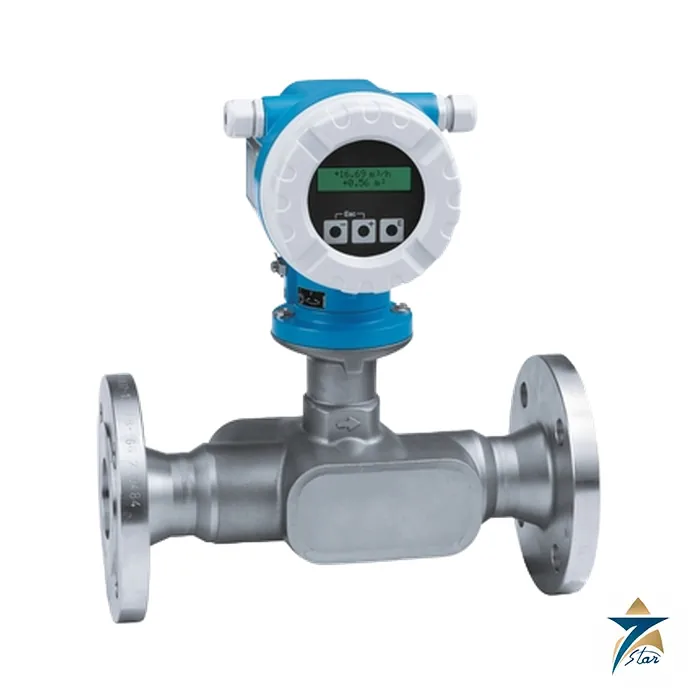
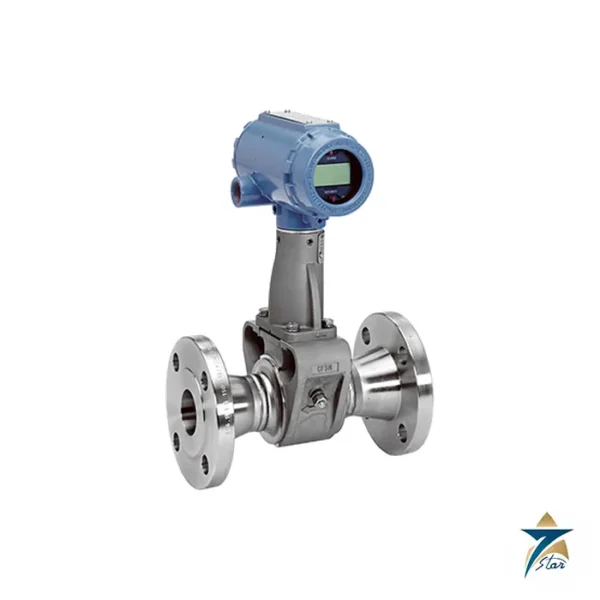
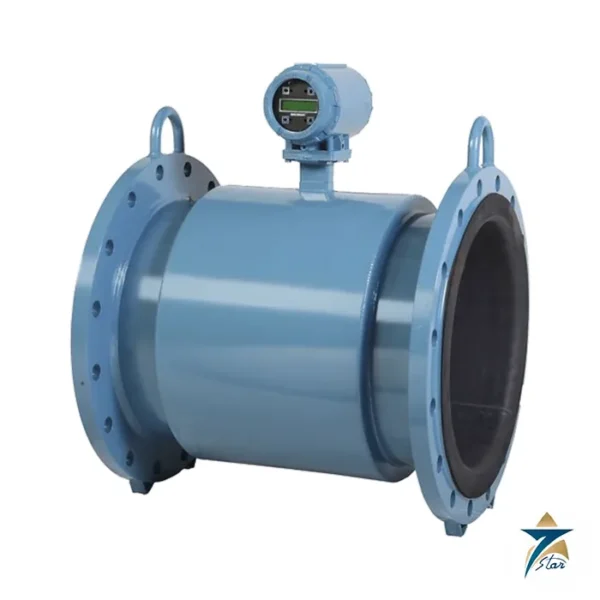
The Endress+Hauser Prosonic Flow 92F is an inline ultrasonic flowmeter engineered for the chemical and petrochemical industries, pairing a rugged full-bore sensor with the loop-powered Prosonic Flow 92 transmitter for straightforward system integration. Its ultrasonic measuring principle delivers accurate volume flow data without introducing any obstruction into the process stream, eliminating the pressure loss and wear associated with mechanical flow elements.
Working closely with plant engineers in the region, Seven Star LLC proudly supplies the Endress+Hauser Prosonic Flow 92F to process plants and industrial facilities across the Sultanate of Oman and the wider GCC, backed by genuine factory calibration, full documentation, and local technical support.
The Endress+Hauser Prosonic Flow 92F measures flow using the transit-time ultrasonic principle. A pair of ultrasonic transducers mounted on the inline sensor body send acoustic signals diagonally across the pipe, both with and against the direction of flow; the difference in transit time between the two signals is directly proportional to the average fluid velocity, from which volumetric flow is calculated.
Because the transit-time method is independent of pressure, density, temperature, conductivity, and viscosity, the Prosonic Flow 92F holds its accuracy across changing process conditions. The full-bore inline design has no moving parts and no flow obstruction, resulting in negligible pressure loss, no wear-related maintenance, and no risk of media contamination from mechanical wear debris.
The sensor body is available in nominal diameters from DN 25 to DN 300 (1 inch to 12 inch), rated to PN 40 / ASME Class 300 / JIS 20K, with wetted materials of A351-CF3M or 1.4404/TP316/TP316L for DN 25 to DN 100, and A106 Grade B for DN 150 to DN 300, covering a medium temperature range of –40°C to +150°C as standard, or up to +200°C as an option.
The Prosonic Flow 92 transmitter is loop-powered for simplified two-wire installation and features a backlit local display for on-site readouts and configuration. The flanged, full-bore inline design allows straightforward retrofitting into existing pipework without the alignment sensitivity of clamp-on sensor mounting.
The Endress+Hauser Prosonic Flow 92F is engineered for accurate, low-maintenance flow measurement, and the Endress+Hauser Prosonic Flow 92F is a proven choice across chemical and petrochemical process lines:
The Endress+Hauser Prosonic Flow 92F is specified across chemical and petrochemical process units, refineries, and general industrial process lines where an obstruction-free, low-maintenance flow measurement is required for corrosive, clean, or particulate-free liquids. Its accuracy independent of fluid properties also makes it well suited to blending and transfer applications where feedstock composition varies.
With fast quotation turnaround and technical support, Seven Star LLC supplies the Prosonic Flow 92F to industrial facilities throughout Oman and the GCC, including projects in the Sohar and Salalah economic zones, petrochemical complexes, and process plants across the region, with lead time confirmed at quotation.
Key technical parameters for the Endress+Hauser Prosonic Flow 92F are summarized below.
| Parameter | Specification |
|---|---|
| Model | Endress+Hauser Proline Prosonic Flow 92F |
| Measuring Principle | Ultrasonic (transit-time, inline) |
| Nominal Diameter | DN 25 to DN 300 (1″ to 12″) |
| Volume Flow Accuracy | ±0.5% of reading standard; ±0.3% option for DN 80 to DN 300 (0.5-10 m/s, Reynolds number above 10,000) |
| Medium Temperature | -40 °C to +150 °C standard; up to +200 °C optional |
| Max Process Pressure | PN 40 / ASME Cl. 300 / JIS 20K |
| Wetted Materials | A351-CF3M, 1.4404/TP316/TP316L (DN25–100), A106 Gr B (DN150–300) |
| Power | Loop-powered, 2-wire |
| Sensor design | Inline transit-time meter available as 2, 3 or 4 beam version; compact or remote transmitter |
| Full scale flow examples | DN 25: 0 to 300 dm³/min; DN 50: 0 to 1100 dm³/min; DN 100: 0 to 4700 dm³/min; DN 150: 0 to 10 m³/min; DN 300: 0 to 40 m³/min |
| Repeatability | ±0.2 % of reading |
| Outputs | 4-20 mA HART; optional pulse/status/frequency output (passive, galvanically isolated); PROFIBUS PA; FOUNDATION Fieldbus H1 |
| Supply voltage HART | Non-Ex 12 to 35 V DC (18 to 35 V with HART); Ex i 12 to 30 V (18 to 30 V); Ex d 15 to 35 V (21 to 35 V) |
| Supply voltage fieldbus | PA/FF: non-Ex 9 to 32 V DC, Ex i 9 to 30 V, Ex d 9 to 35 V; current consumption 16 mA |
| Fluid temperature by version | Stainless steel: -40 to +150 °C standard, -40 to +200 °C optional; carbon steel ASME: from -29 °C; carbon steel AD2000: from -10 °C |
| Nominal pressure | EN PN 16 to 40; ASME Cl. 150 and Cl. 300; JIS 10K and 20K |
| Ambient temperature | Compact -40 to +60 °C; remote sensor -40 to +80 °C |
| Degree of protection | IP67 (NEMA 4X); optional IP68 (NEMA 6P) for sensor with remote transmitter |
| Approvals | ATEX, FM, CSA, TIIS, IECEx, NEPSI; PED; NACE MR0175 and MR0103 |
| Remote version cable | Standard 10 m and 30 m; optional variable length 1 m to max. 50 m |
The Prosonic Flow 92F is a calibrated inline transit-time meter built as a 2, 3 or 4 beam sensor. Endress+Hauser states ±0.5 % of reading over 0.5 to 10 m/s for all sizes from DN 25 to DN 300, while the optional ±0.3 % calibration is offered for DN 80 to DN 300 only. Both figures require a Reynolds number above 10000, and repeatability is ±0.2 % of reading. Full scale values range from 300 dm³/min at DN 25 to 40 m³/min at DN 300.
As a loop-powered 2-wire device, the HART version needs 12 to 35 V DC at the terminals in non-Ex service, 12 to 30 V as Ex i and 15 to 35 V as Ex d, with a further 6 V required for HART communication across the minimum 250 Ω load. An optional passive, galvanically isolated output can be configured as pulse, status or frequency. PROFIBUS PA and FOUNDATION Fieldbus H1 versions draw 16 mA from a 9 to 32 V bus.
Fluid temperature limits depend on the body material. Stainless steel sensors cover -40 to +150 °C as standard and -40 to +200 °C as an option. Carbon steel sensors, offered in DN 150 to 300, start at -29 °C (ASME) or -10 °C (AD2000) and reach +130 °C as standard or +200 °C optionally. Pressure ratings run from PN 16 to PN 40, ASME Class 150 and 300, and JIS 10K and 20K.
Because entrained gas disturbs ultrasonic transit-time measurement, Endress+Hauser advises against installing the 92F at the highest point of a pipeline or directly upstream of a free outlet in a vertical down pipe; a restriction or orifice downstream keeps the sensor full in such cases. The 3 and 4 beam versions need only short straight inlet runs, between 5 and 15 nominal diameters depending on the upstream disturbance, with 3 diameters downstream. The longest value applies when several disturbances are present.
When the meter is insulated or heat-traced, the neck between sensor and transmitter must stay free: the maximum insulation thickness in the electronics area is 20 mm. The compact version is rated for -40 to +60 °C ambient, and a sun cover is recommended outdoors in hot climates. Standard protection is IP67; an IP68 sensor for permanent immersion to 3 m is available only with the remote transmitter, connected by a 10 m or 30 m cable or a custom length up to 50 m.
An inline ultrasonic meter earns its keep on corrosive or aggressive chemical duty only if the wetted material — 316L, CF3M, or a higher-alloy option — genuinely matches your process fluid, and the pressure class has to suit your actual line rating rather than a generic default. As the trusted regional supplier for Endress+Hauser, Seven Star LLC works with your process team to confirm the correct Prosonic Flow 92F material and pressure configuration before order confirmation, drawing on our experience supplying chemical and petrochemical facilities across Oman and the GCC. We also support projects retrofitting ultrasonic metering into existing pipework in Sohar and Salalah’s process complexes, coordinating delivery timelines and factory documentation so commissioning stays on schedule.
Nominal diameters from DN 25 to DN 300 (1 to 12 inch).
±0.5% of volume flow as standard, with a ±0.3% option for DN 80 to DN 300, over 0.5 to 10 m/s.
Medium temperature from -40°C to +150°C as standard (+200°C optional) and pressure ratings of PN 40, ASME Cl. 300 or JIS 20K, depending on the version.
It is a loop-powered, two-wire ultrasonic (transit-time, inline) flowmeter.
For chemical and petrochemical lines standardizing on the Endress+Hauser Prosonic Flow 92F, Seven Star LLC is ready to support your project with a formal RFQ, technical datasheet, and delivery timeline. Our instrumentation engineers provide technical support with selection across Oman and the GCC, with lead time confirmed at quotation. With engineering support in Muscat, contact our instrumentation division today to configure the right Prosonic Flow 92F variant for your process, complete with manufacturer documentation.
Choose the option that best fits your needs to get the fastest response from our team.
Automatically fill the RFQ form with this product's details for a faster process.
Manually enter multiple part numbers, specific brands, or custom requirements.










Reviews
There are no reviews yet.