Honeywell E3Point toxic and combustible gas detector for commercial buildings
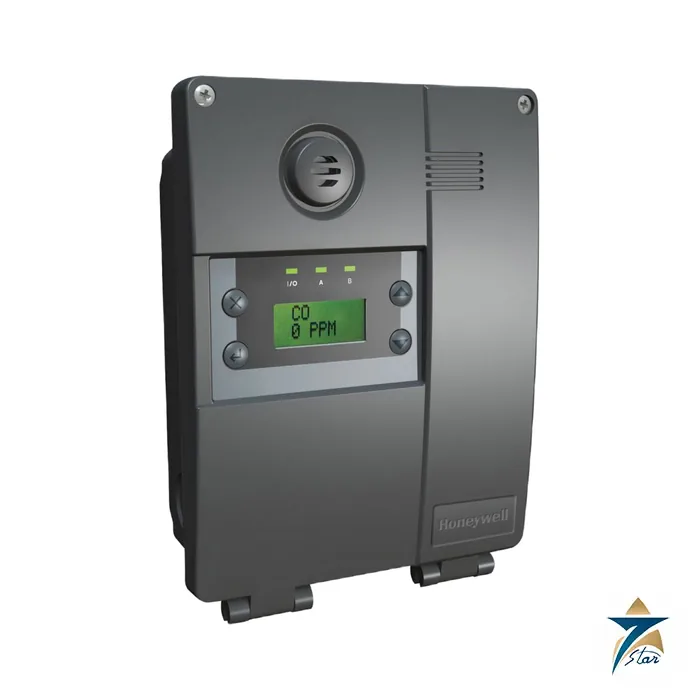
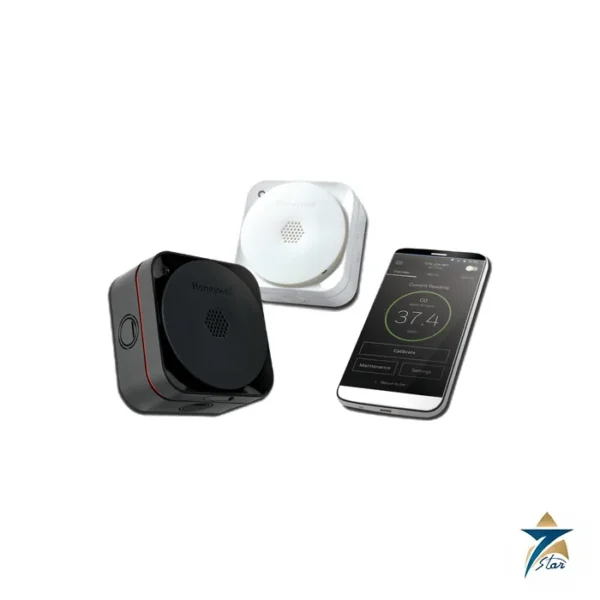
The Honeywell E3Point is a wall or duct-mounted gas detector that combines the sensor, transmitter, display, relay and sounder in one polycarbonate housing. It is built for commercial and light-industrial safe areas such as car parks, boiler rooms, battery charging rooms and loading docks, and it detects toxic, oxygen and combustible gas depending on the cartridge fitted. The attached datasheet describes the network version, which talks BACnet MS/TP or Modbus over RS485.
Seven Star LLC supplies the E3Point in Oman and the GCC as an independent supplier in Muscat. The sections below separate what the network datasheet states from the choices you still have to make when ordering.
E3Point network version: what the datasheet covers
E3Point is offered as a standalone unit, as a standalone unit with a remote sensor (dual gas mode) and as a network unit. The datasheet in this page is the Network Platform sheet, so the digital communications, power values and gas table apply to that version. The manufacturer also states that the unit can be used with the 301C24 controller to build a system that meets California Title 24 requirements, and that a 301C can log data and daisy-chain up to 96 E3Point units.
E3Point technical specifications
| Parameter |
Specification |
| Manufacturer / part number |
Honeywell / E3Point (network platform) |
| Typical use |
Wall or duct-mounted network detector for toxic, oxygen and combustible gases |
| Size (H x W x D) |
20.56 x 14.90 x 6.72 cm (8.09 x 5.87 x 2.65 in) |
| Power |
24 VAC nominal (17 to 27 VAC), 50/60 Hz, 0.35 A; or 24 VDC nominal (20 to 38 VDC) |
| Relay output |
1 DPDT relay, 5 A at 250 VAC; 5 A at 30 VDC (network datasheet) |
| Communications |
RS485 Modbus; BACnet MS/TP master |
| Operating environment |
Commercial, indoor, safe area |
| Display |
8-character, 2-line backlit LCD |
| Visual indicators |
Green LED power; two amber LEDs for alarm/fault |
| Audible alarm |
Above 85 dBA at 3 m (10 ft) |
| Response time |
T90 below 50 s; with ECLAB T90 below 240 s |
| Accuracy |
±3% of full scale at 25 °C; CO only: 5% of reading at 150 ppm and 25 °C; long-term drift below 5% per year |
| Enclosure |
Polycarbonate |
| Safety standard |
UL 61010-1, CSA C22.2 No. 61010-1, IEC 61010-1:2010 (certified by Intertek) |
Gases, ranges and default alarm levels
The network datasheet lists seven gases. Each cartridge covers one gas, and the default alarm levels shown are those printed in the datasheet.
| Gas |
Resolution |
Range |
Alarm A |
Alarm B |
Alarm C |
| Gas |
Resolution |
Range |
Alarm A |
Alarm B |
Alarm C |
| CO |
1 ppm |
0-250 ppm |
25 ppm |
100 ppm |
225 ppm |
| H2S |
0.1 ppm |
0-50 ppm |
10 ppm |
15 ppm |
20 ppm |
| NO2 |
0.1 ppm |
0-10 ppm |
0.7 ppm |
2 ppm |
9 ppm |
| O2 |
0.1% vol. |
0-25% vol. |
19.5% vol. |
22% vol. |
22.5% vol. |
| H2 |
0.5% LEL |
0-100% LEL |
25% LEL |
50% LEL |
90% LEL |
| CH4 |
0.5% LEL |
0-100% LEL |
25% LEL |
50% LEL |
90% LEL |
| C3H8 |
0.5% LEL |
0-100% LEL |
25% LEL |
50% LEL |
90% LEL |
Operating temperature depends on the gas. The datasheet gives -40 to 50 °C (-40 to 122 °F) for H2S, NO2, O2, CH4, H2 and C3H8, and -20 to 50 °C (-4 to 122 °F) for CO.
How the E3Point senses and reports
For toxic gases and oxygen the detector uses advanced electrochemical cells, and for combustible gases it uses a catalytic bead sensor. The manufacturer mentions patented Reflex and smart cartridge technology, which means the sensing cartridge carries its own calibration information and can be swapped without rebuilding the unit. Gas concentration, sensor condition and fault data reach a building automation system over the digital link, which improves diagnostics and allows central logging.
Locally, the LCD shows the reading, the LEDs indicate power and alarm state, and the built-in sounder gives an audible warning. The relay can start a fan or an external alarm, and the network connection allows a building controller to apply demand-controlled ventilation, an energy-saving strategy the manufacturer highlights for car parks.
Where E3Point fits and related Honeywell detectors
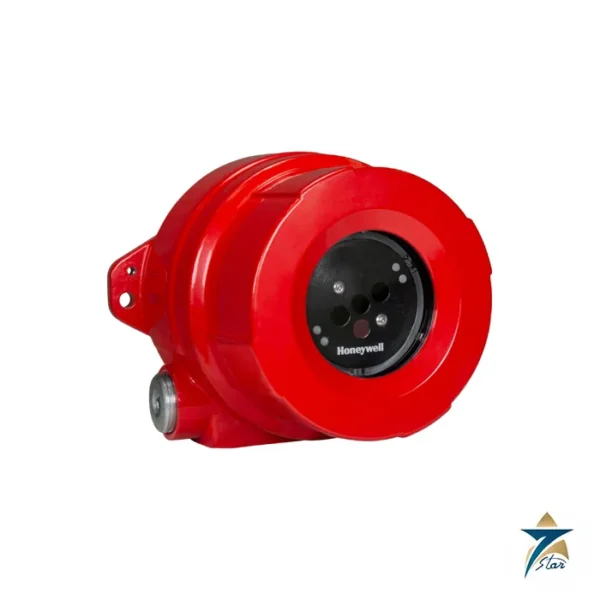
The E3Point is a commercial product; it is rated for indoor safe areas and is not described as an explosion-proof or hazardous-area transmitter. For classified locations in oil, gas and power plants, a series such as the RAEGuard 3 or a sensor like the 705 is the more usual choice. Refrigerant and ammonia rooms are better served by the Manning AirScan IR-F9 and EC-FX-NH3, and paint booth fire protection by the FS10 flame detector.
E3Point selection and ordering checklist
- Target gas from the seven listed: CO, H2S, NO2, O2, H2, CH4 or C3H8.
- Platform: standalone, standalone with remote sensor, or network (BACnet MS/TP or Modbus).
- Supply type available at site, 24 VAC or 24 VDC, and cabling length.
- Mounting position: wall or duct, and the height suited to the gas density.
- Alarm levels: default values or custom setpoints agreed with the site safety officer.
- Controller or panel the unit will report to and the protocol it understands.
- Relay duty needed, for example fan start or alarm tie-in.
Installation, commissioning and maintenance of E3Point
Mount the E3Point where gas is expected to collect or where air from the occupied space reaches it, away from direct draughts, fans and sources of steam or aerosols that could affect the cartridge. Wire power and the RS485 line using shielded twisted pair, set the network address and protocol, then verify that the controller sees the unit before applying gas.
Commissioning includes a bump test with the correct gas for the installed cartridge and a check of the relay and sounder. Because the cartridge is a consumable, plan a calibration and replacement schedule and keep a spare cartridge for each gas used. The manufacturer notes long-term drift below 5% per year for CO, which is a useful figure when setting calibration intervals.
Typical applications in Oman and the GCC
Datasheet-listed uses include battery charging rooms, boiler rooms, commercial kitchens, hospital and ambulance bays, loading docks, car parks and transport terminals. In Oman and the Gulf these correspond to underground and multi-storey parking, hotel and mall plant rooms, hospital boiler houses, airport and port terminals and labour accommodation kitchens. Because the housing is polycarbonate and designed for indoor safe areas, the unit should be installed inside air-conditioned or sheltered spaces rather than outdoors in direct sun, dust and heat.
Information to send with an RFQ
- Gas to be detected and number of detection points.
- Standalone, remote-sensor or network version.
- Protocol: BACnet MS/TP or Modbus RS485.
- Power supply, 24 VAC or 24 VDC.
- Duct or wall mounting and any accessories or controller needed.
- Delivery location and project timeline.
Documents and quotation
A datasheet for the E3Point network platform is attached on this page. It lists the sensors, ranges, power, communications and alarm levels summarised above.
Send the gas, version and quantity and we will confirm the exact configuration and available documents before quoting. Seven Star LLC is an independent supplier and not the manufacturer.



























Reviews
There are no reviews yet.