Honeywell Unipoint DIN-rail gas controller: what it is
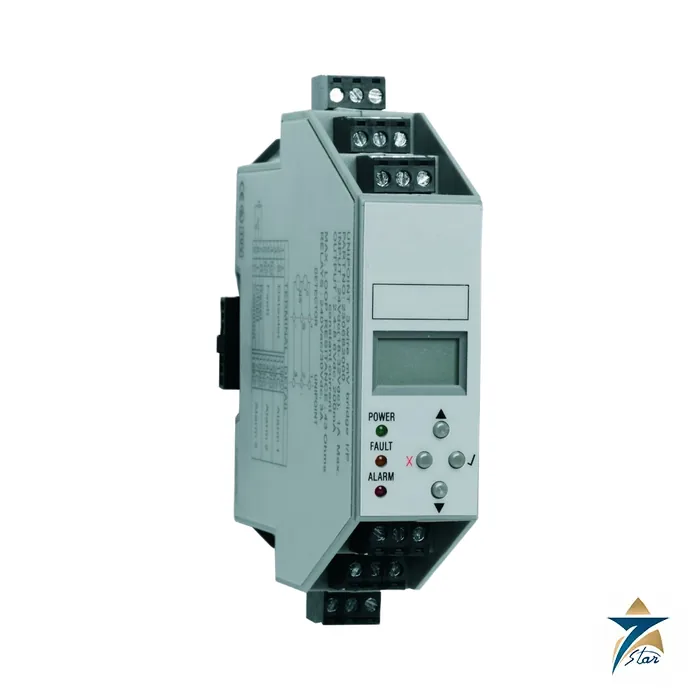
The Honeywell Unipoint is a compact gas detection controller built for TS35 (top-hat) DIN rail. It gives a panel builder or system integrator a low-cost way to bring a flammable, toxic or oxygen detector into a control cabinet, with a backlit display, built-in audible and visual alarms, three programmable alarm relays and a dedicated fault relay. Seven Star LLC, an independent supplier in Muscat, supplies the Unipoint in Oman and the GCC.
Two Unipoint versions exist, and the difference is the detector input. The mV version, part number 2306B2000, reads a 3-wire mV bridge (catalytic bead) flammable gas sensor. The mA version, part number 2306B1000, reads any 2-wire or 3-wire 4-20 mA gas detector. Choosing the wrong version is the most common ordering mistake, so the Unipoint part number must always follow the detector type.
The controller is not itself approved for hazardous areas. It is intended to sit in a suitable plastic or metal enclosure, which can be a hazardous-area enclosure, and the rated environment is indoor use (IP3x) inside that enclosure.
Unipoint part numbers and versions
| Part number |
Description |
| 2306B2000 |
Unipoint controller, mV input version, for 3-wire mV bridge flammable detectors |
| 2306B1000 |
Unipoint controller, mA input version, for 2-wire or 3-wire 4-20 mA detectors |
| 2306B3010 |
Unipoint terminal block plug (supplied as a pack of two) |
| 2306B3020 |
Unipoint DIN rail socket kit |
| 2306B3030 |
Unipoint power connector kit |
The datasheet pairs the controller with detector families: Signalpoint and Sensepoint flammable detectors (3-wire mV) need the mV controller, Signalpoint and Sensepoint toxic and oxygen detectors (2-wire mA) need the mA controller, and Sensepoint Plus and Sensepoint Pro detectors (3-wire mA source output) also need the mA controller. Each Unipoint is supplied with its DIN rail socket, a power connector, gas type stickers and the instruction manual.
Unipoint technical specifications
| Parameter |
Specification |
| Manufacturer / part number |
Honeywell (Honeywell Analytics) / Unipoint; 2306B2000 (mV) and 2306B1000 (mA) |
| Mounting |
TS35 DIN rail, via the supplied socket; units clip together |
| Supply |
Nominal 24 VDC (18 to 32 VDC) |
| Maximum power |
mV version 4.8 W including detector power; mA version 3.0 W excluding power to a 3-wire detector |
| Inputs |
3-wire mV bridge; 2-wire 4-20 mA loop powered; 3-wire 4-20 mA source output |
| Relay outputs |
Three alarm relays plus one fault relay, each SPCO, 3 A, 240 VAC / 28 VDC (non-inductive load) |
| Alarm relay options |
Latching or non-latching, energised or de-energised, trip point, rising or falling, on/off delay 0 to 900 s |
| Default alarm points |
Alarm 1 at 10% FSD, Alarm 2 at 25% FSD, Alarm 3 at 50% FSD (latching) |
| Local indication |
Backlit LCD, power (green), fault (amber) and alarm (red) LEDs, built-in audible alarm 63 dB at 0.3 m |
| Remote inputs |
Accept, reset and inhibit (field inhibit input on mA versions) |
| Terminals |
Plug-in screw terminals, up to 1.5 mm² (16 AWG) |
| Operating temperature |
-10 °C to +40 °C |
| Operating humidity |
10 to 90% RH, non-condensing |
| Operating pressure |
90 to 110 kPa |
| Storage |
-25 °C to +60 °C, 20 to 80% RH non-condensing |
| Ingress protection |
IP3x, indoor, to BS EN 60529 (install in a suitable enclosure) |
| Weight |
225 g (controller only) |
| Standards listed |
EN 50270 (EMC), EN 61010 and UL 61010b (electrical safety), CE, TUV |
The ATEX measuring-function entry in the datasheet refers to EN 61779; read the current documentation before quoting approvals for a specific project.
How the Unipoint 2306B controller works
Each controller powers its detector, reads the signal, scales it into a gas reading and compares it against three alarm set points. For the mV version the controller supplies a constant current of 200 mA at 2.4 to 8.6 V to the bridge, with a maximum cable loop resistance of 28 ohm. For the mA versions the detector supply is the controller input voltage less about 1.5 V, limited to 30 mA for a 2-wire loop and 0.5 A for a 3-wire source output, with a 33 ohm sense resistor.
Scale, units and calibration are user programmable from four menu buttons, and the menus can be password protected. Two operating pushbuttons handle normal alarm reset and a self-diagnostic test. The fault relay is normally energised, so it drops out on a detector fault or on loss of power, which gives a fail-safe indication to the host system.
Wiring limits and power planning for Unipoint
The power rail that joins adjacent sockets limits how many controllers can share one supply. The datasheet allows up to eight controllers on one rail for 3-wire mV and for 2-wire mA detectors, and up to four for 3-wire mA detectors. Wiring several rails in parallel lets a larger system be built.
| mV and mA load case |
Controller power |
| 3-wire mV, normal, zero cable resistance |
2.4 W |
| 3-wire mV, normal, 28 ohm loop |
3.6 W |
| 3-wire mV, all alarms, 28 ohm loop |
4.8 W |
| mA, normal operation (2-wire loop current included) |
1.8 W |
| mA, all alarms |
3.0 W |
Size the 24 VDC supply from the worst case, not from normal running, and remember that the 3-wire mA figures exclude the detector’s own power.
Selection checklist for the Unipoint
- Confirm the detector output: mV bridge, 2-wire 4-20 mA or 3-wire 4-20 mA, then choose 2306B2000 or 2306B1000.
- Count the channels. One Unipoint serves one detector, so a four-detector room needs four controllers.
- Decide which relay behaviour the plant needs: latching or not, energised or de-energised, and any delay.
- Check the supply budget against the rail limits above.
- Plan the enclosure, its ingress protection and, where required, its hazardous-area rating.
- Order the spares you want to keep: terminal plugs, socket kit and power connector kit.
Installation, commissioning and maintenance
Fit the DIN rail socket first, wire the removable terminal plugs on the bench, and then clip the controller in. Because the terminals unplug, one controller can be replaced without disturbing its neighbours or the field wiring. Set the gas label, units and range, calibrate against the detector’s span gas, check each alarm relay, and test the fault relay by disconnecting the detector.
Routine care is light: check the display and LEDs, run the self-test, bump test the detector according to site procedure and keep the enclosure free of dust. Spare terminal plugs are a sensible stock item for panels that are serviced often.
Applications in Oman and the GCC
The datasheet lists small and medium integrated systems, control cabinets, unmanned equipment rooms, boiler houses, HVAC systems, analyser houses, car parks, crane cabs and laboratories. In Oman and the GCC the same pattern appears in analyser shelters at oil and gas sites, boiler and compressor rooms at power and desalination plants, and car-park ventilation in commercial buildings. High ambient temperatures matter here: the controller itself is rated to +40 °C, so panels in direct sun or unventilated shelters need shading or cooling, and dust-tight enclosures are advisable.
Information to send with an RFQ for Unipoint
- Detector make, model and output type (mV, 2-wire mA or 3-wire mA).
- Quantity of controllers and any spare terminal plugs, socket kits or power connector kits.
- Supply voltage available and the enclosure type planned.
- Required relay behaviour for the three alarms and the fault output.
- Project location, delivery timing and any documentation needs.
Documents and quotation
A datasheet for the Unipoint is attached on this page. It includes the ordering table and the electrical limits summarised above.
Send the Unipoint part number (2306B2000 or 2306B1000), the detector type and the quantity to Seven Star LLC and we will prepare a quotation for Oman and the GCC.






















Reviews
There are no reviews yet.