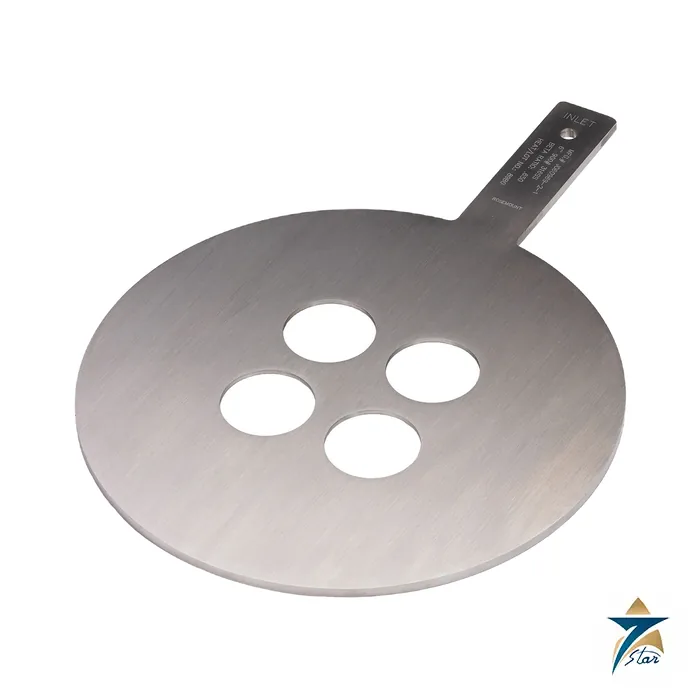
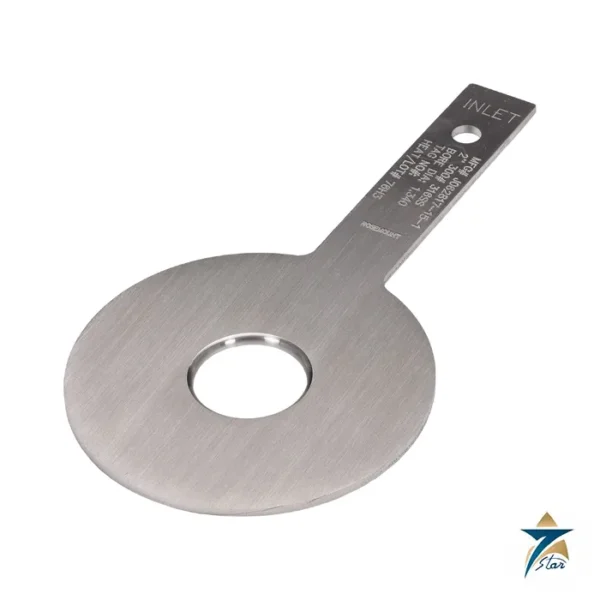
Rosemount 1595 conditioning orifice plate for short straight runs
The Rosemount 1595 combines a flow conditioner and an orifice plate in one element. Instead of one centre bore it has a four-hole pattern that straightens the profile and reduces swirl, so it needs only two pipe diameters of straight run upstream and two downstream from most disturbances. Seven Star LLC supplies the Rosemount 1595 in Oman and the GCC as an independent supplier in Muscat, for projects where space or piping layout makes a conventional orifice run impractical.
The four-hole 1595 is available in line sizes from 2 to 24 in. (50 to 600 mm), in paddle (P) or universal (U) plate types, for gas, liquid and steam. It is a primary element only, and is read by a differential pressure transmitter.
Rosemount 1595 technical specifications
| Parameter |
Specification |
| Manufacturer / part number |
Rosemount (Emerson) / 1595 |
| Element type |
Conditioning orifice plate, four-hole design |
| Plate types |
P paddle, square edged; U universal, square edged (up to 12 in. line size; for plate holders in RTJ flanges or orifice fittings) |
| Line sizes |
2, 3, 4, 6, 8, 10, 12, 14, 16, 18, 20 and 24 in. (50 to 600 mm) |
| Flange ratings |
ASME B16.5 Class 150 RF; ASME B16.36 Class 300, 600, 900, 1500, 2500 RF; EN 1092-1 PN10 to PN100 (plate type P, to 12 in.); RTJ Class 300 to 2500 (plate type U, to 12 in.) |
| Materials |
316/316L SST, Alloy C-276, Alloy 400 |
| Thickness |
0.125 in. up to 0.500 in., depending on line size and plate type |
| Beta ratios |
0.20, 0.40, 0.50, 0.65 (0.60 for 2 in. line size) |
| Flow service |
Liquid, gas or steam, turbulent flow, pipe Reynolds number above 5,000 |
| Straight run |
2D upstream and 2D downstream from most disturbances (reference manual installation) |
| Pressure taps |
Flange taps for all betas; radius taps (D and D/2) for beta 0.4 or smaller |
| Temperature, 316/316L |
–430 to 1200 °F (–257 to 649 °C) |
| Temperature, Alloy 400 |
–325 to 900 °F (–198 to 482 °C) |
| Temperature, Alloy C-276 |
–325 to 1250 °F (–198 to 677 °C) |
Source: manufacturer DP flow product data sheet, March 2025 edition. Temperature ratings follow ASME B31.3 as stated in the data sheet.
How the Rosemount 1595 works
The four holes shape the flow as it crosses the plate, so the velocity profile is conditioned and the discharge coefficient stays stable even when the upstream pipe has elbows, valves or reducers close by. The differential pressure is still developed across the plate in the usual way, and the transmitter is configured for a square-root relationship to flow.
The 1595 does not need impulse-line changes, special flanges or major piping modifications, and can be direct-mounted. Self-centering features help keep the plate on the pipe axis, which supports the ISO 5167 centering requirement. The pressure taps should be placed between any two of the four holes, and at 90° to the plane of the last upstream elbow when there are fewer than six pipe diameters upstream or when a 0.65 beta is used.
Accuracy of the 1595 and the calibration option
The data sheet gives discharge coefficient uncertainty at 95 percent confidence by beta range. For installation per the reference manual with short runs, a calibrated plate (option WD, a ten-point discharge coefficient verification) is stated at ±0.50 percent for beta 0.20 to 0.35, ±0.75 percent for 0.40 to 0.55 and ±1.25 percent for 0.60 to 0.70. Without calibration, 2 to 4 in. pipes are given as ±1.50, ±1.50 and ±1.75 percent for the same beta ranges. A separate table covers installation per ISO 5167. For beta of 0.65 or higher with low Reynolds number, an extra 0.5 percent is added.
Rosemount 1595 in the DP flow family
The 1595 is used with the Rosemount 1496 flange union and a differential pressure transmitter, for example from the 3051 series. When the pipe has plenty of straight length, the Rosemount 1495 conventional orifice plate may be simpler and cheaper; when space is tight, the 1595 can avoid re-routing pipe. The Rosemount 485 Annubar and 405 compact element are alternatives for different line sizes and pressure-loss limits.
Selection checklist for a Rosemount 1595
- Line size between 2 and 24 in., and the pipe schedule.
- Plate type: paddle (P) for flange pairs, universal (U) with plate holder for RTJ, limited to 12 in.
- Flange rating and facing, noting that Class 150 B16.5 is not compatible with standard B16.36 orifice flanges.
- Material: 316/316L, Alloy C-276 or Alloy 400, matched to the fluid.
- Beta ratio from the sizing calculation; a sizing run is required before ordering.
- Whether discharge coefficient verification (WD), PMI, material traceability or NACE MR0175 certificate is needed.
- The upstream disturbance type and how many diameters of straight run really exist.
Installation and maintenance
Install the plate so it is centred, with the inlet side facing upstream, and orient the taps as described above. After commissioning, verify transmitter zero and check that impulse lines are free of blockage. The four-hole pattern is less sensitive to small amounts of deposit than a single bore, but dirty or erosive fluids still call for periodic inspection at shutdown. Keep a record of the line size, beta and bore so a replacement can be ordered correctly.
Typical applications in Oman and the GCC
Compact skids, retrofit work on congested process units and offshore or plant-pipe racks are the usual cases where a short-run element helps. Fuel gas headers, steam lines, cooling-water and process-liquid lines in oil and gas, power generation, desalination and petrochemical plants are typical. Stainless steel suits most utility and hydrocarbon duties, while Alloy 400 and Alloy C-276 are chosen for seawater-related or corrosive services. Heat, dust and humidity mainly affect the transmitter side, so enclosure and impulse-line protection should be planned together with the plate.
Information to send with an RFQ
- Fluid and composition; flow range with units and base conditions.
- Operating and design pressure and temperature.
- Line size, schedule or inner diameter, and the arrangement of upstream fittings.
- Flange standard, class and facing.
- Plate type, material and any certificates (WD, PMI, Q8, NACE).
- Quantity and delivery requirement.
Documents and quotation
The Rosemount DP flow product data sheet covering the 1595 is attached on this page, including model code tables and the uncertainty tables referred to above.
To request a quotation for the Rosemount 1595, send the process data and line details listed above and we will confirm availability and lead time.
Other Models in the Rosemount Dp Orifice Range
Seven Star LLC supplies models from the Rosemount Dp Orifice range in Oman and the GCC. Compare the related models below and request a quote for the one that matches your application.




















Reviews
There are no reviews yet.