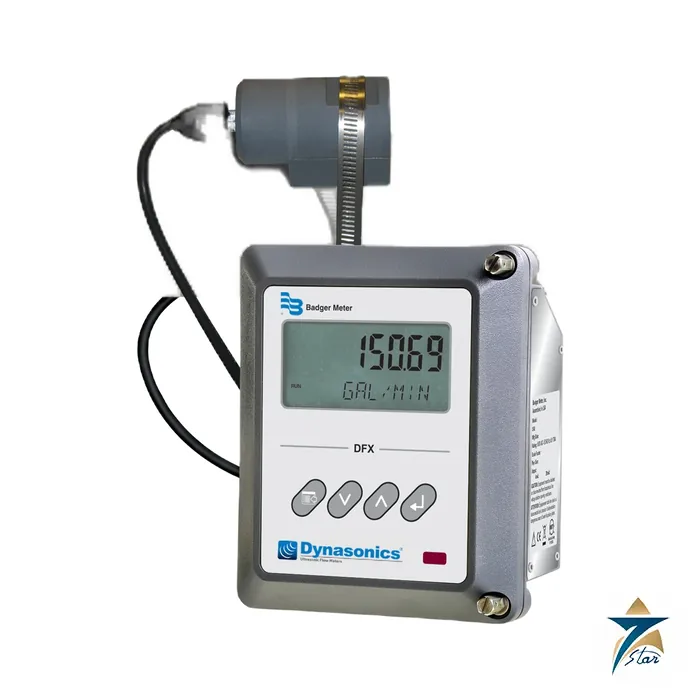
Badger Meter Dynasonics DFX clamp-on Doppler ultrasonic flow meter for dirty and aerated liquids
The Badger Meter Dynasonics DFX is a clamp-on Doppler ultrasonic flow meter for liquids that contain suspended particles or air bubbles, such as sewage, sludge, mud slurries and process water with solids. Its DT9 series transducers strap to the outside of the pipe, so there is no cutting, no flanged spool piece and no process shutdown. It complements the transit-time meters of the same Dynasonics family, which need clean liquid. Seven Star LLC supplies the DFX in Oman and the GCC as an independent supplier in Muscat, and this page explains how Doppler measurement works, what the data sheet specifies and what to check before ordering.
How the DFX measures flow
The transmitting transducer sends ultrasonic sound at 625 kHz through the pipe wall into the liquid. Particles or bubbles in the liquid reflect the sound, and the receiving transducer picks up the echo. If the reflectors are moving, the echo frequency is shifted by the Doppler effect, and the difference between the transmitted and received frequency is directly proportional to the reflector speed, from which the meter calculates flow. The meter therefore needs something in the liquid to reflect the sound; the data sheet states a minimum of 100 ppm of useful sonic reflectors larger than 35 microns, with at least 25 percent of the particle volume larger than 100 microns. Dissolved solids do not reflect sound and do not count.
Technical specifications of the DFX
| Parameter |
Specification |
| Manufacturer / part number |
Badger Meter / Dynasonics DFX |
| Measuring principle |
Doppler ultrasonic, compression-mode transducers at 625 kHz |
| Velocity range |
0.15 … 30 ft/s |
| Accuracy |
±2 % of full scale over the calibrated span |
| Liquid requirement |
Minimum 100 ppm useful sonic reflectors above 35 micron; at least 25 % of particle volume above 100 micron |
| Pipe sizes |
Standard transducers: 1 in (25 mm) and larger; small-pipe transducers: 0.25 … 1 in (6 … 25 mm) |
| Transducer rating |
Type 6 (IP67), -40 … +90 °C; CPVC, Ultem, nylon, PVC cable jacket; aluminium for small pipe |
| Cable lengths |
20, 50 and 100 ft (6.1, 15, 30 m), 78 Ω twinax; optional flexible armored conduit |
| Monitor enclosure |
NEMA 4X (IP66); 178 x 146 x 99 mm |
| Power supply |
100/115/230 V AC 50/60 Hz, 17 VA max; or 12 … 28 V DC, 7 VA max |
| Display |
2 lines x 8 characters, LED backlight; 8-digit rate and resettable 8-digit total |
| Analog output |
4…20 mA, 800 Ω max, 12-bit |
| Relays |
Dual optically isolated Form C, 200 V AC at 0.5 A resistive; rate alarm, totalizer pulse, error |
| Rate pulse |
500 mV AC or open collector, to 2,500 Hz |
| Response time |
6 … 60 s, user selectable |
| Ambient conditions |
-40 … +85 °C; 0…95 % RH non-condensing |
| Approvals |
General safety US and Canada: UL 61010-1 and CSA C22.2 No. 61010-1 |
| Multiple meters |
Up to four meters interconnected up to 30 m apart for a single pipe or manifold |
Application constraints given by the manufacturer
- Enough reflectors: clean water with no particles or bubbles will not give a Doppler signal; use a transit-time meter instead.
- Good acoustic coupling: the transducer is coupled to the outside of the pipe with grease or RTV couplant, and the pipe wall must pass ultrasound without heavy attenuation. Most solid, homogeneous pipes qualify, while concrete pressure pipe, wood stave pipe, Teflon-lined pipe and fibreglass-reinforced pipe are listed as difficult.
- Full pipe: the meter assumes the pipe is completely full when it calculates flow, so partial filling gives inaccurate readings.
Installation benefits and limits
The manufacturer states that the DFX can be installed and operational within minutes on a full, active pipe, with no need to break into the line and no moving parts to wear. This saves flanges, fittings, strainers and filters. The automatic gain control and in-field linearisation help adapt to varied applications. Accuracy of ±2 percent of full scale is typical of clamp-on Doppler technology and is not comparable to a magnetic flow meter, so a DFX is chosen for convenience, for monitoring and for liquids where an in-line meter is not practical, rather than for custody transfer. The standard transducers are Standard Temperature (up to 90 °C), so very hot lines are outside the range.
Selection and ordering checklist for the DFX
- Pipe outside diameter, wall thickness and material, plus liner and scale condition.
- Liquid solids or bubble content: confirm at least 100 ppm of reflectors in the stated size range.
- Transducer set: standard (DT94) or small pipe (DT95), and cable length.
- Power supply: AC mains or 12…28 V DC.
- Outputs: 4…20 mA, relays or rate pulse into the control system.
- Mounting: wall or panel mount of the monitor.
- Whether several meters will share one pipe or manifold.
Commissioning notes
Enter the pipe data and the units, choose the response time, clean the pipe surface, apply the couplant and fix the transducers with the mounting brackets. Because the Doppler signal depends on particles, readings should be checked against a known flow, a tank fill test or another meter after installation, and the calibrated span adjusted accordingly. A flow profile disturbed by bends, valves or pumps close to the transducer can affect the reading, so allow straight pipe where practicable. Inspect the couplant at intervals, because dry couplant is a common cause of lost signal.
Typical applications in Oman and the GCC
The DFX suits sewage and sludge lines at treatment plants, return activated sludge and mixed liquor lines, mud and slurry lines, dredging and tailings lines, produced water with solids and cooling water with particles. Clamp-on installation is an advantage where lines run through existing plant and shutdowns are costly, and the wide ambient range of -40 to +85 °C is helpful in hot outdoor installations.
Information to send with an RFQ for the DFX
- Pipe size, material and wall thickness
- Liquid, solids content and temperature
- Transducer type and cable length
- Power supply and outputs
- Quantity and delivery site
Documents and quotation
The Badger Meter DFX product data sheet is attached on this page. It includes the specification table and the transducer options.
Send the pipe and liquid data and Seven Star LLC will confirm availability and prepare a quotation.
Other Models in the Badger Dynasonics Range
Seven Star LLC supplies models from the Badger Dynasonics range in Oman and the GCC. Compare the related models below and request a quote for the one that matches your application.



















Reviews
There are no reviews yet.