
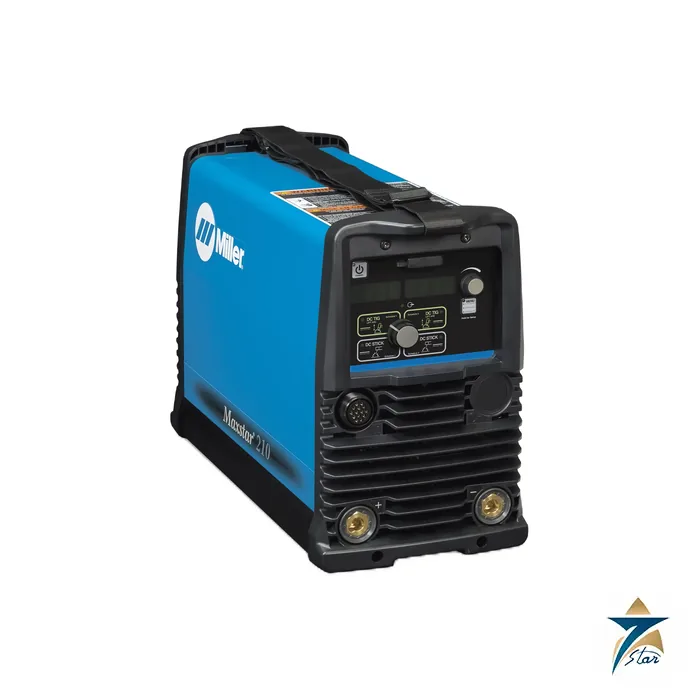
The Miller Maxstar 210 STR is a compact, portable inverter for DC stick (SMAW) and DC TIG (GTAW) welding with Lift-Arc starting. It is the stick-focused model of the Miller Maxstar 210 Series, delivering a 10–210 A welding range and a rated output of 210 A at 18.4 V at 60% duty cycle in TIG mode, in a case that weighs only 16.3 kg (36 lb). Auto-Line circuitry accepts any input voltage from 120 to 480 V, single- or three-phase, so the Miller Maxstar 210 STR can be carried from a workshop outlet to a site generator without relinking. The attached Miller spec sheet covers the whole Maxstar 210 Series; this page describes the STR model specifically.
Seven Star LLC supplies the Miller Maxstar 210 STR to maintenance departments, shutdown contractors and fabrication shops across Oman and the GCC. Its light weight and stick-plus-TIG capability make it a natural tool for repair crews at oil fields, gas plants, power stations and water facilities from Muscat to Salalah, where welders often carry the machine to the job.
As a general principle, an inverter welding power source converts incoming AC mains to DC, switches it at high frequency through power transistors, reduces it through a small high-frequency transformer and rectifies it back to a controlled DC welding output. The high switching frequency is what allows a 210 A welder to weigh a fraction of a traditional transformer machine, and it gives fast, precise control of the arc. In stick welding the machine operates in constant-current mode, holding the selected amperage while the welder controls arc length by hand.
The Miller Maxstar 210 STR uses this fast control for several stick functions. DIG control changes the arc characteristics for specific electrodes: a lower setting for smooth-running electrodes such as E7018 and a higher setting for stiffer, more penetrating electrodes such as E6010. Hot Start adaptive control gives positive arc starts without sticking, and Stick-Stuck detects when the electrode is stuck to the part and turns the output off so it can be removed safely. In TIG mode, Lift-Arc starts the arc by touching and lifting the tungsten, with no high frequency that could disturb nearby electronics.
The Miller Maxstar 210 STR case measures about 346 mm high, 219 mm wide and 495 mm deep and comes with an adjustable shoulder strap, an 8 ft power cord and two 50 mm Dinse-style connectors. The front panel carries a voltmeter and ammeter display, an output contactor indicator, an encoder control, a menu button, a process selector and four process schedules: DC TIG Lift-Arc schedules 1 and 2 and DC stick schedules 1 and 2. Dual schedules let operators switch parameters for different electrodes or passes without readjusting the machine, minimising downtime and helping quality.
Wind Tunnel Technology protects internal electrical components from airborne contaminants, and Fan-On-Demand cooling operates only when needed, reducing noise, energy use and the amount of dust pulled through the machine. A front-panel memory card port allows software updates. The user and tech menus provide remote trigger settings, arc time and cycle counters, an error log, Stick-Stuck on/off, low or normal open-circuit voltage, and meter calibration for certification. The case is IP23 rated for outdoor use when sheltered from precipitation.
Input current is modest, which matters when the Miller Maxstar 210 STR is plugged into temporary site power panels. According to the spec sheet, at rated TIG output the machine draws about 7 A per phase on 400 V three-phase supply and about 12 A on 400 V single-phase supply, while stick output at rated load draws about 8 A on three-phase and 13 A on single-phase at the same voltage. These figures help electricians size breakers and extension leads correctly before the job starts.
Features of the Miller Maxstar 210 STR drawn from the manufacturer spec sheet include:
Miller lists precision fabrication, petrochemical, aerospace, food and beverage, dairy and shipboard work as industries for the Maxstar 210 Series. In Oman the Miller Maxstar 210 STR fits pipe support repairs, small-bore piping, structural maintenance, pump base and skid modifications, and general plant upkeep where a welder needs stick capability for carbon steel and TIG for small stainless jobs. It runs from generators of 9 kW or more, which makes it suitable for remote wellsite and pipeline maintenance work.
The Miller Maxstar 210 STR pairs naturally with the stick electrodes and filler metals that Seven Star LLC supplies, and with heavier equipment in our range such as the ESAB Rebel EMP 285ic multi-process welder and the Lincoln Electric Power Wave S500. Our team can quote the STR together with the matching No. 2 stick cable set, an A-150V TIG torch and an argon flow gauge regulator. More options are available in our stick (MMA) welding machines category.
The Miller Maxstar 210 STR data below comes from Miller spec sheet DC/32.1 for the Maxstar 210 Series (subject to change without notice).
| Parameter | Specification |
|---|---|
| Model | Miller Maxstar 210 STR (stock 907682) |
| Processes | DC stick (SMAW), DC TIG with Lift-Arc (GTAW) |
| Input power | Auto-Line 120–480 V, 1- or 3-phase, 50/60 Hz |
| Welding range (STR) | 10–210 A |
| Rated output, TIG (208–480 V) | 210 A at 18.4 V, 60%; 175 A, 100% |
| Rated output, stick (208–480 V) | 160 A at 26.4 V, 60%; 210 A, 30%; 125 A, 100% |
| Output on 120 V | TIG up to 150 A; stick up to 100 A |
| Max. open-circuit voltage | 80 VDC (11 VDC low OCV sense voltage) |
| DC TIG thickness range (STR) | 0.6–6.4 mm (0.025–1/4 in.) |
| Max. stick electrode | E6010 4.8 mm; E7018 and E7024 4.0 mm |
| Generator requirement | 9 kW |
| Enclosure / operating temperature | IP23; -10 to 40 °C |
| Dimensions (H × W × D) | 346 × 219 × 495 mm |
| Net weight | 16.3 kg (36 lb) |
| Standards | CSA certified; CE models conform to applicable parts of IEC 60974 |
To order the Miller Maxstar 210 STR, send Seven Star LLC an RFQ with the quantity, your typical electrodes and whether you need the stick cable set, TIG torch and regulator. Download the Maxstar 210 Series spec sheet attached to this page and contact our Muscat team for current availability and engineering support across Oman and the GCC.
Choose the option that best fits your needs to get the fastest response from our team.
Automatically fill the RFQ form with this product's details for a faster process.
Manually enter multiple part numbers, specific brands, or custom requirements.
Reviews
There are no reviews yet.