A portable AC/DC TIG power source that also sticks and runs wire
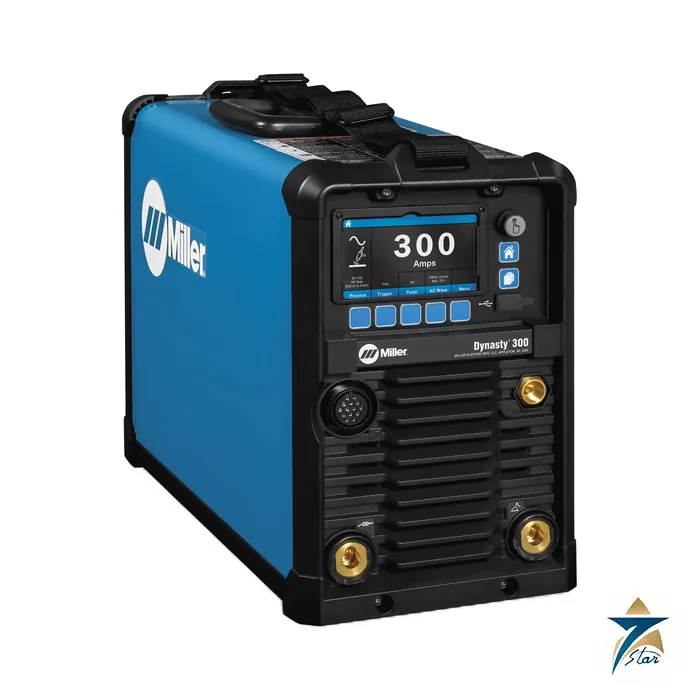
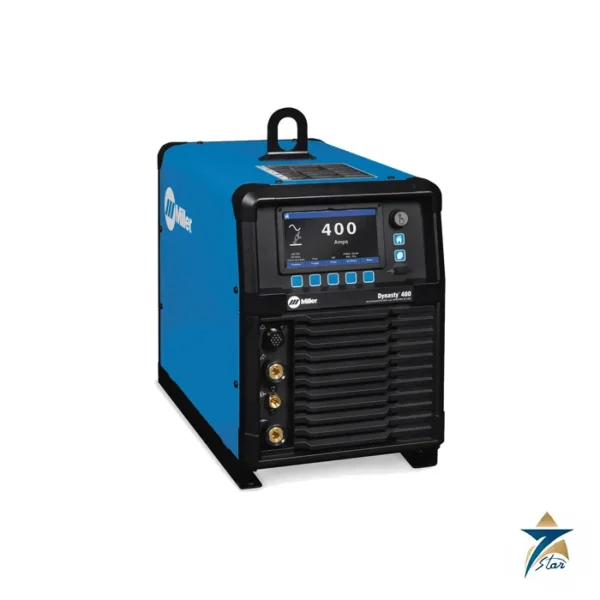
The Miller Dynasty 300 Multiprocess is an inverter power source that welds AC and DC TIG, pulsed TIG, stick, air carbon arc gouging, and MIG or flux-cored when paired with a voltage-sensing wire feeder such as the ArcReach SuitCase. It delivers 1 to 300 A DC and 2 to 300 A AC, with a rated output of 250 A at 20 V and 60% duty cycle, in a 55 lb (25 kg) case. That combination is aimed at shipbuilding, rental fleets, pipe and tube fabrication, aluminum and stainless work, maintenance and repair.
Auto-Line accepts any input from 208 to 600 V, single or three phase, with no manual linking, which is useful on dirty or unreliable power and for moving between shop and site. Miller notes the low power draw can allow other equipment on the same circuit. An IP23 rating means it is designed for outdoor use but should be sheltered from precipitation while operating.
Technical specifications
| Parameter |
Specification |
| Processes |
AC/DC TIG (GTAW), pulsed TIG, stick (SMAW), air carbon arc (CAC-A); MIG (GMAW) and flux-cored (FCAW) with a voltage-sensing feeder |
| Input power |
208-600 V, 3-phase or 1-phase, 50/60 Hz, Auto-Line |
| Amperage range |
TIG 1-300 A DC, 2-300 A AC; stick 5-300 A; MIG/flux-cored 5-300 A |
| Voltage range |
14-28 V (DC) |
| Rated output, 60% duty cycle |
TIG 250 A at 20 V; stick 250 A at 30 V (3-phase), 200 A at 27.2 V (1-phase); MIG 250 A at 26.5 V (3-phase), 200 A at 24 V (1-phase) |
| TIG input current, 3-phase at 208/230/400/460/600 V |
19 / 17 / 10 / 8 / 7 A; 7.5 kVA, 6.6 kW |
| TIG input current, 1-phase at 208/230/400/460/600 V |
33 / 30 / 17 / 15 / 11 A; 6.7 kVA, 6.7 kW |
| Maximum open-circuit voltage |
60 VDC (30 VDC sense voltage for low-OCV stick and Lift-Arc TIG) |
| AC TIG controls |
Balance (ball 30-99% EN), frequency 20-400 Hz, advanced square, soft square, sine and triangular waveforms, independent EN and EP amperage 2-300 A |
| Pulse |
0.1-500 pps, peak time 5-95%, background 5-95%; square, sine or triangular DC waveshape; QuietPulse |
| Sequencer |
Initial, final amps and slopes 0.0-50.0 s, weld time to 999 s, preflow 0-25 s, postflow auto/off-50 s; programs 1-99 |
| Dimensions (H x W x D) |
13.88 x 8.5 x 21.88 in. (352 x 216 x 555 mm) |
| Net weight |
55 lb (25 kg) |
| Environment |
IP23; operating -10 to 40 C; storage -30 to 65 C |
| Generator requirement |
12.5 kW for the performance rows quoted by Miller |
| Warranty printed |
Power source three years, parts and labor |
Process capability and the MIG option
For TIG Miller lists a material thickness range of 0.012 to 3/8 in. (0.3 to 9.5 mm) on AC and 0.004 to 3/8 in. (0.1 to 9.5 mm) on DC. Stick performance is stated up to 6010 at 1/4 in., 7018 at 7/32 in. and 7024 at 3/16 in., with air carbon arc gouging to 3/16 in. For MIG the voltage range is 14 to 29 V and wire speed 50 to 780 ipm with the feeder, using solid wire .023 to .052 in. and flux-cored .030 to .052 in.
Stick features include adjustable DIG, Hot Start adaptive control and Stick-Stuck detection. The color LCD display has soft keys, a home button, a program button and a USB port; trigger options cover foot, finger and pushbutton remotes, and the sequencer supports 2T, 3T, 4T, 4TE, 4TL and 4TM.
Matching the Dynasty 300 to the work and the power supply
Start with the material mix. Shops that weld mostly aluminium need the AC TIG controls, and the ability to change balance, frequency and waveform is what separates this machine from a basic DC TIG unit. If the work is mainly stainless and carbon steel tube with occasional stick repairs, the DC side and the pulse controls will do most of the work. Wire welding should only drive the choice if a voltage-sensing feeder is part of the plan.
- Confirm the site supply: single phase limits stick and MIG output compared with three phase, as the rated output rows show.
- Decide between air-cooled and water-cooled torches based on how long the arc runs at high current, not only on the maximum amperage.
- Choose the remote type that suits the welding position; a foot control on a bench, a finger or pushbutton remote on pipe and structural work.
- If an engine-driven generator will feed the machine on site, check its capacity against the generator requirement quoted by Miller.
Setting up and first use
Place the power source where cooling air can reach the front and rear louvres freely and where grinding sparks or dust are not drawn straight into it. Connect the work clamp close to the joint on clean metal, and check that the gas hose, regulator and torch fittings are tight before opening the cylinder. For TIG, confirm the tungsten type and preparation suit AC or DC work before striking the arc.
Use the programme memory to store proven settings for each recurring job, for example one for thin aluminium sheet, one for stainless tube root passes and one for stick repairs. This keeps settings consistent between welders and shifts. When changing from TIG to stick, lower the hot start and DIG to the values the electrode needs and confirm the polarity selection on the panel rather than relying on the previous process.
Maintenance and troubleshooting
- Arc wanders or is hard to start: check the tungsten tip, gas flow and work clamp connection before changing parameters.
- Porosity in aluminium welds: review base-metal cleaning, gas coverage and AC balance setting.
- Machine shuts down on thermal protection: clear the airflow path and check the duty being demanded against the rated duty cycle.
- Torch overheating on water-cooled set-ups: check coolant level and flow, and inspect hoses for kinks.
Blow out the interior with dry, clean compressed air at regular intervals with the power disconnected, and inspect cables, connectors and the torch for damaged insulation.
Welding in Oman and the GCC: heat, dust and salt
Fabrication yards, shipyards and plant shutdowns in Oman expose welding equipment to high afternoon temperatures, blowing sand and, along the coast, salty air. The IP23 rating allows outdoor use, but the machine should still be sheltered from direct sun and rain, and raised off the ground away from wind-blown sand. In peak summer, ambient air near the top of the stated operating range will shorten the time the machine can weld before resting, so plan the heaviest work for cooler hours where possible.
Internal dust build-up is the main enemy of inverter welders on desert sites, so shorten the cleaning interval when the machine works outdoors. In shipyard and coastal service, wipe down the case, check the work and electrode connectors for corrosion, and store the unit indoors between jobs. Auto-Line helps on variable site power, but long extension leads still need cables of adequate size to avoid voltage drop.
Ordering, packages and what to confirm before ordering
Stock numbers printed by Miller: Dynasty 300 Multiprocess 907819 (CE version 907819002); TIGRunner water-cooled version 907819001 (CE 907819003) with Coolmate 1.3, Small Runner cart and coolant; the air-cooled contractor package with wired foot control and an ArcReach SuitCase 12 as 951000099; and the water-cooled complete package with wireless foot control, W-280 torch kit and SuitCase 12 as 951000100. Torch kits listed are W-250 300185, W-280 300990 and W-375 301268, with remote controls such as wireless foot 301580 and RFCS-14 HD foot 301589.
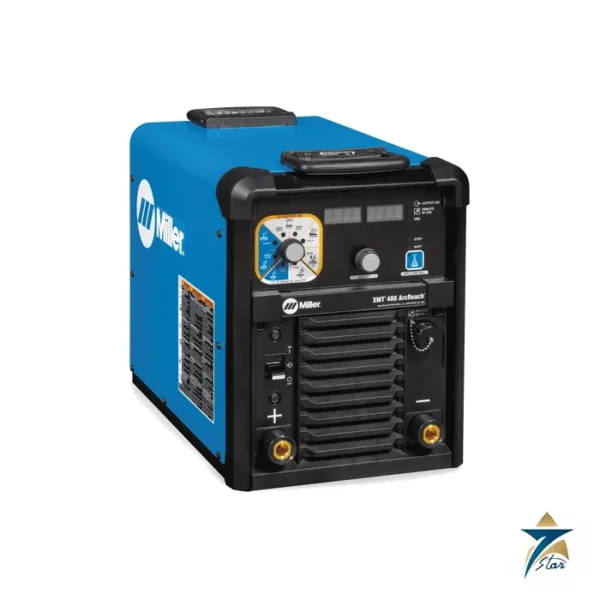
Confirm the CE or non-CE version for the local supply and plug, whether the job is air or water cooled, the torch and remote, and if wire welding is needed because the SuitCase feeder is a separate item. Compare with the Miller XMT 400 ArcReach for heavier CC/CV work, or browse all Multi-Process Welding Machines.
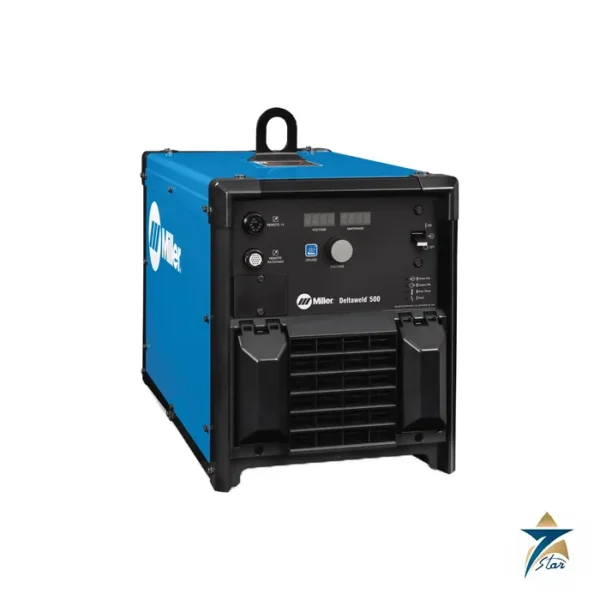
See also: Miller Deltaweld 500 Industrial MIG Welding Power Source; Miller XMT 650 CC/CV Multiprocess Welding Power Source.

Reviews
There are no reviews yet.