Midas S2 compact extractive gas transmitter
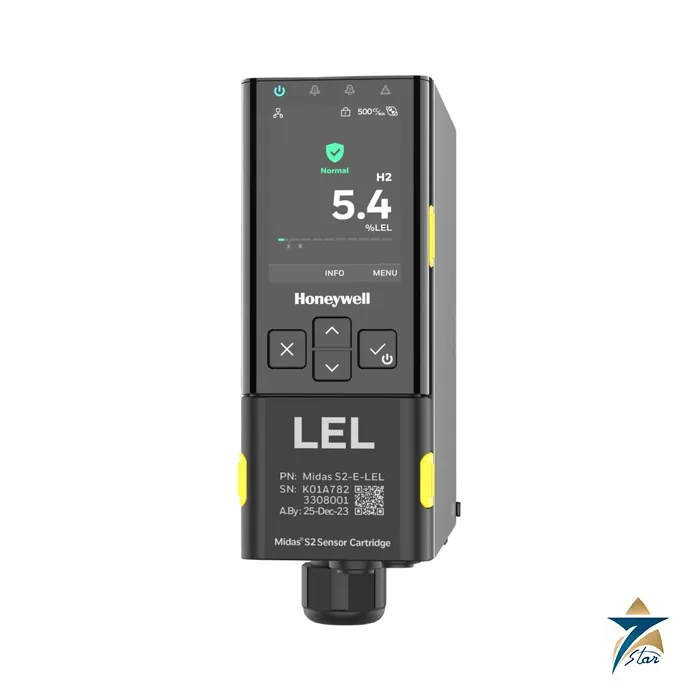
The Honeywell Midas S2 is a fixed, single-point gas transmitter that draws air through a sample line to a plug-in sensor cartridge. It is aimed at semiconductor fabrication, light manufacturing and university or national laboratories, where several toxic, flammable or oxygen points have to be watched in crowded plant rooms. Seven Star LLC supplies this unit and its cartridges in Oman and the GCC as an independent supplier in Muscat.
Compared with a conventional sample-draw monitor, the S2 puts the pump, the cartridge and the display on the front, so a technician can swap the consumable parts without pulling the wiring or the unit from the wall.
What you get with the S2
- A 2.4 in IPS colour display (16.7 million colours, viewing angle 160 degrees or more) with status icons, monitoring point name and location, and alarm messages.
- Plug-and-play installation in a compact housing of 5.46 in high, 2.17 in wide and 5.83 in deep.
- A single sensor cartridge with an on-board electronic calibration certificate, factory calibrated to reduce routine gas testing.
- Power over Ethernet: one connection can carry power, control and communication.
- Password-protected menus to keep configuration under control.
- A block test routine that checks the sample-line connection and tests for leaks.
Midas S2 technical specifications
| Parameter |
Specification |
| Manufacturer / part number |
Honeywell / Midas S2 (sensor cartridges ordered separately, for example MIDAS S2-I-CH3F) |
| Type |
Fixed, extractive single-point gas transmitter for toxic, flammable and oxygen cartridges |
| Flow rate |
500 mL/min |
| Sample line |
30 m maximum; tubing 0.125 in ID x 0.25 in OD; transport time 25 seconds |
| Exhaust line |
30 m maximum; tubing 0.188 in ID x 0.25 in OD |
| Pump |
Extractive pump system with 2-year lifetime; sampling up to 100 ft |
| Display / keys |
2.4 in IPS colour TFT; 4-button keypad; power, alarm and fault LEDs |
| Analog output |
4 to 20 mA, sink or source |
| Relay outputs |
Alarm 1, Alarm 2 and Fault, Form C, rated 1.0 A at 30 VDC or 0.5 A at 125 VAC maximum |
| Digital communication |
Modbus, TCP Ethernet and Power over Ethernet (PoE) |
| Wiring |
2-wire 14 AWG maximum for the analog loop; CAT5 or equivalent with RJ45 for digital |
| Enclosure rating |
NEMA 4 |
| Sensor cartridge life expectancy |
24 months (general figure); the infrared CH3F cartridge lists 5 years |
| Storage temperature |
+41 to +77 °F (5 to 25 °C) |
| Standards listed |
CSA C22.2 No. 61010-1; EN 50270:2015 (EMC, CE); EN 61010-1; IEC 61010-1; UL 61010-1; RoHS EU 2015/863 |
| Ambient port |
In-line air filter required |
How the S2 samples and alarms
The pump pulls a continuous 500 mL/min sample from the measuring point, through the in-line filter and sample tubing, across the cartridge and out through the exhaust line. The cartridge converts the gas concentration into a reading; the transmitter compares it with the alarm points, drives the front LEDs and the screen, and switches the Alarm 1, Alarm 2 and Fault relays. Fault and event conditions are also reported on the 4 to 20 mA output and through the digital connection.
Cartridge technology depends on the gas. Honeywell describes the family as electrochemical, and its infrared methyl fluoride (CH3F) cartridge MIDAS S2-I-CH3F gives a useful example of what a cartridge sheet contains: a 0 to 500 ppm range, default alarms at 150 and 200 ppm, 10 ppm resolution, accuracy of ±20 % of the measured value, a typical response time (t62.5) of 20 seconds, an operating window of 15 to 35 °C and 0 to 90 % RH non-condensing, and a warm-up of under 10 minutes. Always calibrate with the target gas rather than with cross-sensitivity factors.
Midas S2 compared with the original Midas
| Item |
Midas S2 |
Midas |
| Display |
2.4 in IPS colour TFT |
LCD with multicolour backlight and icons |
| Sample / exhaust length |
30 m |
100 ft (30 m) with FEP tubing |
| Transport time |
25 seconds |
2 to 30 seconds maximum |
| Enclosure rating listed |
NEMA 4 |
Not stated in the specification sheet |
| Power |
Power over Ethernet |
24 VDC or 48 VDC via PoE |
| Cartridge numbering |
MIDAS S2-x-xxx format |
MIDAS-E-xxx format |
Check this table before ordering: the two models use different cartridge codes, so a cartridge for one should not be assumed to fit the other.
Midas S2 selection and ordering checklist
- Target gas, range and alarm levels, then the matching S2 cartridge part number.
- Sample-line length and the location of the in-line filter.
- Output needs: Form C relays, 4 to 20 mA loop, Modbus, TCP Ethernet or PoE.
- Any gas-specific accessory noted on the cartridge sheet.
- Spare cartridge and pump parts to hold in stock for the service interval.
- Delivery to Muscat or another GCC site, with quantity.
Midas S2 installation and maintenance
Mount the transmitter in a position where the display can be read and the front panel can be opened for cartridge and pump service. Run the sample and exhaust lines without kinks and fit the in-line air filter at the sampling point. Connect the 4 to 20 mA loop with 2-wire cable and the digital connection with CAT5. Once powered, run the block test to confirm the sample line is tight, check the zero in clean air, and apply the calibration gas listed on the cartridge sheet.
Plan the replacement of sensor cartridges against their listed life, keep cartridges stored within the +5 to +25 °C window, and keep a spare pump assembly because the extractive pump has a stated 2-year lifetime. Use the event history and the password-protected menus to keep a service record.
Typical applications for Midas S2 in Oman and the GCC
In the Gulf, the S2 fits electronics and semiconductor support work, research laboratories, specialist gas rooms, water treatment and light manufacturing, where a small footprint and remote sampling are more useful than a bulky stand-alone sensor head. Hot, dusty air makes filter care important, and the unit should sit in a conditioned room within the temperature limits on the cartridge sheet.
Midas S2 information to send with an RFQ
- Gas name, measuring range and cartridge part number
- Number of points and sample-line length
- Output and network requirements
- Spare cartridges or pump parts needed
- Site conditions, quantity and delivery location
Documents and quotation
Please send the cartridge part number and your gas list, and we will confirm which Honeywell documents are available for that configuration.
We then quote the transmitter and cartridges for delivery in Oman and the GCC.




















Reviews
There are no reviews yet.