- Automation & ControlView all 2,765 products
- Automation Accessories
- AC Drives
- PLC & I/O Cards
- Industrial Communications
- Vibration Monitoring
- Controllers & Data Acquisition
- Isolator & Barrier
- Safety Switches & Guard Locking
- Motor Soft Starters
- CCTV & Security
- Encoders
- HMI Displays
- Pneumatic Cylinders
- Servo Drives
- Industrial Computers
- Machine Vision
- Automation Software
- Robotics
Brand: JUMO
JUMO 902190/20-388 Bayonet Pt100 Probe, Ceramic Tip, 6 mm
Description
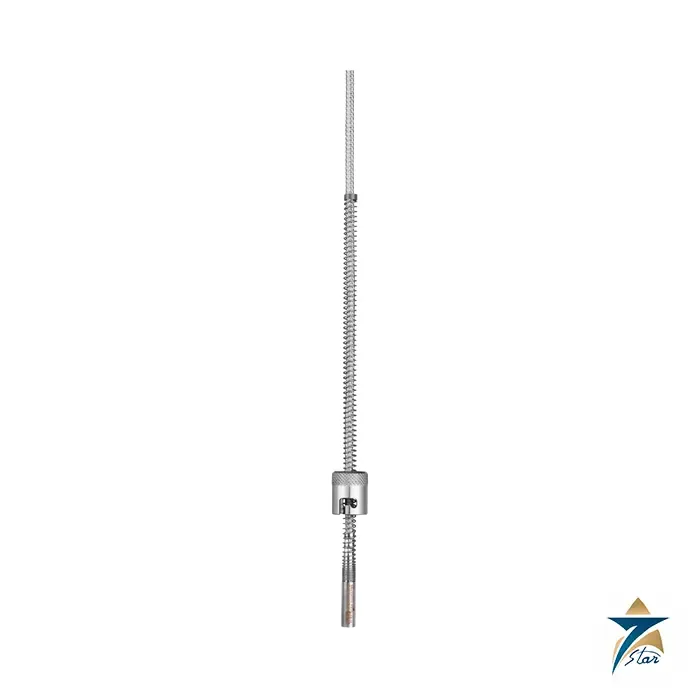
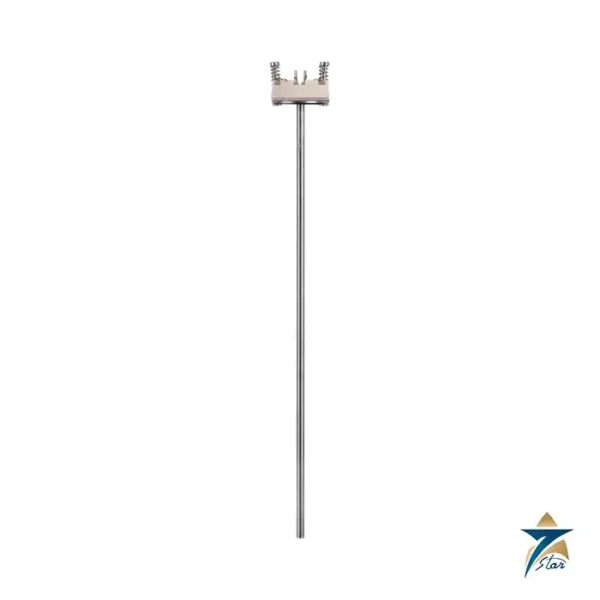
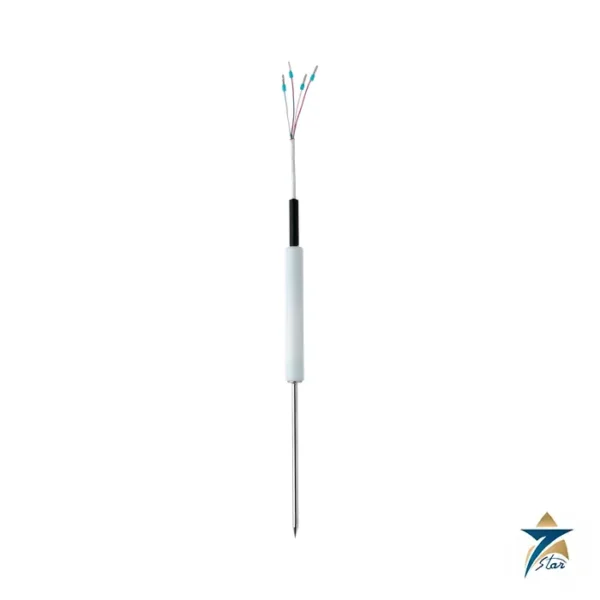
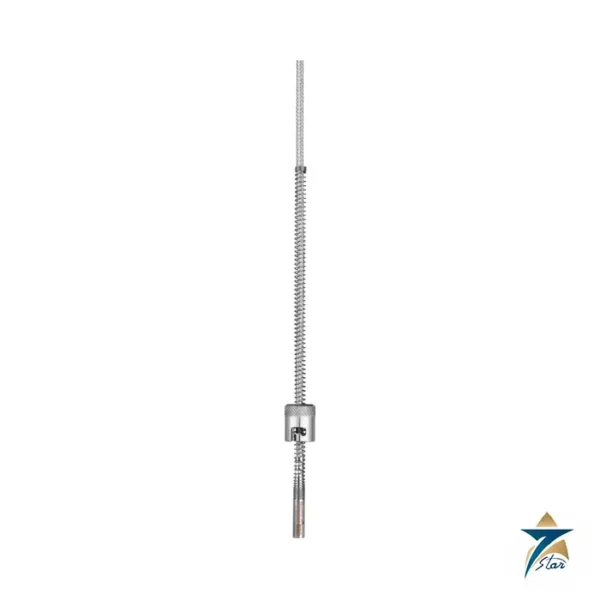
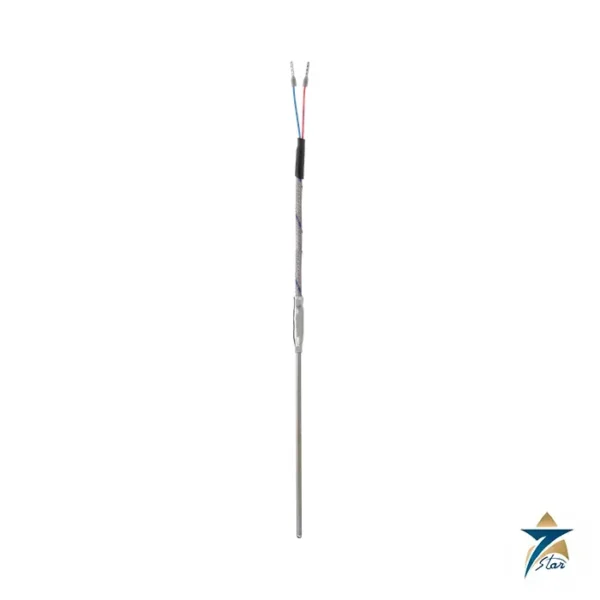
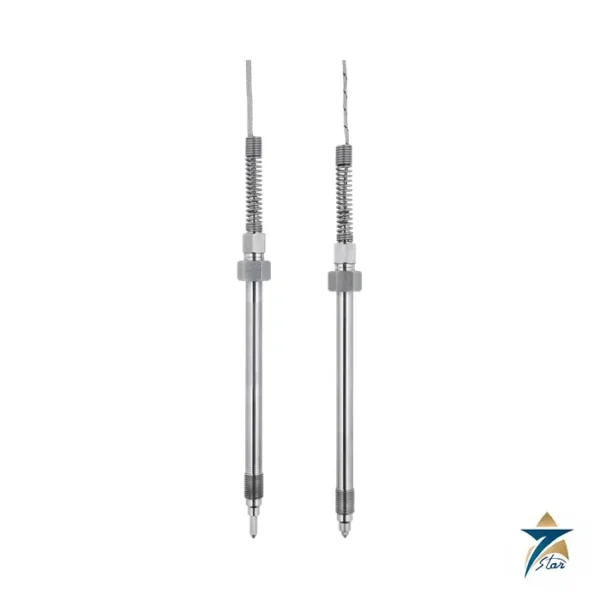
JUMO 902190/20-388-1003-1-6-185-13-2500/317 belongs to the group of spring-loaded bayonet probes that are pressed into a drilled hole to read the temperature of a solid part rather than a flowing fluid. This particular code is the 902190/20 version whose measuring tip is ceramic and shaped at 120 degrees for cone-bottom bores, so it is chosen when a plain flat tip would not seat properly. Seven Star LLC is an independent supplier serving Oman and the GCC and is not affiliated with the manufacturer; the description below is paraphrased from the JUMO datasheet.
What 902190/20-388-1003-1-6-185-13-2500/317 is made for
The manufacturer positions this probe family for solids, bearings and moulding tools, with the plastics industry named as a typical user. In Gulf plants the same logic applies to extruder barrels and injection moulds at polymer converters, bearing housings on pumps and fans, heated platens, packing machine sealing jaws and steel blocks inside heat-treatment fixtures. The pressure spring keeps the tip in contact with the bottom of the hole, and removal needs no tool, which makes it a convenient part for production lines that change dies often.
Reading the order code 902190/20-388-1003-1-6-185-13-2500/317
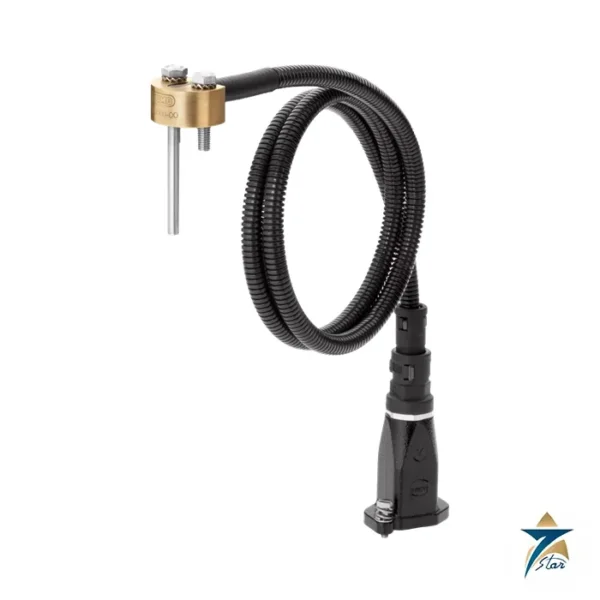
Basic version 20 is the bayonet probe with a stainless steel sheath, material 1.4571, and a ceramic KER 221 measuring tip at 120 degrees. The operating code 388 means minus 50 to plus 260 degrees Celsius with a metal braiding cable. Code 1003 is a single Pt100 in 2-wire circuit and the next 1 is class B. The figure 6 is the 6 mm sheath diameter; 185 is the fitting length range of 29 to 185 mm; 13 is a 6.3 mm receptacle to DIN 46247 on the cable end; 2500 is the cable length of 2.5 m; and the extra code 317 is a shielded connecting cable.
Technical data for 902190/20-388-1003-1-6-185-13-2500/317
| Characteristic | Value |
|---|---|
| Basic version | 902190/20, ceramic 120 degree tip |
| Sheath material | Stainless steel 1.4571, 6 mm diameter |
| Measuring tip | Ceramic KER 221, 120 degrees |
| Sensor | 1x Pt100, EN 60751 class B, 2-wire |
| Cable and ambient | Metal braiding, minus 50 to plus 260 degrees Celsius (code 388) |
| Bayonet lock | Nickel-plated brass, 12 mm diameter |
| Spring | Stainless steel 1.4310, also acts as cable protection |
| Fitting length EL | 29 to 185 mm, adjustable by turning the bayonet |
| Cable end | Receptacle 6.3 to DIN 46247, shielded, 2500 mm |
| Part number | 00055808 |
How 902190/20-388-1003-1-6-185-13-2500/317 differs from other 902190 variants
The 902190/10 and 902190/30 versions have a flat-bottom tip in 1.4571 steel, for flat bores; this part has the ceramic 120 degree tip for a cone-shaped hole. The other stock codes use 388 or 397 operating ranges: code 397 reaches plus 350 degrees Celsius with metal braiding, and the 380 silicone option is limited to plus 200. This code uses a 6 mm sheath, but the family also offers 8 mm, and its fitting length of 29 to 185 mm is longer than the 20 to 85 mm of the shortest version. The cable end differs too: stock sibling 902190/10 uses ferrules code 11, here the receptacle code 13 is selected for push-on terminals.
Selection and fitting hints
Drill the hole so that its depth, measured from the face to the tip, is covered by the adjustable fitting length, and match the bore diameter to the 6 mm sheath. The bayonet socket must be bought or machined separately; the datasheet points to bayonet sockets in data sheet 909750. Because the spring forces the tip onto the bottom of the hole, a clean bore with no chips gives the best heat transfer. Where vibration is high, the shielded cable and braiding help both mechanically and electrically.
Installation and commissioning
Push the probe into the socket and turn the bayonet until it locks; the fitting length changes as the lock is rotated. Route the cable so that it never rests on a hot surface above its rating. Push the receptacles onto the matching tabs, secure the shield at one end only to avoid ground loops, and verify the 2-wire reading against a reference at ambient before running the machine up to temperature.
Maintenance
The only wearing parts are the spring and the tip, which should be inspected during every tool change. If the reading lags, check that the tip still touches the bottom of the hole and that the bore is clear of residue. As the sensor is non-replaceable, a failed element means a swap of the complete probe, so stock a spare with the same order code 902190/20-388-1003-1-6-185-13-2500/317.
Ordering notes
The datasheet lists the part number 00055808 for this order code under stock versions. Extra codes such as 302 or 303 change the bayonet diameter to 15 or 16 mm and are not included here. Confirm the cable length and termination before ordering because they are fixed in the string.
Thermal contact and accuracy considerations for 902190/20-388-1003-1-6-185-13-2500/317
Surface-type and bore-type probes measure the temperature at the tip, which is not always the temperature of the surrounding mass, so the position of the bore relative to the heater or cooling channel matters more than the sensor class. The ceramic tip of 902190/20-388-1003-1-6-185-13-2500/317 is useful where electrical insulation between the tip and the metal part is wanted, and the spring keeps the contact force steady after thermal cycles. Class B at the Pt100 gives the tolerance defined in EN 60751 for the classification, and class A is a separate option in the same datasheet if a tighter tolerance is needed. Do not wrap insulation around the spring section, since the cable protector must stay free to move when the bayonet is turned.
Documents and quotation
The JUMO 902190 datasheet is attached to this page. To receive a quotation for 902190/20-388-1003-1-6-185-13-2500/317, send the full order code, the number of pieces and your delivery location in Oman or the GCC through the RFQ form.
Datasheets & Documents
- Datasheet JUMO 902190/20-388 Bayonet Pt100 Probe, Ceramic Tip, 6 mm Datasheet Download
Reviews (0)
How would you rate this product? Cancel reply
About brand
JUMO is the German maker of temperature sensors, process controllers, pressure transmitters and liquid analysis instruments. Moritz Kurt Juchheim founded it in Fulda in 1948 as M. K. Juchheim KG, making glass thermometers with six employees. The name JUMO comes from the founder's name. It is still a family company headquartered in Fulda, and the parent company has been called JUMO GmbH & Co. KG since 2003.
Seven Star LLC is an independent supplier in Muscat. We list JUMO RTD and thermocouple probes, thermowells, transmitters, controllers, recorders and water analysis instruments, and supply them to process plants, OEMs, HVAC contractors and water utilities in Oman and the GCC by type number.
JUMO company profile
| Established | 1948, Fulda, Germany, by Moritz Kurt Juchheim |
|---|---|
| First products | Glass and contact thermometers; platinum glass sensors from 1966 |
| Ownership | Family-owned; renamed JUMO GmbH & Co. KG in 2003 |
| Product families | RTD and thermocouple probes, thermowells, temperature and pressure transmitters, controllers and thermostats, safety temperature limiters, paperless recorders, liquid analysis and flow and level instruments |
Milestones
- 1948: Moritz Kurt Juchheim founds M. K. Juchheim KG in Fulda, making glass thermometers with six employees.
- 1966: Platinum glass temperature sensors are added.
- 2003: The parent company is renamed JUMO GmbH & Co. KG.
JUMO products we list
| Family | Models | Typical use |
|---|---|---|
| RTD and thermocouple probes | 902020, 902030, 902050, 902120, 902006 2xPt100, PROCESStemp, mineral-insulated RTD, 901020 thermocouple, 901210, 902810 hygienic, 902550 surface, 902520 HVAC, MarineTemp | Temperature measurement in pipes, vessels, machines, HVAC and food plants |
| Thermowells and inserts | 909710 thermowells, 909740 measuring inserts | Protecting sensors and replacing them without opening the process |
| Temperature transmitters | dTRANS T01, T03, T04, T05, T06 SIL, T07 HART, T09, T1000 IO-Link, DELOS T switch | Converting sensor signals to 4-20 mA, HART or IO-Link |
| Pressure and level | dTRANS p20, p30, p31 hygienic, p33 Ex, p02 DELTA, MIDAS S05, MIDAS DP10, DELOS S02, MAERA S25, NESOS R20 | Pressure in process, hydraulic and OEM systems; tank and well level |
| Controllers, limiters and recorders | DICON touch, IMAGO 500, dTRON 316, iTRON, cTRON, diraTRON 104, eTRON T, safetyM STB/STW, safetyM TB/TW, LOGOSCREEN 601, mTRON T | Furnace, oven and process control, over-temperature protection and recording |
| Liquid analysis and flow | AQUIS touch S, AQUIS touch P, AQUIS 500 pH, AQUIS 500 CR, dTRANS pH 02, pH electrode, digiLine DO, ecoLine NTU, flowTRANS MAG H20, flowTRANS US W01 | pH, conductivity, oxygen and turbidity in water treatment; liquid flow |
Choosing a temperature sensor starts with the range and accuracy. A Pt100 RTD is accurate and stable from about -200 to 600 °C and is the usual choice in process plants. A thermocouple (type K or J, for example) covers much higher temperatures and responds faster but is less accurate. The wiring also matters: a 3-wire or 4-wire Pt100 connection cancels the resistance of the cable, while a 2-wire connection adds an error that grows with cable length. That is why a head-mounted transmitter is often fitted close to the sensor.
Where JUMO products are used
In Oman and the GCC, JUMO sensors and controllers are used in oil and gas and chemical plants, food and beverage production, plastics and metal heat treatment, HVAC and district cooling, water and wastewater treatment, swimming pools and marine applications.
Ordering JUMO products: what we need
Send the JUMO type number and the full order code from the label (for example 902020/10-...). For probes, add the sensor type (Pt100, Pt1000, type K or J), the number of wires, the insertion length and diameter, and the process connection. For controllers, add the input, outputs and supply voltage.
Facts checked against JUMO's company history, October 2026.
Browse JUMO products by category: Temperature Instrumentation, Pressure Instrumentation, Liquid Analysis Sensors, Controllers & Data Acquisition, Level Transmitter.
FAQ
Questions about the JUMO 902190/20-388 Bayonet Pt100 Probe, Ceramic
Answers from our engineering team on installation, compatibility and integration.
01Why choose 902190/20-388-1003-1-6-185-13-2500/317 instead of the flat-bottom 902190/10?
Basic version 20 has a ceramic KER 221 measuring tip with a 120 degree shape, made for cone-shaped bores, whereas versions 10 and 30 have a flat tip for flat-bottom holes.
02What is the fitting length range of 902190/20-388-1003-1-6-185-13-2500/317?
Code 185 gives a fitting length of 29 to 185 mm, and it is changed by rotating the bayonet lock, which is also how the spring pressure on the hole bottom is set.
03What is the cable temperature limit for 902190/20-388-1003-1-6-185-13-2500/317?
Operating code 388 specifies minus 50 to plus 260 degrees Celsius with a metal braiding connecting cable, and extra code 317 adds shielding.
04How is the Pt100 wired in 902190/20-388-1003-1-6-185-13-2500/317?
The measuring insert code 1003 is one Pt100 to EN 60751 in 2-wire circuit, class B, terminated in a receptacle 6.3 to DIN 46247 (code 13).
05Which bayonet diameter is supplied with 902190/20-388-1003-1-6-185-13-2500/317?
Without extra codes 302 or 303 the bayonet lock is the standard 12 mm diameter in nickel-plated brass; matching sockets are covered by datasheet 909750.


Reviews
There are no reviews yet.