One field instrument for pH, ORP and ammonia loops
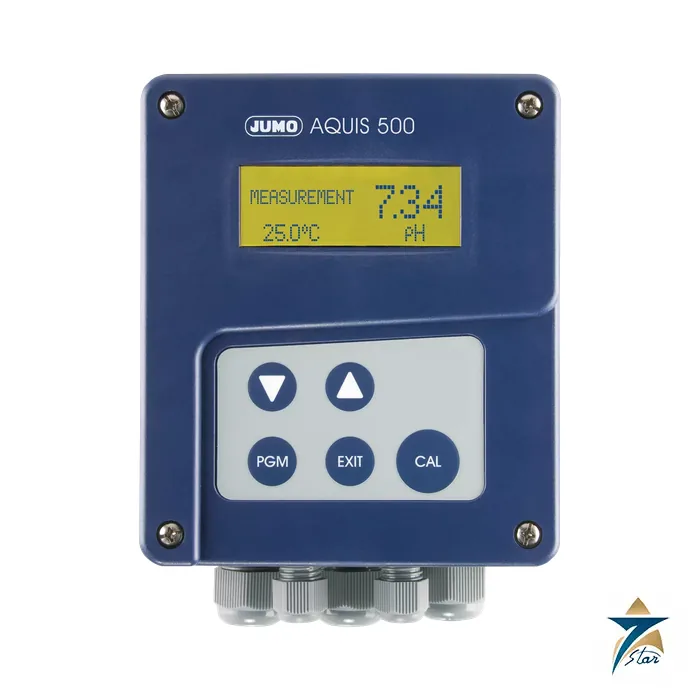
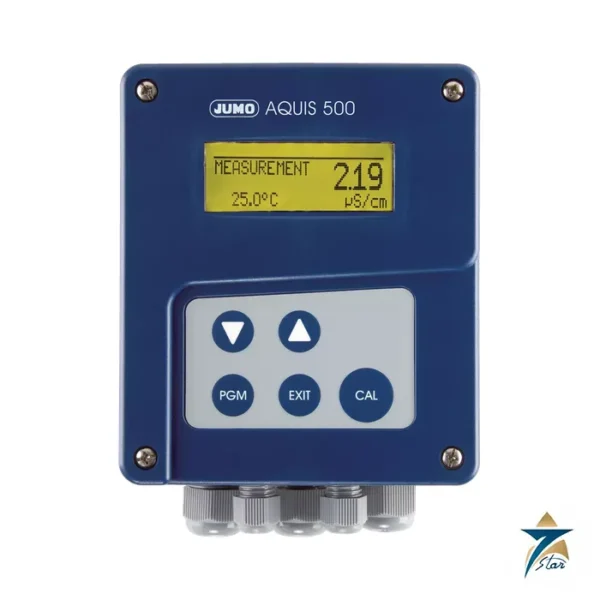
The JUMO AQUIS 500 pH (data sheet type 202560) is a transmitter and controller that can be switched on the device between pH, ORP (redox) and NH3 (ammonia) measurement. The second input takes a Pt100, Pt1000 or NTC/PTC temperature sensor, so pH and ammonia readings are temperature-compensated automatically or from a manually entered value.
It is built for use right at the tank or channel: the surface-mounted housing is rated IP67, while the panel-mounted version is IP65 at the front. Glass electrodes with a separate reference, combination electrodes, antimony electrodes and pH-ISFET sensors can all be connected, which is why the unit appears in water treatment, wastewater and cooling-circuit leak monitoring.
Technical specifications
| Parameter |
Specification |
| Data sheet type |
202560 |
| Measured variables |
pH, ORP (redox), NH3 (ammonia concentration), temperature |
| pH range / accuracy |
-1 to +15 pH, 0.3 %, temperature error 0.2 %/10 K |
| ORP range / accuracy |
-1500 to +1500 mV, 0.3 % |
| NH3 range |
0 to 9999 ppm, 0.3 % |
| Temperature input |
Pt100/Pt1000 (auto-detected) -50 to +250 C, 0.5 C; NTC/PTC up to 4 kOhm |
| Analog outputs |
Up to 2, 0/4 to 20 mA or 0 to 10 V, 0.25 %, NAMUR NE43 |
| Switching outputs |
Up to 2 changeover relays, 3 A / 250 V AC resistive |
| Binary input |
1, key inhibit / HOLD / alarm suppression |
| Controller functions |
Limit comparator, limit controller, pulse width, pulse frequency, modulating, continuous; P, PI, PD, PID |
| Supply voltage |
AC 110-240 V (-15/+10 %), AC/DC 20-30 V, or DC 12-24 V |
| Power consumption |
Approx. 14 VA |
| Enclosure |
Surface housing IP67 (ABS, about 900 g); panel mounting IP65 front, IP20 rear (about 480 g) |
| Ambient temperature |
-10 to +50 C within accuracy; operating -15 to +65 C; storage -30 to +70 C |
| Approval as printed |
cULus (UL 61010-1), file E 201387, valid for all types |
Selecting the version and the order code
The order code is built from the type 202560, a basic-type extension, the two analog outputs, two relay outputs and the supply voltage. Extension 10 is the panel-mounting unit and 20 the surface-mountable housing. Output codes 888 (analog) or 000 (none) apply to outputs 1 and 2, and 310 (changeover relay) or 000 to outputs 3 and 4. Supply codes are 23 (110 to 240 V AC), 25 (20 to 30 V AC/DC) and 30 (12 to 24 V DC).
The data sheet names stock versions with part numbers: 202560/20-888-888-310-310-23/000 is 00480051, 202560/20-888-000-310-000-23/000 is 00480050, and 202560/20-888-000-000-000-25/000 is 00491075. Panel versions such as 202560/10-888-888-310-310-23/000 (00480048) are listed as manufactured to order.
Maintenance features and typical installations
Impedance monitoring of glass electrodes can be activated; it detects short circuit and cable break and works best above about 100 uS/cm, with a cable no longer than 10 m and no impedance converter in the circuit. A calibration logbook keeps the five latest successful calibrations, so electrode ageing can be judged, and a calibration timer reminds the operator when the next routine calibration is due. Calibration is by 1-, 2- or 3-point for pH, and 1- or 2-point for ORP.
The display offers large digits, bar graph or trend mode, and a min/max memory shows whether the connected sensor was ever exposed to values beyond its design range. Language selection covers German, English and French, with more loadable through the optional setup program.
The data sheet lists universal use in water and wastewater engineering, service and process water, drinking water, well and surface water, and leakage monitoring in refrigeration plant through NH3-sensitive sensors. Sensor cable to the transmitter should be the special coaxial type of 3 to 5 mm diameter named in the data sheet (type 202990/02-92-(x)-00). Accessories listed include a protective roof, pipe and DIN-rail installation sets and the PC setup software.
Choosing the right sensor for each measuring mode
Because the AQUIS 500 pH accepts several electrode types, the sensor should be chosen for the medium rather than for the instrument.
| Sensor type |
Typical use |
| Combination glass pH electrode |
Drinking water, cooling water and general process water |
| Glass electrode with separate reference |
Media that poison or block standard references, where the reference can be replaced on its own |
| Antimony electrode |
Media containing hydrofluoric acid, where glass membranes are attacked |
| pH-ISFET sensor |
Applications where glass breakage must be avoided, such as food-related processes |
| ORP (redox) electrode |
Disinfection monitoring with chlorine or ozone, and detoxification steps |
Temperature compensation matters for pH: a Pt100 or Pt1000 mounted close to the electrode gives the most reliable result, especially in outdoor tanks where temperature swings through the day.
Control strategies
The two relays and up to two analog outputs allow the instrument to do more than display a value. A simple limit comparator can raise an alarm when pH leaves a band. Pulse width or pulse frequency outputs can drive dosing pumps for acid or caustic directly, and a continuous 0/4 to 20 mA output can feed a dosing pump with analog input or a PLC. PID parameters let the loop be tuned to the delay between dosing point and sensor, which is often the main cause of overshoot in neutralisation tanks.
Use in Oman and GCC water applications
Typical installations include desalination post-treatment, where pH is adjusted before water enters the distribution network, sewage treatment plants, swimming pool and water feature dosing, and cooling tower blowdown control. The IP67 surface-mounted version suits plant rooms and shaded outdoor positions, but direct sun on the housing and display should be avoided in summer. Electrodes age faster in hot water and in media with oil or solids, so a regular calibration and cleaning routine is worth planning from the start.
What to include in your RFQ
- The required measuring mode (pH, ORP or NH3) and the housing version, surface or panel mounted.
- The number of analog and relay outputs and the supply voltage.
- Electrodes, fittings, buffer solutions and cable lengths if needed.
- Medium details: temperature, pressure and any chemicals present.
Documents and quotation
Open the attached JUMO AQUIS 500 pH data sheet 202560 (EN, V3.00, 2021-12-21) for the complete data and dimension drawings. Before you place an order, confirm the supply voltage, relay and analog output codes with the system designer, then submit your request with the exact code; our team prepares the quotation. Related items are listed under Liquid Analytical Systems.









Reviews
There are no reviews yet.