Conductivity, TDS and resistivity at the point of use
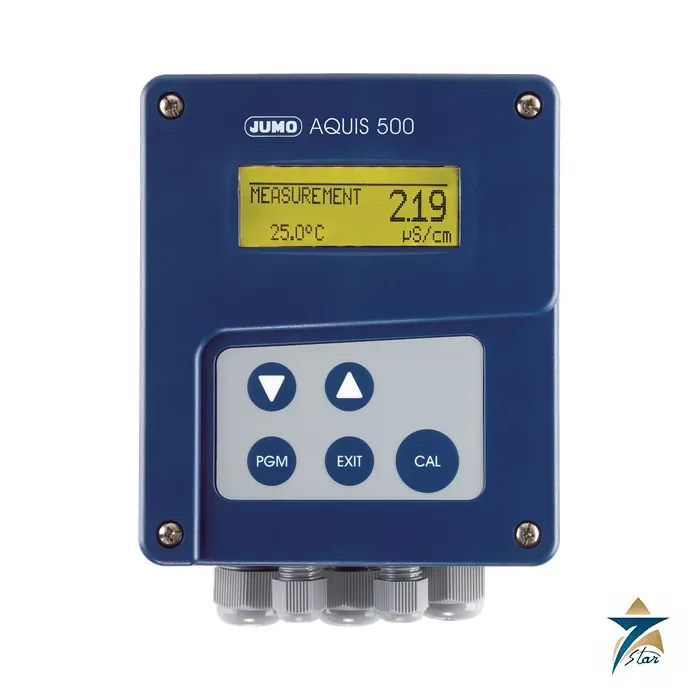
The JUMO AQUIS 500 CR (type 202565) measures and controls electrolytic conductivity, resistivity or TDS from conductive cells, and can show a conductivity reading converted through a customer-defined table of up to 20 value pairs. That table function turns the instrument into a simple concentration meter for rinse baths or dosing checks.
Two-electrode cells with the usual cell constants of 0.01, 0.1, 1.0, 3.0 and 10.0 1/cm connect directly, as do four-electrode cells (preset K = 0.5 and 1.0). The relative cell constant is adjustable, so a cell of, for example, K = 0.2 or 0.4 can also be used. A Pt100 or Pt1000 input provides automatic temperature compensation.
Technical specifications
| Parameter |
Specification |
| Data sheet type |
202565 |
| Measured variables |
Conductivity (uS/cm, mS/cm), resistivity (kOhm x cm, MOhm x cm), TDS (ppm), temperature |
| Conductivity accuracy |
Up to 0.6 % of range + 0.3 uS x cell constant (K); temperature error 0.2 %/10 C |
| Temperature input |
Pt100/Pt1000 auto-detect, -50 to +250 C; 0.5 K up to 100 C; NTC/PTC up to 4 kOhm |
| Compensation |
Linear 0 to 8 %/C (-10 to 160 C); ASTM D1125-95 high-purity water; natural water ISO 7888; reference 15 to 30 C, preset 25 C |
| Cell constants |
2-electrode: 0.01, 0.1, 1.0, 3.0, 10.0 1/cm; 4-electrode: 0.5 and 1.0 1/cm |
| Analog outputs |
Up to 2: 0/4 to 20 mA (max 500 Ohm) or 0 to 10 V; 0.25 %; NAMUR NE43 |
| Relays |
Up to 2 changeover, 3 A at 250 V AC resistive, over 2×10^5 operations |
| Controller |
Limit comparator, limit controller, pulse width, pulse frequency, modulating, continuous; P/PI/PD/PID |
| Supply |
AC 110-240 V, AC/DC 20-30 V or DC 12-24 V; approx. 14 VA |
| Display |
Graphics LCD 120 x 32 pixels with programmable backlight |
| Protection |
Surface housing IP67; panel mounting IP65 at the front |
Choosing a measuring span
The device range is wider than any single cell can use, so the cell sets the practical span. For a 2-electrode cell the data sheet recommends 0.05 to 20 uS/cm at K = 0.01, 1 to 1000 uS/cm at K = 0.1, 0.01 to 100 mS/cm at K = 1.0, 0.1 to 30 mS/cm at K = 3.0 and 0.1 to 200 mS/cm at K = 10. Temperature-compensated, the instrument itself covers about 0.1 uS/cm x K up to 1250 mS/cm x K.
Pharmaceutical and pure-water users should note that the data sheet lists use for USP, Ph. Eur. and WFI water measurement and the ASTM D1125 compensation curve for high-purity water; the high-purity cell calibration is entered manually as a relative cell constant.
Order code and stock versions
Type 202565 is followed by extension 10 (panel) or 20 (surface housing), output 1 and 2 codes 888 (analog) or 000, output 3 and 4 codes 310 (changeover relay) or 000, and supply code 23 (110 to 240 V AC), 25 (20 to 30 V AC/DC) or 30 (12 to 24 V DC). Stock items named in the data sheet are 202565/20-888-888-310-310-23/000 (part no. 00480055) and 202565/20-888-000-310-000-23/000 (part no. 00480054); the data sheet quotes three working days for stock shipment.
Accessories printed in the same sheet include a protective roof (00398161), pipe installation set (00483664), DIN-rail kit (00477842) and the PC setup software (00483602), which is also needed to load the concentration table.
Key features
- Three measured variables in one unit: conductivity, resistivity and TDS, with temperature shown alongside.
- Two- and four-electrode cells: two-electrode cells suit clean water, while four-electrode cells tolerate higher conductivity and some electrode fouling.
- Several compensation methods: linear, ASTM D1125 for high-purity water and ISO 7888 for natural water cover most water-treatment duties.
- Built-in controller: limit, pulse-width, pulse-frequency, modulating and continuous control modes allow direct dosing or blowdown control without a separate PLC.
- Two housing styles: IP67 surface housing for field mounting or panel mounting with IP65 front protection.
Typical applications
| Application |
Typical measurement and cell |
| Reverse osmosis permeate |
Low µS/cm range, K = 0.1 or 0.01 cell |
| Cooling tower blowdown |
Hundreds to thousands of µS/cm, K = 1.0 cell, relay or pulse control |
| Boiler feed and condensate |
Low to medium µS/cm, K = 0.1 cell |
| Rinse baths in surface treatment |
Conductivity or concentration via the customer table |
| Brackish feed water and brine |
mS/cm range, K = 3.0 or 10 cell, or four-electrode cell |
Using the controller functions
For cooling tower blowdown, a simple limit contact can open a bleed valve when conductivity rises above the set point, with hysteresis to prevent rapid cycling. For chemical dosing, the pulse-frequency output can drive a metering pump directly, with a PI or PID algorithm adjusting the dosing rate to hold a conductivity target. The analog outputs can send the measured value to a PLC or SCADA system, and NAMUR NE43 signalling lets the receiving system distinguish a sensor fault from a genuine low or high reading.
Calibration and maintenance
- Check the cell against a conductivity standard solution of suitable value, and enter a relative cell constant if the measured value deviates.
- Clean two-electrode cells regularly in scaling or fouling water; deposits change the effective cell constant.
- Verify the temperature sensor against a reference thermometer, since compensation errors grow with temperature distance from the reference value.
- Record calibration results so that drift trends can be seen over time.
Installation notes
Install the cell where the sample is representative and free of air bubbles, typically in a pipe section that stays full or in a flow-through fitting. Keep the cable between cell and instrument as short as practical and route it away from power cables. The protective roof accessory helps where the surface housing is installed outdoors.
Water treatment in Oman and the GCC
Desalination, RO polishing, district cooling and industrial cooling towers make conductivity one of the most widely measured parameters in the region. Feed water salinity is high, while product water and boiler water must stay low, so selecting the correct cell constant for each point matters more than the instrument itself. Outdoor installations benefit from the IP67 housing and a sun roof to limit display heating.
What to include in your RFQ
- Full order code of type 202565, including housing, outputs, relays and supply.
- Cell type, cell constant, process connection and cable length, if a cell is required.
- Expected measuring range, process temperature and pressure.
- Accessories such as the protective roof, pipe installation set, DIN-rail kit or setup software.
Documents and quotation
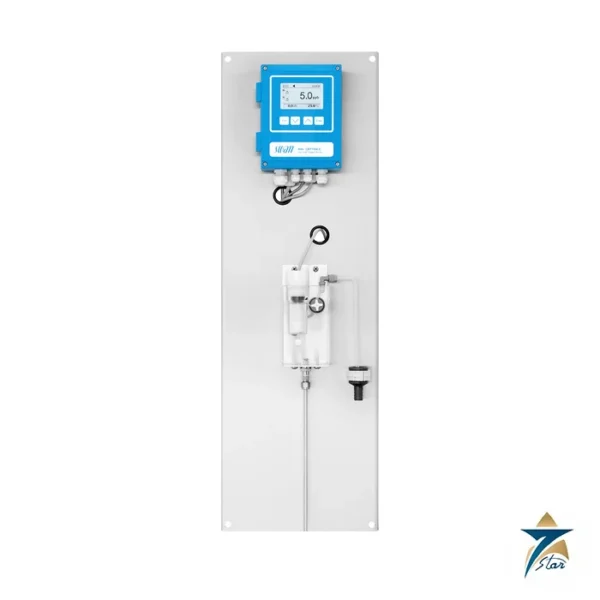
Please check the cell constant, outputs and supply voltage before ordering, because the final code depends on the installation. The attached manufacturer file, JUMO AQUIS 500 CR data sheet 202565 (EN, 2021), carries the authoritative data. Send the code you selected and the quantity, and we respond with a written offer. Similar instruments: Liquid Analytical Systems.










Reviews
There are no reviews yet.