Honeywell MasterLogic-200 programmable logic controller: platform overview and model code
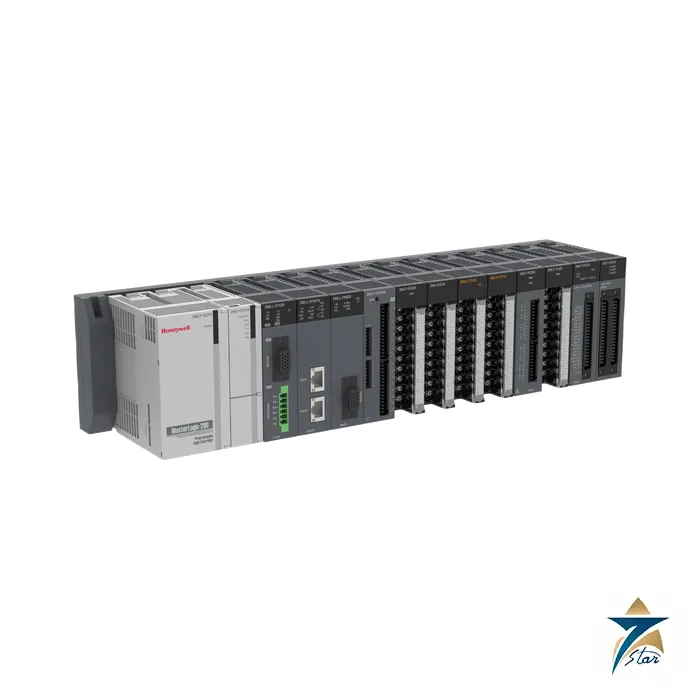
MasterLogic-200 is a modular programmable logic controller from Honeywell that targets fast logic, interlock, sequence and batch control, with a particular focus on integration into Honeywell Experion systems. The platform is built around a high-speed CPU, a family of interchangeable I/O modules, and open networks including Fast Ethernet, serial and Profibus-DP. Seven Star LLC supplies MasterLogic-200 components in Oman and the GCC as an independent supplier in Muscat, and this page explains the main building blocks so an RFQ can be written against the real part numbers. The source document is the MasterLogic-200 specifications and technical data release R200 dated May 2010, so confirm current availability and revisions for any particular module before ordering.
The part numbers follow a pattern. The first digit pair identifies the series, the next letters show the function: 2MLI for the non-redundant CPU and digital input modules, 2MLR for the redundant CPU and its bases, 2MLQ for digital output, 2MLF for analogue, temperature and high-speed counter, 2MLL for communications, 2MLB for bases, 2MLP for power supplies and 2MLC for expansion cables.
MasterLogic-200 CPU variants and system limits
| CPU |
Architecture |
Capacity |
Notes |
| 2MLI-CPUU |
Non-redundant |
8 bases (main plus 7 expansion), 96 slots, 6,144 local points with 64-channel modules |
Non-redundant power and I/O cable |
| 2MLR-CPUH/T |
Redundant, TP/CAT5 sync |
Up to 31 bases, 372 slots, 23,808 local points |
Redundant CPU, power and ring-type I/O cable |
| 2MLR-CPUH/F |
Redundant, fibre optic |
Up to 31 bases, 372 slots, 23,808 local points |
Fibre optic I/O interface, up to 2 km |
Both CPU families offer 128,000 points of network I/O capacity through the memory map and share the same programming languages and function block library. The redundant CPU switchover time is stated as 22 ms.
MasterLogic-200 technical specifications
| Parameter |
Specification |
| Manufacturer / part number |
Honeywell / MasterLogic-200 (2MLI-CPUU, 2MLR-CPUH/T, 2MLR-CPUH/F) |
| Programming languages |
Ladder Diagram, Sequential Function Chart, Structured Text, Instruction List (view only) |
| Program execution |
Cyclic scan, time-driven interrupts, internal device interrupts |
| Instruction speed (2MLI-CPUU / 2MLR-CPUH) |
LD 0.028 / 0.042 µs per step; MOV 0.084 / 0.112 µs per step |
| Memory |
25 MB total; 16 MB built-in flash; 7 MB program memory; 2 MB data memory |
| Symbolic variable area |
512 KB (256 KB retain settable) |
| Tasks |
Up to 256 total; 32 time-driven and 32 internal-device interrupt tasks, 1 init task |
| Built-in ports |
RS-232C (Modbus slave) and USB |
| Operating temperature |
0 to 55 °C ambient; storage –25 to +70 °C |
| Humidity |
5 to 95 % RH non-condensing |
| Standards |
IEC 61131-2 (vibration, shock, noise); UL 508; CE EMC (EN 50081-2, EN 50082-2) |
| Environment |
Free from corrosive gases and excessive dust; pollution degree 2; altitude below 2,000 m |
Specifications above are copied from the manufacturer’s R200 technical data; the storage temperature, humidity and shock limits are generic PLC cabinet conditions, so a Gulf site should still provide an air-conditioned, filtered control room or cabinet.
Redundancy options in MasterLogic-200
The datasheet describes three architectures. A fully redundant system uses the 2MLR-CPUH CPU with redundant power and a dual-path ring I/O cable. A non-redundant system uses the 2MLI-CPUU for cost-effective applications. A hybrid arrangement runs only the master 2MLR-CPUH without the standby, giving non-redundant CPU but redundant power and I/O cable. The two redundant CPUs are linked by a synchronisation cable; the fibre version uses 62.5/125 multimode fibre with LC connectors for a distance of up to 200 m between CPUs. Choose the architecture early in the design, because the 2MLI and 2MLR families use different bases and power supplies according to the model tables.
I/O and communication modules in the MasterLogic-200 family
- Digital input: 24 VDC modules in 8, 16, 32 and 64 point versions (2MLI-D21A, D22A, D24A, D28A, with sink or source variants such as D22B, D24B and D28B), plus AC 110 V and 220 V inputs (2MLI-A12A, 2MLI-A21A).
- Digital output: relay outputs (2MLQ-RY1A, RY2A, RY2B), transistor sink and source outputs in 16, 32 and 64 points (2MLQ-TR2A, TR4A, TR8A, TR2B, TR4B, TR8B) and triac output (2MLQ-SS2A).
- Analogue: voltage and current inputs (2MLF-AV8A, AC8A, AD8A, AD16A, AD4S), voltage and current outputs (2MLF-DV4A, DC4A, DC4S, DV8A, DC8A).
- Temperature and counters: thermocouple input 2MLF-TC4S, RTD input 2MLF-RD4A, high-speed counters 2MLF-HO2A (200 kHz) and 2MLF-HD2A (500 kHz).
- Communication: Fast Ethernet 2MLL-EFMT (CAT5) and 2MLL-EFMF (fibre), serial 2MLL-C22A, C42A and CH2A, and Profibus-DP master 2MLL-PMEA.
Bases, power supplies and expansion for MasterLogic-200
On the non-redundant side, main bases come in 4, 6, 8 and 12 slot sizes (2MLB-M04A, M06A, M08A, M12A) with matching expansion bases (2MLB-E04A to E12A). Power modules are 2MLP-ACF1, ACF2, AC23 and the 24 VDC 2MLP-DC42. Expansion cables range from 0.4 m (2MLC-E041) to 15 m (2MLC-E152), with a total expansion distance not exceeding 15 m. On the redundant side, the CPU base is the 6-slot 2MLR-M06P and the expansion base is the 12-slot 2MLR-E12P, with power modules 2MLR-AC13, AC23, AC12, AC22 and DC42 and I/O interface modules 2MLR-DBSF (fibre), 2MLR-DBST (twisted pair) and 2MLR-DBSH (hybrid). The terminator 2MLT-TERA is required for base expansion and the dummy module 2MLT-DMMA protects unused slots from dust.
Software, integration and diagnostics
Programming uses the SoftMaster tool (order code SSS-MLPT) via a USB cable (USB-301A). A simulation environment lets engineers test control logic without hardware. For Experion integration the interface driver SSS-MLDP is listed, and the datasheet notes it is not required for Experion HS or LS. The platform provides system and error logs, network monitoring, ping tests and frame monitoring. Open protocols include Modbus ASCII, RTU and TCP and Profibus-DP, which helps when integrating third-party skid packages.
Selection and replacement checklist for MasterLogic-200
- Confirm whether the installed rack is the 2MLI (non-redundant) or 2MLR (redundant) family before ordering any CPU, base, power or interface module.
- Read the exact part number from the module label; module families such as 2MLI-D22A and 2MLI-D22B differ in sink or source behaviour.
- Check the base size and the number of free slots; any module can be fitted in any slot, except that the Ethernet module cannot be placed in remote fibre-linked bases.
- Verify the power module rating (5 V and 24 V currents) against the loaded slots.
- Save the project and retain-area data before changing a CPU; moving a retained program to a new CPU uses the programming tool.
- For a legacy plant, ask for the firmware release and consider spares of the programmable parts, because the document is a 2010 release.
Typical MasterLogic-200 applications in Oman and the GCC
MasterLogic-200 suits package control and interlocks where a compact, fast PLC is wanted beside a Honeywell DCS. Typical Gulf uses include burner and boiler sequences, water-treatment and reverse-osmosis skid logic, pump-station sequences, cooling-water systems, utility packages and material-handling control. Panel installations in Oman should account for ambient above the 55 °C limit during summer and for dust and humidity in coastal areas; cabinet air-conditioning, filtration and correct grounding extend module life.
Information to send with a MasterLogic-200 RFQ
- Complete module part numbers (for example 2MLI-CPUU, 2MLR-CPUH/T, 2MLI-D24A) and quantities.
- Photos of the module label and the base showing series, revision and serial number.
- Redundancy architecture and base type in service.
- Software and driver needs (SoftMaster, Experion interface driver) if replacing a programming station.
- Delivery destination and whether you require tested spares.
Documents and quotation for MasterLogic-200
A MasterLogic-200 specifications and technical data document is attached on this page, with the module model number tables.
Send the part numbers you need to Seven Star LLC and we will confirm availability, condition and lead time for the quotation.






















Reviews
There are no reviews yet.