Honeywell Guardian ODS overspeed detection system: purpose and architecture
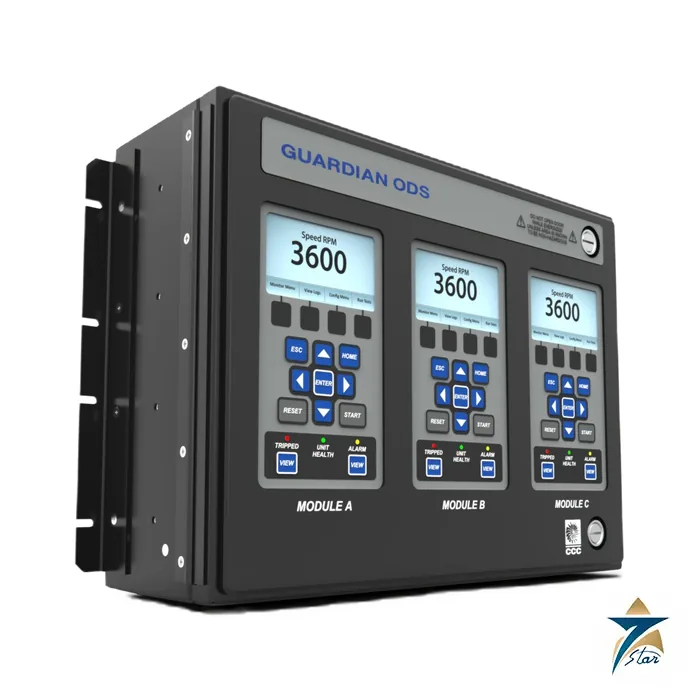
The Guardian ODS is a stand-alone overspeed safety device from Honeywell Compressor Controls Corporation (CCC) for turbines and compressors. It monitors rotor speed through magnetic pickups or proximity probes and issues a shutdown command to the trip valve or trip system when speed or acceleration crosses its set limit. It is built as three independent modules, A, B and C, that vote two-out-of-three on the shutdown relay. The design is separate from the machine control system, which means a controller fault or cyber event in the control layer does not remove the overspeed protection. Seven Star LLC supplies the Guardian ODS in Oman and the GCC as an independent supplier in Muscat.
In practical terms the Guardian ODS replaces or upgrades an older overspeed trip panel on a steam turbine, gas turbine or turbo-compressor train, and meets the API 670, API 611 and API 612 requirements listed in the datasheet.
Guardian ODS technical specifications
| Parameter |
Specification |
| Manufacturer / part number |
Honeywell (Compressor Controls Corporation) / Guardian ODS |
| Architecture |
Three independent hot-swappable speed modules (A, B, C), 2-out-of-3 voting |
| Functions |
Overspeed detection, optional acceleration detection, on-line testing, trip and alarm logging |
| Response time |
12 ms across 0.5 to 80,000 rpm (brochure figure) |
| Speed inputs |
1 per module, 3 in total: MPU 100 to 32,000 Hz at 1 to 35 Vrms; proximity probe 0.5 to 25,000 Hz at 24 Vdc; gear range 1 to 320 teeth |
| Discrete inputs |
3 per module, 9 in total: alarm/trip reset, start command, speed-fail override |
| Shutdown relays |
2 total, 2-out-of-3 voted, 8 A at 220 Vac or 8 A at 24 Vdc |
| Alarm relays |
1 per module, 3 total, 2 A at 24 Vdc |
| Analogue output |
4-20 mA speed readout, 1 per module |
| Communications |
Serial RS-232, RS-422 or RS-485 Modbus port, 1 per module |
| Power |
Two redundant supplies: 88 to 264 Vac / 47 to 63 Hz or 90 to 150 Vdc at 90 W; 18 to 32 Vdc at 100 W |
| Environment |
IP56; –20 to +60 °C; conformal coating resistant to H2S and SO2 (IEC 721-3-3 class 3C2) |
| Dimensions |
Approximately 330 × 445 × 159 mm (13 × 17.5 × 6.25 in) including faceplate |
| Compliance |
TUV certified SIL-3 per IEC 61508; API 670, 611 and 612; CSA Class I Div 2 Groups A-D T4 at 60 °C; ATEX Zone 2 Category 3 Ex nA II T4 |
Specification values are taken from the Guardian ODS specification sheet and brochure. Confirm the exact configuration, such as the voted-relay model, when quoting.
How the Guardian ODS detects overspeed and acceleration
Each module reads one speed signal. It checks the pickup circuit for open wiring before the machine starts, and the datasheet describes loss-of-speed logic that validates the sensor while the turbine runs. Speed is compared with the overspeed setpoint; where acceleration detection is enabled, the derivative of the speed signal is also compared with an acceleration limit. When two of the three modules agree that a trip condition exists, the voted shutdown relays de-energise the trip circuit. A single module fault therefore neither trips the machine unnecessarily nor leaves it without protection.
Because the voting is built into the hardware and the settings can only be changed with direct access to the unit, the device fits the separation principle recommended for safety instrumented functions.
On-line testing, repair and event logging
- On-line test. Each module can be tested manually from the front panel, through the Modbus port, or automatically by a periodic routine that tests modules A, B and C one at a time with an internal frequency generator and logs the result.
- On-line repair. The triple-modular design lets a module be replaced while the turbine is running. The backplane is plug-and-operate and the replacement module learns from the others.
- Logs. The scrolling trip log keeps the last 50 trip or alarm events and the last 20 overspeed events with time stamps, stored in non-volatile memory so they survive loss of power.
- Clock. A real-time clock in each module is averaged between modules to keep the log consistent.
- Software. The datasheet mentions TrainTools for viewing log files.
Guardian ODS and the wider CCC and Honeywell control environment
The manufacturer states that the unit integrates with its CCC control systems, and the same CCC safety range also includes the Guardian surge detection system and the EAS3 surge detector. Output signals are conventional: voted trip relays for the trip valve circuit, alarm relays, and a 4-20 mA speed output for indicators or a DCS. The Modbus port allows monitoring from a PLC or DCS. Since the design is not tied to a specific machine controller, it can also be retrofitted where a different governor or control system already runs the train.
Selection checklist for the Guardian ODS
- Speed sensor type. Confirm whether the machine uses magnetic pickups (with frequency and voltage levels) or proximity probes, and the number of gear teeth.
- Trip logic. The datasheet lists voted-relay models; specify the required shutdown relay arrangement and the trip circuit voltage.
- Acceleration detection. State whether it is required in addition to overspeed.
- Power. Choose between the high-voltage (88 to 264 Vac or 90 to 150 Vdc) and low-voltage (18 to 32 Vdc) supply, noting that two redundant sources are used.
- Location. IP56 and conformal coating suit most control rooms and some outdoor panels, but the installation should still be inside a suitable enclosure at the site.
- Regulatory fit. Confirm the area classification (Class I Div 2 or ATEX Zone 2 category 3, Ex nA) and the project’s SIL target.
Installation and commissioning notes for the Guardian ODS
- Mount in a panel with clearance for the faceplate and cabling; the overall dimensions are listed above.
- Use screened twisted-pair cable for pickup signals and route them away from power cables, with grounding at the control panel end.
- Configure overspeed and acceleration setpoints and the voting logic using the front panel or TrainTools, and record the settings.
- Run the on-line overspeed test sequence for each module, and verify trip valve response time against the logged result.
- Schedule periodic automatic tests, and compare logged response times over the years to detect trip valve deterioration.
Typical applications of the Guardian ODS in Oman and the GCC
Overspeed protection is a mandatory safety layer on steam turbines, gas turbines and turbo-compressors in LNG, gas processing, refining, petrochemical and power facilities in the region. The Guardian ODS is a candidate where an existing mechanical or electronic trip system is being modernised, where the machine owner wants protection that is physically separate from the control system, or where an API 670 compliant overspeed system is specified for a new train. The sulfur-resistant coating is relevant to sour-gas sites, and the wide supply voltage window suits both AC and DC auxiliary systems found in Gulf plants.
Information to send with a Guardian ODS RFQ
- Machine type, tag, rated speed and trip speed.
- Speed sensor type, signal level and gear teeth count.
- Trip circuit details (voltage, current) and the shutdown relay model required.
- Power supply voltages available on site.
- Area classification, SIL target and applicable API standard.
- Whether acceleration detection and Modbus integration are required.
Documents and quotation for the Guardian ODS
The Guardian ODS specification sheet is attached on this page.
Send us the machine and signal details and we will confirm availability and lead time for the quotation.


























Reviews
There are no reviews yet.