Honeywell BW Flex portable multi-gas detector: model overview
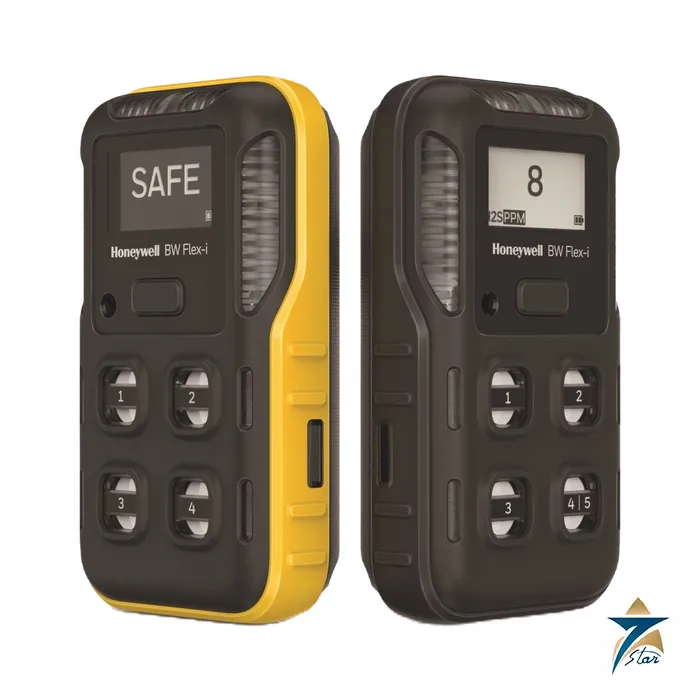
The Honeywell BW Flex is a pocket-size portable gas detector that can be configured with up to four sensors chosen from fourteen sensor types, protecting a worker against as many as five gas hazards at once. The datasheet covers the BW Flex 4/5 series. It is a personal safety instrument for confined-space entry, plant rounds and maintenance work, and it is supplied in Oman and the GCC by Seven Star LLC, an independent supplier in Muscat.
BW Flex is a configurable platform rather than a single fixed sensor set. The gases fitted, the alarm points and the connectivity options all depend on the exact configuration ordered, so the model name should always be followed by a sensor list when requesting a quotation.
BW Flex sensor choices
The datasheet lists fourteen sensor types: infrared LEL, NDIR carbon dioxide, filtered catalytic LEL, unfiltered catalytic LEL, oxygen, hydrogen sulphide, a dual toxic H2S and CO sensor, carbon monoxide, hydrogen-compensated carbon monoxide, sulphur dioxide, nitric oxide, nitrogen dioxide, hydrogen cyanide and chlorine. Spare sensors follow a catalogue pattern of the form SR-xx-1S, where the two-character identifier (for example W5, B1, X1, H1) marks the sensor type.
| Hazard |
Sensor type available |
| Flammable gas |
Infrared LEL or catalytic LEL (filtered or unfiltered) |
| Oxygen |
Electrochemical O2 |
| Toxic |
H2S, CO, CO with hydrogen compensation, dual H2S/CO, SO2, NO, NO2, HCN, Cl2 |
| Carbon dioxide |
NDIR CO2 sensor |
Some combinations are not recommended or not allowed because of cross sensitivity and possible interference, so the final sensor list should be checked with the manufacturer’s documentation before ordering. The infrared LEL sensor cannot detect hydrogen or acetylene; where those gases are present, the catalytic LEL sensor must be specified.
BW Flex technical specifications
| Parameter |
Specification |
| Manufacturer / part number |
Honeywell / BW Flex (BW Flex 4/5 series) |
| Sensors |
Up to 4 sensors from 14 types; detection of up to 5 gases |
| Size |
108.2 × 61.5 × 43.2 mm with alligator clip; 108.2 × 61.5 × 37.8 mm with Klick Fast stud |
| Weight |
189 g (catalytic LEL) or 186 g (IR LEL) with alligator clip; 173 g or 170 g with Klick Fast stud |
| Certified temperature |
-40 °C to 60 °C; -20 °C to 60 °C with a catalytic LEL sensor |
| Working humidity |
5 to 95% RH non-condensing, sensor dependent |
| Ingress protection |
IP66 and IP68 |
| Alarms |
Visual, vibrating and audible (95 dB); low, high, TWA, STEL, negative drift, over limit, multi-alarm, low battery |
| Self-test |
Diagnostic on activation; Reflex test of analogue sensors every 10 minutes |
| Typical battery life |
40 days at 8 hours per day with NDIR CH4 sensor; up to 15 hours with catalytic LEL (depends on alarm duration) |
| Connectivity |
Bluetooth Low Energy to the Safety Communicator app, Device Configurator app and Safety Suite Device Configurator software |
| Approvals listed |
ATEX, IECEx, CSA, FTZU, INMETRO, GOSST, CCCF, CPA, KRS, MED, DNV, SABS, FCCID, IC, UKCA, CE |
The approvals line is the series summary in the datasheet. Confirm the marking that applies to the exact configuration before specifying it for a classified area.
How the BW Flex alerts and protects the worker
Alarm status is shown by the IntelliFlash and ultra-bright LEDs in a simple traffic-light scheme: red means stop, amber is a warning and green is clear. The SafetyTick indicator lets a supervisor see at a glance whether the unit is within its compliance schedule. The display can show all gases together or step through them one at a time. Instantaneous alarms are backed by time-weighted average and short-term exposure limits, so protection covers both a sudden release and slow accumulation.
Connected features, configuration and calibration
Through Bluetooth the detector can be paired with a phone or a PC. Operators can change high, low, TWA and STEL alarm points, enable latching alarms and peak hold, set calibration and bump test reminders, assign a worker and a location, and keep the instrument always on. Event records are stored for download and can be synchronised with Safety Suite fleet management software. The unit is also compatible with the IntelliDoX automated test and calibration system, which speeds routine bump tests and keeps records current.
Maximum calibration interval is 180 days for most sensor types in the datasheet, and shorter for some. Treat that as a ceiling and follow the site’s own bump test procedure, which is usually stricter.
Selection checklist for BW Flex
- List every gas that can be present and the alarm points required by site rules.
- Choose infrared or catalytic LEL, remembering that infrared does not detect hydrogen or acetylene.
- Check the ambient range: -40 °C to 60 °C certified, with -20 °C as the lower limit for catalytic LEL.
- Decide whether Bluetooth configuration and fleet software are required.
- Choose the clip type: alligator clip or Klick Fast stud.
- Plan spare sensors and a calibration gas supply, or a docking station.
Care, maintenance and spares
Daily care is a visual check, a bump test with certified gas as the site procedure requires, and a battery status check. The modular design lets a sensor be replaced without sending the whole instrument away. Keep spare sensors for the gases used most, such as H2S, CO, O2 and LEL, and store them as the manufacturer advises. Toxic sensors have a finite life, listed in the datasheet as roughly 1 to 5 years or more depending on the type, so plan replacement into the maintenance calendar.
Applications in Oman and the GCC
BW Flex suits oil and gas facilities, refineries and petrochemical plants, power and desalination stations, tank and vessel entry, marine and offshore work, and general plant inspection. High heat and dust are normal in the region, and the IP66/IP68 rating and wide temperature range help here. For hydrogen sulphide exposure on sour service the H2S or dual H2S/CO configuration is common, and for confined-space entry the oxygen, LEL, H2S and CO set is the usual starting point.
Information to send with an RFQ for BW Flex
- Required gases and ranges, and whether LEL should be infrared or catalytic.
- Quantity of detectors and spare sensors.
- Bluetooth or connected-worker needs and any docking or calibration equipment.
- Hazardous-area classification and required approvals.
- Delivery location and timing.
Documents and quotation
A datasheet for the BW Flex series is attached on this page.
Send the BW Flex model with the sensor list and quantity to Seven Star LLC and we will quote for Oman and the GCC.






















Reviews
There are no reviews yet.