AMETEK Land System 4 single-spot pyrometer family
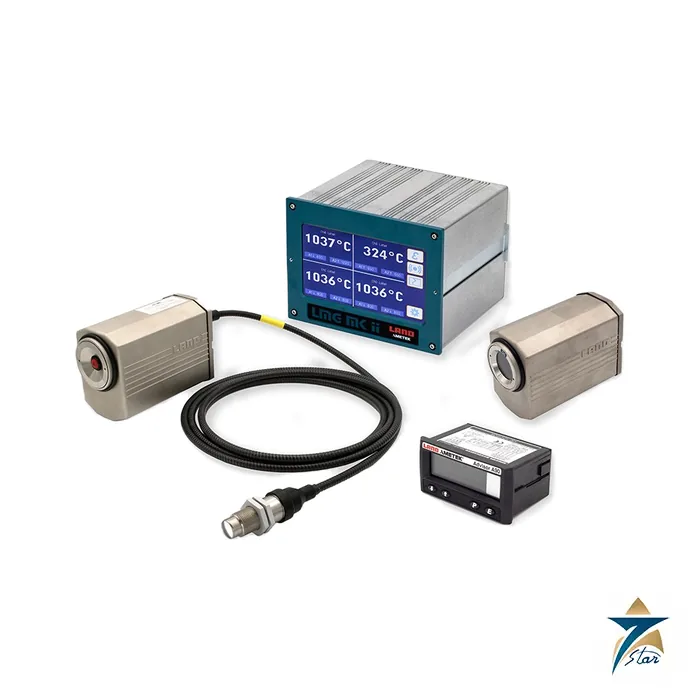
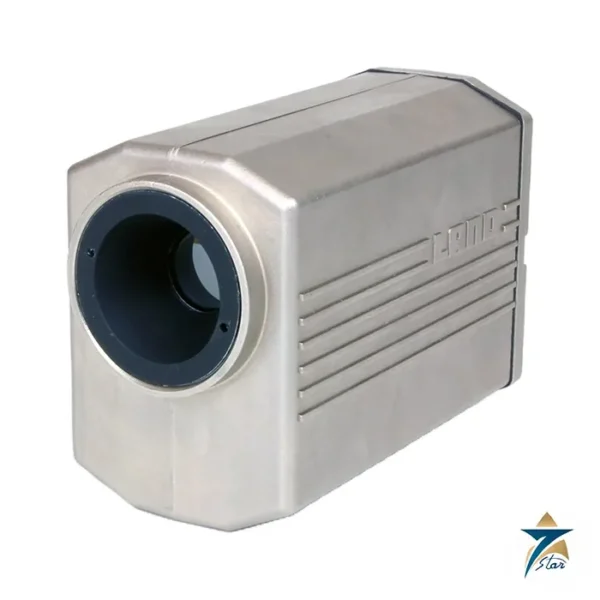
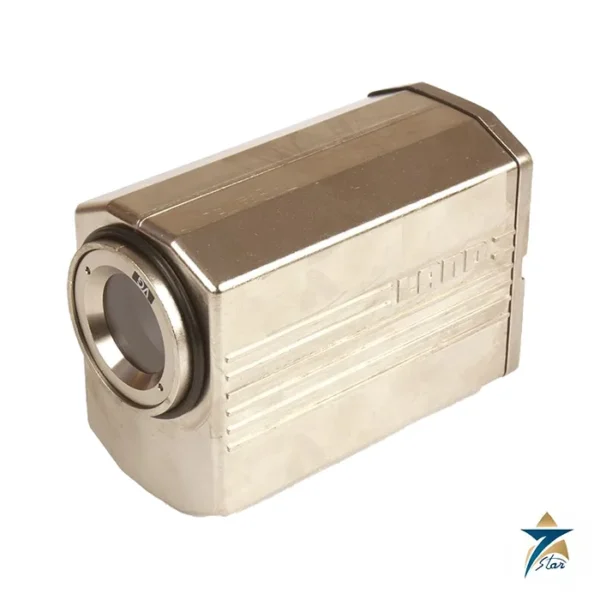
System 4 is the high-precision, single-spot non-contact thermometer family from AMETEK Land. It covers radiation thermometers with through-the-lens sighting, fibre-optic thermometers where the sensing head must sit away from the electronics, and ratio versions that cope with changing emissivity. Taken together the family spans roughly 0 to 2600 °C (about 50 to 4700 °F), and the manufacturer describes a range of 38 models that work with four Landmark signal processors. Seven Star LLC supplies System 4 thermometers and the matching Landmark processors in Oman and the GCC as an independent supplier in Muscat.
The model name encodes the detector type and the temperature span. For example, “M1 600/1600C” is a one-micron single-wavelength thermometer for 600 to 1600 °C, the “F” suffix indicates the same span in Fahrenheit, a trailing “YL” or “CYL” marks a fibre-optic version with the laser-targeting option (“Y” denotes that a laser sighting system is available), and “R1” is the ratio type.
System 4 technical specifications
| Parameter |
Specification |
| Manufacturer / part number |
AMETEK Land / System 4 (model selected from the table below) |
| Overall measuring span |
About 0 to 2600 °C (50 to 4700 °F) across the family |
| Sighting (standard bodies) |
Through the lens, 6° graticule-defined field of view, 1.8× magnification, 30 mm eye relief |
| Focus, standard (V) version |
0.5 m (19.7 in) to infinity |
| Focus, short (S) version |
0.35 to 1.0 m (13.8 to 39.4 in) |
| Close-up lenses (optional) |
Viewing distance down to 90 mm (3.5 in); targets as small as 0.45 mm (0.02 in) |
| Fibre-optic light guide lengths |
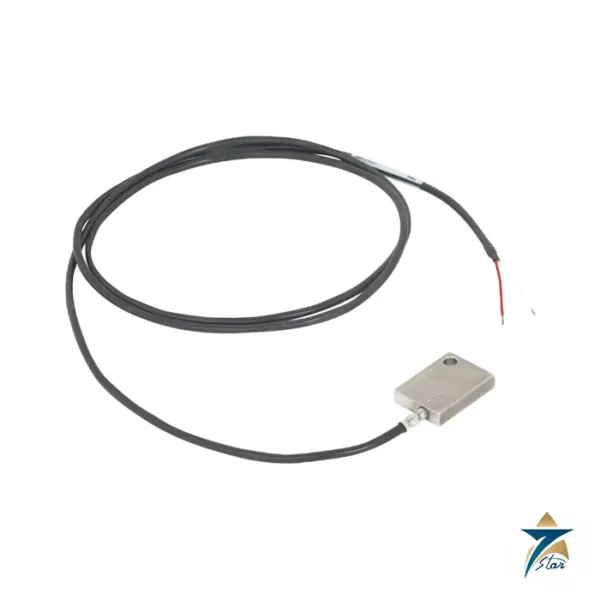
1.0 m, 2.0 m and 3.5 m |
| Fibre-optic focus spacers |
None 500 mm, blue 250 mm, red 100 mm |
| Fibre-optic head and light guide ambient limit |
200 °C (392 °F) maximum |
| Humidity |
0 to 99 % non-condensing |
| Vibration |
3 g, 60 to 300 Hz; 0.5 mm, 10 to 60 Hz |
| Sealing |
To IP65 requirements |
| EMC |
CE, EN 50-082-2 (immunity) and EN 50-081-1 (emission) |
| Accuracy basis |
Quoted to ITS90; valid with Landmark Technic or Graphic processors, uncertainty rises by 50 % with the Basic processor |
Radiation, fibre-optic and ratio models in the System 4 range
The table lists the standard (non-fibre) models with the span, spectral response, response time and accuracy published for each. Fibre-optic equivalents exist for the M1, M2, M3 and R1 types.
| Model |
Range |
Waveband |
Response (95 %) |
Accuracy |
| M1 450/1000C |
450 to 1000 °C |
1 µm |
5 ms |
0.4 % K |
| M1 600/1600C |
600 to 1600 °C |
1 µm |
5 ms |
0.4 % K |
| M1 800/2600C |
800 to 2600 °C |
1 µm |
5 ms |
0.7 % K |
| M2+ 300/1100C |
300 to 1100 °C |
1.6 µm |
5 ms |
0.25 % + 1 K |
| M4 50/250C |
50 to 250 °C |
2.4 µm |
100 ms |
3 K |
| M4 150/550C |
150 to 550 °C |
2.4 µm |
100 ms |
4 K |
| M6+ 0/300C |
0 to 300 °C |
3 to 5 µm |
100 ms |
0.3 % + 2.5 K |
| M6+ 100/700C |
100 to 700 °C |
3 to 5 µm |
100 ms |
0.3 % + 2 K |
| R1 600/1600C |
600 to 1600 °C |
0.85 to 1.1 µm (ratio) |
100 ms |
0.65 % K |
| R1 1000/2600C |
1000 to 2600 °C |
0.85 to 1.1 µm (ratio) |
100 ms |
1.1 % K |
The fibre-optic list adds M3 50/250CQ (50 to 250 °C, 2.1 µm, under 100 ms, 3 K). Each model also exists with a Fahrenheit span, for example M1 1100/2900F.
How the System 4 measurement works
Every System 4 thermometer collects the infrared radiation emitted by the target, converts it to an electrical signal in a detector tuned to a chosen waveband, and passes that to a Landmark processor that linearises, filters and outputs the temperature. Shorter wavelengths such as 1 µm suit hot metal and glass because emissivity errors are smaller there, while 3 to 5 µm is used for cooler or glass-surface work. The ratio R1 type compares two close wavebands, so it keeps reading correctly when the target only partly fills the field of view, when dust or steam obscures part of the path, or when emissivity varies.
The through-the-lens graticule matters in practice. At least 98 % of the energy the thermometer detects is guaranteed to come from the area defined by the graticule, so what the installer sees is what the instrument measures. Focusing can be done without pulling the thermometer out of its protective mounting jacket.
Where System 4 fits in the measurement system
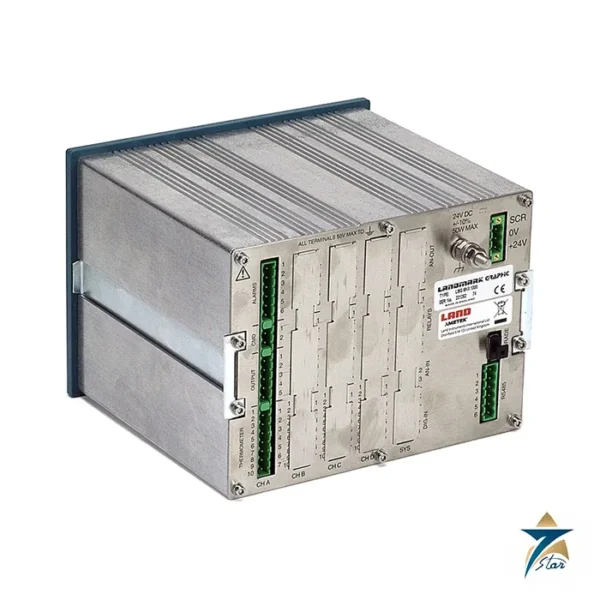
A System 4 thermometer is never a standalone loop device. It connects to a Landmark signal processor: Landmark Graphic MkII, Landmark Technic (DIN-rail), the Basic processor, or a Landmark Indicator (LMi). The processor supplies peak-picker, averager, track-and-hold and alarm functions and the 4 to 20 mA or serial outputs. Thermometers and processors are individually calibrated, so a replacement thermometer can be swapped without re-calibrating the loop. For a simpler installation with a built-in 4 to 20 mA output, the UNO thermometer from the same manufacturer is the standalone alternative, and SOLOnet is the digital option with Ethernet and RS485.
Selecting a System 4 model
- Material and surface: hot metal, glass and refractory work normally points to M1 or M2+; bright or lightly oxidised metal surfaces to M4; low-temperature glass, paper, food and textile work to M6+.
- Emissivity and view conditions: if the target is partly obscured, small, or its emissivity changes, the R1 ratio type is the intended choice.
- Temperature span and Celsius or Fahrenheit labelling of the model code.
- Optics: standard V focus, short S focus, close-up lens, or a fibre-optic head with the 100, 250 or 500 mm spacer.
- Access and ambient: use fibre optic where the detector must be away from heat, strong magnetic fields or RF; check the 200 °C head limit.
- Alignment aid: laser targeting is available on fibre-optic versions marked Y.
- Processor: choose the Landmark unit with the channel count, alarms and outputs the control system needs.
Installation, commissioning and maintenance
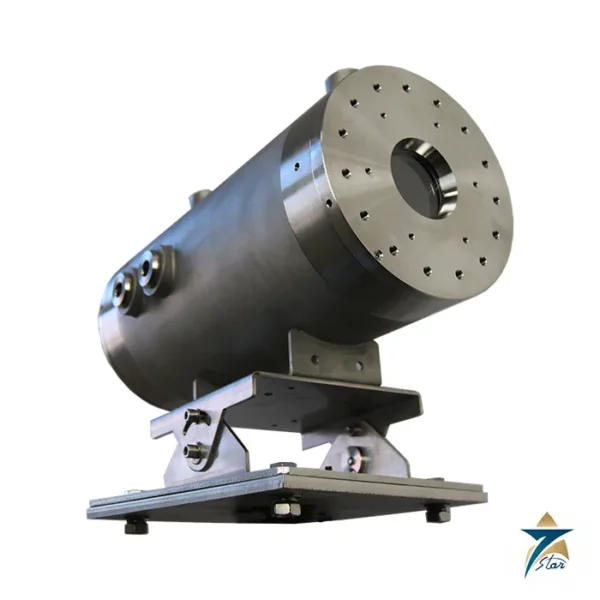
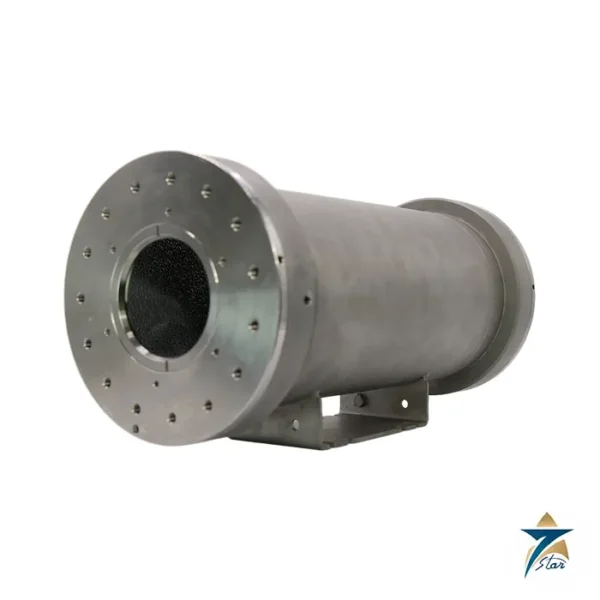
Mount the thermometer in a protective jacket or bracket, aim using the graticule, then set focus to the target distance. Air purging keeps the lens clean in dusty or steamy areas, and water cooling extends use beside furnaces. Keep cables away from power conductors and earth the processor correctly, since the family is rated for immunity to EN 50-082-2 but long unscreened runs are still the main source of noise. After commissioning, check the reading against a reference at one point and record emissivity settings. The lens window should be wiped on a schedule that matches the process. Because calibration is per-unit, spare thermometers should be stocked with their matching processors noted.
Typical applications in Oman and the GCC
In the Gulf region System 4 is relevant wherever a hot product cannot be touched: glass container and float lines, steel and aluminium reheating, ceramic and cement kilns, and metal heat treatment. Fibre-optic variants are used inside enclosures with strong electromagnetic fields, for example induction heating. Ambient temperatures in Oman can exceed 50 °C in the shade, so verify the ambient limit of the chosen thermometer against the mounting position and use purge air or a cooled jacket where needed. Dust and humidity favour sealed IP65 bodies and clean purge air.
Information to send with an RFQ for System 4
- Full model code from the AMETEK Land list, including the C or F span.
- Target material, size, and distance to the lens.
- Target temperature range and required response speed.
- Ambient temperature at the mounting point and any magnetic or RF fields.
- Fibre-optic length and spacer, laser targeting required or not.
- Landmark processor type, number of channels, alarms and output signals.
- Mounting jacket, purge or cooling accessories.
Documents and quotation
The manufacturer brochure for System 4 is attached on this page. It lists the model ranges, optical data and environmental limits used above; please check it before ordering.
Send the exact model code and your application details to Seven Star LLC and we will confirm availability and lead time for Oman and the GCC.
Other Models in the Ametek Land System4 Range
Seven Star LLC supplies models from the Ametek Land System4 range in Oman and the GCC. Compare the related models below and request a quote for the one that matches your application.




















Reviews
There are no reviews yet.