TMT71 iTEMP analog 4–20 mA temperature transmitter
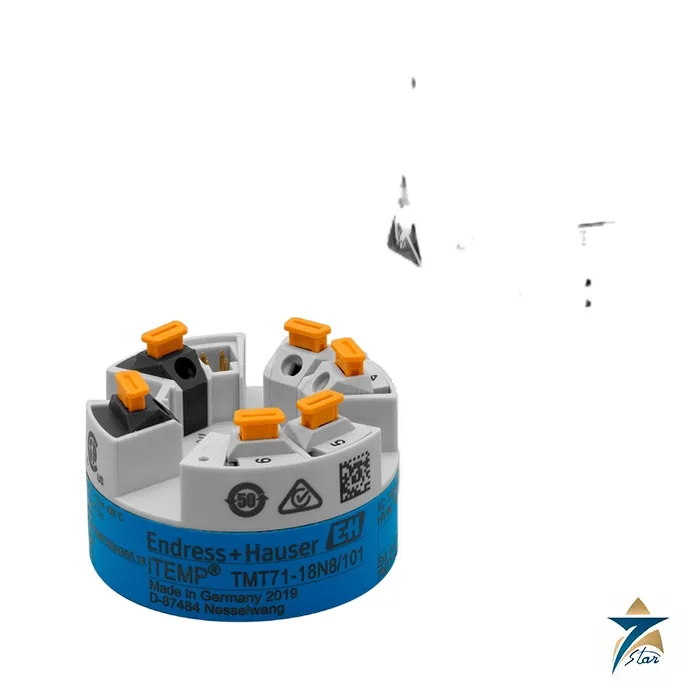
The Endress+Hauser TMT71 is a compact iTEMP temperature transmitter that turns the signal of one sensor into a plain 4–20 mA loop current. It accepts a resistance thermometer (RTD), a thermocouple, a resistance value or a millivolt signal on a single universal input, and it can be fitted as a head transmitter in a form B terminal head, as a DIN rail module in a cabinet, or in a field housing. Setup is by PC using a service interface or, if the optional Bluetooth interface is fitted, from a phone with the SmartBlue app. Seven Star LLC supplies the TMT71 in Oman and the GCC as an independent supplier in Muscat.
Within the iTEMP range the TMT71 is the analog, no-protocol version. If you need a digital HART channel on the same wiring, the TMT72 is the sibling to look at, and for PROFIBUS PA fieldbus the TMT84 applies.
Endress+Hauser TMT71 technical specifications
| Parameter |
Specification |
| Manufacturer / part number |
Endress+Hauser TMT71 (iTEMP TMT71 temperature transmitter) |
| Input |
One universal input: RTD, thermocouple, resistance (10 to 400 Ω or 10 to 2,000 Ω) or voltage (−20 to 100 mV) |
| RTD ranges |
Pt100 −200 to 850 °C; Pt500 −200 to 500 °C; Pt1000 −200 to 250 °C; Ni100/Ni120 −60 to 250 °C; Cu50/Cu100 −180 to 200 °C |
| Thermocouples |
Types A, B, C, D, E, J, K, L, N, R, S, T, U, up to 2,500 °C depending on type; min. span 50 K |
| Output |
4–20 mA or 20–4 mA, invertible; galvanic isolation 2 kV AC input/output |
| Failure signal |
NAMUR NE43: under-range 3.8 mA, over-range 20.5 mA, alarm ≤3.6 mA or ≥21 mA (21.5 to 23 mA selectable) |
| Supply voltage |
Head transmitter 10 to 36 V DC; DIN rail 11 to 36 V DC (non-hazardous area); current consumption ≤23 mA |
| Typical accuracy |
Pt100 0 to 200 °C: 0.08 °C at the current output; type K 0 to 800 °C: 0.35 °C |
| Response / switch-on |
≤1 s response; ≤7 s to first valid value; digital filter 0 to 120 s |
| Ambient temperature |
−40 to +85 °C (hazardous areas per Ex documentation) |
| Degree of protection |
IP20 for head and DIN rail versions; field housing TA30x determines the installed rating |
| Vibration |
Head 2 to 100 Hz at 4 g; DIN rail 2 to 100 Hz at 0.7 g |
| Weight / housing |
Head approx. 40 to 50 g, DIN rail approx. 100 g; polycarbonate, screw or push-in terminals |
| MTTF |
168 years without Bluetooth; 123 years with Bluetooth |
How the TMT71 converts and monitors the sensor signal
The transmitter measures the sensor, linearises it (temperature-linear, resistance-linear or voltage-linear) and scales it to your range. Thermocouple inputs use an internal Pt100 for the cold junction, or you can enter a fixed external reference value between −40 and +85 °C. A 50/60 Hz mains filter and an adjustable first-order damping filter calm noisy signals.
Monitoring is built in: open circuit and short circuit of the sensor wires, wrong wiring, internal faults, over-range and under-range of sensor and electronics temperature are all detected and driven to the NAMUR NE43 alarm levels. Corrosion of sensor leads can be detected per NAMUR NE89 on thermocouples, mV inputs and four-wire RTDs, and if the supply drops below its minimum the output falls below 3.6 mA for about five seconds before retrying. The diagnostics simulation function lets you test how the control system reacts without disturbing the process.
TMT71 sensor matching and measuring ranges
RTDs are linear but not perfectly so, and a real sensor deviates from the standard curve. The TMT71 supports Callendar-Van Dusen coefficients for Pt100 and polynomial linearisation for nickel and copper RTDs, so the sensor and transmitter can be matched using calibration data. A one-point offset adjustment and a correction of the 4 mA and 20 mA output values are available as well. Minimum span is 10 K for RTDs, 50 K for thermocouples, 5 mV for voltage and 10 Ω for resistance. Two-wire RTD circuits allow compensation of lead resistance up to 30 Ω, and three- and four-wire circuits tolerate up to 50 Ω per wire.
Where the TMT71 fits and related iTEMP models
The TMT71 is the economical choice when the control system simply reads 4–20 mA and there is no need for HART data. Typical companion devices are Endress+Hauser thermometer inserts with Pt100 sensors or thermocouple assemblies, active barriers such as the RN series for intrinsically safe loops, and loop-powered indicators. The TMT72 adds HART 7 communication to the same hardware concept, while the TMT84 provides two sensor inputs and PROFIBUS PA instead of an analog loop.
TMT71 selection and ordering checklist
- Installation style: terminal head form B, DIN rail on TH35, or field housing, including the Ex d field housing option for flameproof areas.
- Sensor type and range, wiring (2, 3 or 4 wire) and whether sensor-transmitter matching coefficients are to be loaded.
- Terminal version: screw or push-in; push-in terminals need ferrules for thin flexible wire.
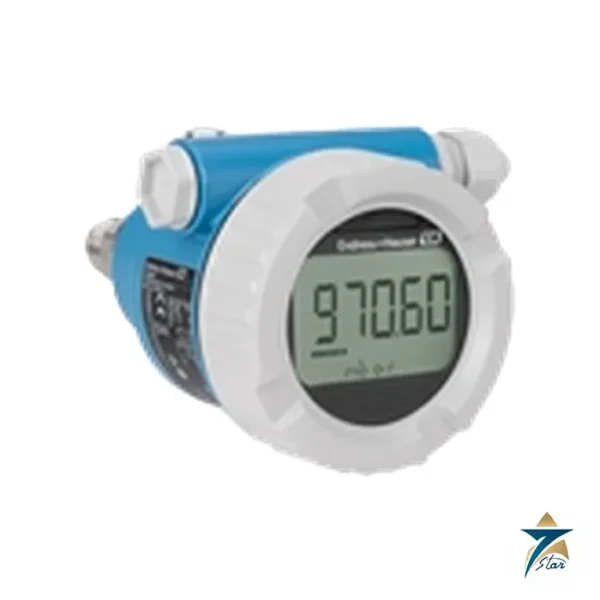
- Bluetooth interface or not, and whether the optional plug-on TID10 display is wanted; the display and Bluetooth cannot be used at the same time.
- Hazardous-area approval and the supply voltage limits from the associated safety instructions.
- Alarm direction and configured range, plus any required tag text.
Installing and commissioning the TMT71
In a terminal head, secure the transmitter on the insert with the standard mounting set and connect sensor wires and loop supply to the numbered terminals; the DIN rail version clips onto a TH35 rail. Use shielded cable in electrically noisy places, and on the DIN rail version shield the sensor cable once it exceeds 30 m. Condensation is acceptable for the head transmitter but not for the DIN rail module, so keep the cabinet dry.
Configuration is done with the TXU10 kit and FieldCare or DeviceCare via the service interface, or wirelessly over Bluetooth within about 10 m of a display-window housing or 5 m inside a closed head. Write protection is available through a switch on the display and a password role concept. For maintenance, keep a spare unit with the same configuration saved; the compact design makes replacement fast.
TMT71 in Oman and GCC plants
Plants across Oman and the GCC use head-mounted transmitters like the TMT71 on process pipework, heaters, exchangers and bearing temperature points where a robust analog signal is all that is needed. The −40 to +85 °C ambient range and vibration rating suit outdoor and skid-mounted installations in hot, dusty conditions, and the Ex d field housing option covers hazardous gas areas. DIN rail versions are common in marshalling cabinets for HVAC, utilities and desalination skids.
Information to send with a TMT71 RFQ
- Sensor type, wiring and required measuring range.
- Head, DIN rail or field housing, with any Ex rating.
- Terminal type and Bluetooth or display requirement.
- Loop supply voltage and the receiving system or barrier.
- Quantity and tag list.
Documents and quotation
The Endress+Hauser Technical Information for the iTEMP TMT71 is attached on this page as a datasheet. It lists measuring ranges, accuracy data, housings and accessories.
Send the TMT71 part number, sensor details and installation style, and Seven Star LLC will confirm availability and delivery for Oman and the GCC.
Other Models in the Eh Itemp Transmitter Range
Seven Star LLC supplies models from the Eh Itemp Transmitter range in Oman and the GCC. Compare the related models below and request a quote for the one that matches your application.



























Reviews
There are no reviews yet.