STT170 series STT 3000 smart temperature transmitters
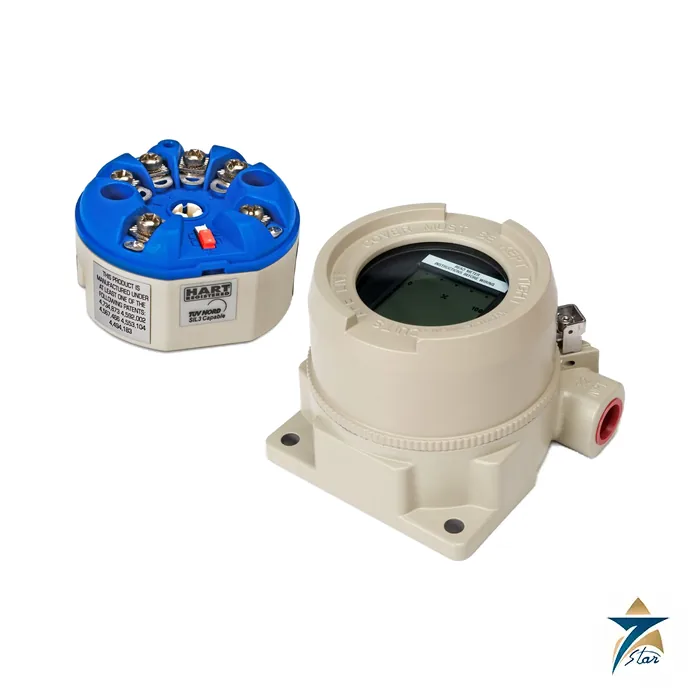
The Honeywell STT170 series is a family of programmable, two-wire temperature transmitters in the STT 3000 line, built as small head-mount modules to DIN Form B. They linearise the signal from an RTD, thermocouple, resistance or millivolt sensor over a range you set and send it back as a 4 to 20 mA loop signal. The series has three transmitter models, STT171, STT173 and STT17H, plus the STT17C PC configuration tool. Seven Star LLC supplies STT170 series transmitters in Oman and the GCC as an independent supplier in Muscat.
These are straightforward, cost-conscious transmitters for sensor heads. For field-housing units with display and Fieldbus, see the STT850; for the newer head-mount design see the STT700.
STT170 series models and what the codes mean
| Model |
Output |
Input |
Notes |
| STT171 |
4 to 20 mA analog |
RTD or ohm input |
Programmed with STT17C; update 135 ms |
| STT173 |
4 to 20 mA analog |
RTD, thermocouple, ohm or mV input |
Galvanic isolation; update 440 ms |
| STT17H |
4 to 20 mA with HART |
RTD, thermocouple, ohm or mV; single or dual sensor (difference or average) |
HART multidrop capable; update 440 ms |
| STT17C |
Configuration tool |
Configures STT171, STT173 and STT17H |
Software and interface for non-hazardous areas only |
STT170 technical specifications
| Parameter |
Specification |
| Manufacturer / part number |
Honeywell / STT170 series (STT171, STT173, STT17H; STT17C configurator) |
| Sensor types supported |
Pt100, Pt1000, Ni100, thermocouples B, E, J, K, L, N, R, S, T, U, W3, W5, ohm and mV (depending on model) |
| Output |
4 to 20 mA; HART on STT17H |
| Sensor-error response |
NAMUR NE43: upscale 23 mA, downscale 3.5 mA; programmable alarm levels 3.5 to 4 mA down, 20 to 23 mA up |
| Supply voltage |
STT171 8 to 30 Vdc; STT173 and STT17H 8 to 35 Vdc |
| Supply voltage effect |
0.005 % of span or less per volt |
| Response time (programmable) |
STT171 0.33 to 60 s; STT173 and STT17H 1 to 60 s |
| Update time |
STT171 135 ms; STT173 and STT17H 440 ms |
| Ambient temperature, rated |
-40 to 85 °C (-40 to 185 °F) |
| Humidity and vibration |
0 to 95 % RH non-condensing; up to 4 g from 25 to 100 Hz |
| Mounting |
DIN Form B head mount; DIN rail clip and field housings are optional |
| Hazardous-area approvals |
ATEX, FM and CSA intrinsically safe versions (BS); zone 2 non-sparking version (BN); CE, EMC to EN 61326 |
How the STT170 works
A microprocessor inside the module reads the sensor, applies the linearisation for the programmed sensor type and scales the result between the 4 mA and 20 mA values you set. For thermocouples, the STT173 and STT17H support internal cold junction compensation or an external Pt100 or Ni100 reference, and the cold junction accuracy is ±1.0 °C. Accuracy is quoted as a fixed value or a percentage of span, whichever is greater: for example the STT171 is ±0.3 °C or 0.1 % of span on a Pt100, and the STT17H is ±0.2 °C or 0.1 % of span on Pt100 and Pt1000, with type K, J, E and T thermocouples at ±0.5 °C.
If the sensor fails the output goes to a programmable alarm current, by default following NAMUR NE43. The STT17H also supports a dual sensor with averaging or difference, and HART multidrop on the same loop wiring.
STT170 compatibility and related parts
The STT170 series fits any DIN Form B sensor head and works with standard 4 to 20 mA input cards; the STT17H also works with HART hosts. The series can also be installed in Honeywell field-mount enclosures when approvals require it. Other Honeywell temperature models we quote are STT850 and STT700; for flow and level points see the SMV800 multivariable transmitter and the SmartLine GWR and NCR level transmitters.
STT170 selection and ordering checklist
- Model: STT171 (RTD or ohm, analog), STT173 (universal, isolated, analog) or STT17H (universal, HART, dual-sensor option).
- Safety approval: none (00), BS for intrinsically safe FM, CSA and ATEX use, or BN for zone 2 non-sparking use. Field-mount enclosure selections have their own approval codes.
- Configuration: factory default or custom configuration with printed report (tag, sensor type, wiring, range, units, output limits, sensor error action and response time).
- Calibration: standard, or custom calibration with printed report.
- Mounting and accessories: pipe bracket, spring-loaded mounting set, DIN rail clip (part 50017850-001), M20 or 3/4 NPT adaptors and lightning protection in field housings.
- Option code for extended warranty, stainless tag and operator manual language.
Installing and commissioning the STT170
Fit the module in a DIN Form B head on the sensor insert, wire the sensor according to the wiring diagram for the sensor type (2, 3 or 4 wire RTD, thermocouple or mV), then connect the two-wire loop. The loop load limit is (supply voltage minus 8) divided by 0.023 A; the datasheet gives a maximum of 870 ohm for the STT171 and 1174 ohm for the STT173 and STT17H.
If you order a default unit, set range, sensor and failsafe with the STT17C before installation; the configurator is not approved for hazardous areas, so configuration should be done in the workshop or a safe area. The STT17C software is quite old (it lists Windows 98SE to XP), so plan for a suitable laptop or request the transmitter pre-configured to your tag list.
Typical STT170 applications in Oman and the GCC
The STT170 series suits existing plants that already use sensor heads with 4 to 20 mA input cards: skid and package temperatures, heat tracing and heater control, pump and motor bearing monitoring, and utility lines in power, desalination and petrochemical facilities. The wide supply range and sensor-error response make it easy to match old loops, and the -40 to 85 °C rating suits the heat of exposed outdoor heads in Oman and the Gulf.
Information to send with an STT170 RFQ
- Model (STT171, STT173, STT17H or STT17C) and the full order code if replacing.
- Sensor type, wiring, range and units.
- Approval needed: general purpose, intrinsically safe or zone 2.
- Mounting: head, pipe bracket, DIN rail or field housing.
- Quantity, tag list and destination.
Documents and quotation
The Honeywell STT 3000 STT170 specification (34-TT-03-07) is attached on this page, with the model selection guide and the custom configuration sheets. Send your STT170 model code and sensor data and we will confirm availability and quote.
Seven Star LLC is an independent supplier in Muscat; we quote against the part number you give us.
Other Models in the Honeywell Smartline Stt Range
Seven Star LLC supplies models from the Honeywell Smartline Stt range in Oman and the GCC. Compare the related models below and request a quote for the one that matches your application.



























Reviews
There are no reviews yet.