Delta DVP-50MC EtherCAT multi-axis motion controller
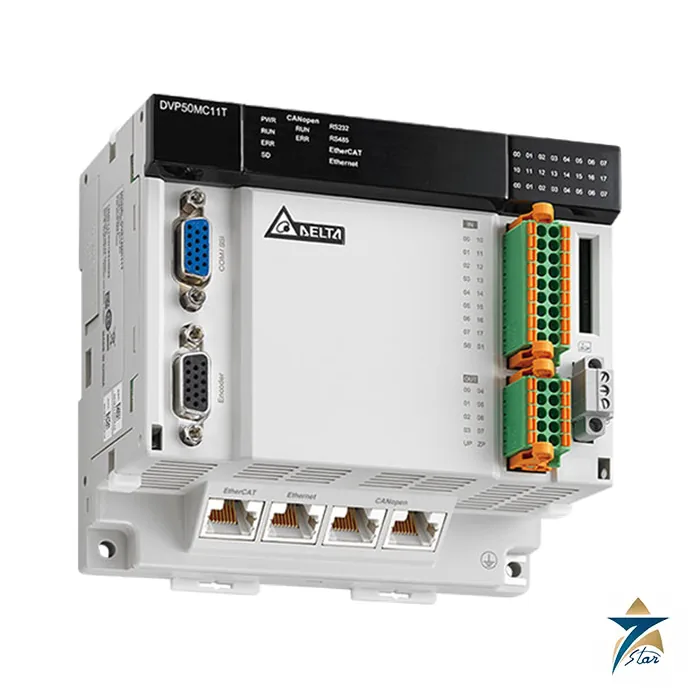
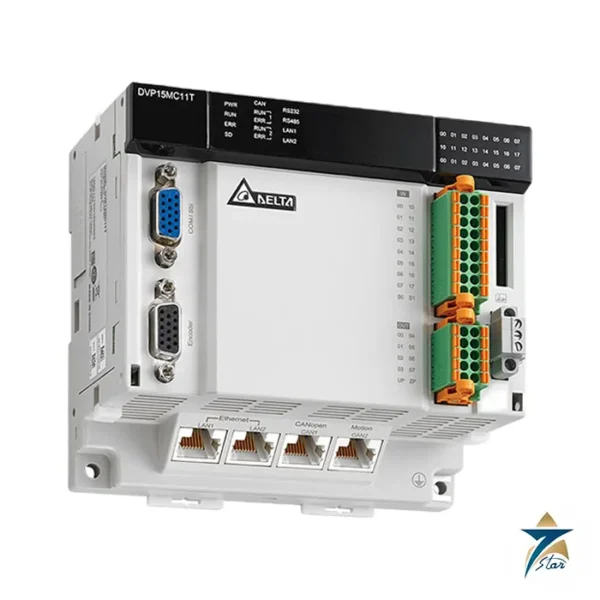
The Delta DVP-50MC is a multi-axis motion controller developed by Delta on EtherCAT technology. It follows the standard motion-control instruction libraries defined by international organisations, which shortens the learning curve for engineers who already know that style of programming. The controller can manage up to 32 real axes through its EtherCAT port, and the unit shown on the product page carries the label DVP50MC11T.
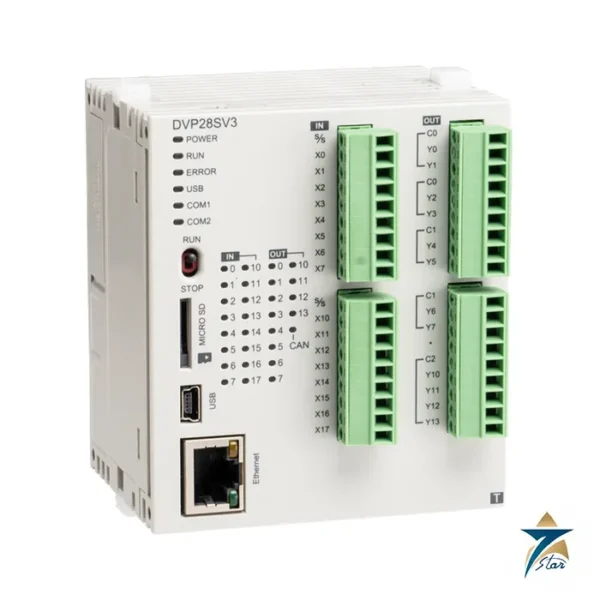
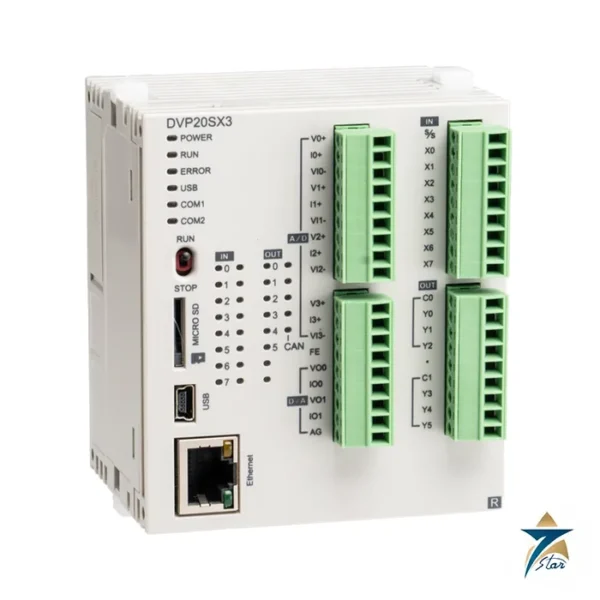
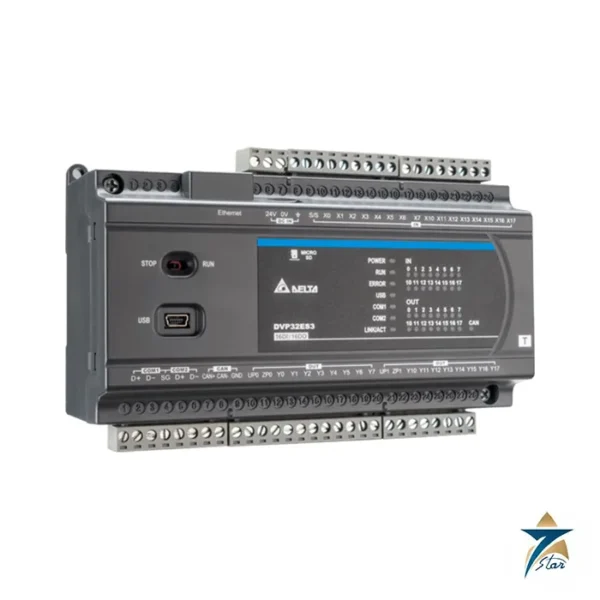
Compared with the slim DVP-SV3, DVP-SX3 and DVP-SE2 PLCs, the DVP-50MC is built for coordinated movement rather than general discrete control. Seven Star LLC supplies the DVP-50MC in Oman and the GCC as an independent supplier in Muscat.
Reading the model name
DVP is the family, 50MC the EtherCAT motion controller, and the 11T suffix on the labelled unit is a Delta model code. The product page does not break the suffix down, so confirm the exact ordering code for your project before ordering.
DVP-50MC technical specifications
| Parameter |
Specification |
| Manufacturer / part number |
Delta / DVP-50MC (unit pictured labelled DVP50MC11T) |
| Motion bus |
EtherCAT, up to 32 real axes; virtual axes 1 to 32 |
| Processor |
1 GHz floating-point; LREAL (double precision) supported |
| Synchronisation |
32 axes in 1 ms |
| Memory |
Program capacity 20 MB; data capacity 20 MB |
| Motion instructions |
Speed, torque, homing, position; electronic gear, E-Cam, rotary cut; G-code and group axes with 8-axis linear, arc and helical interpolation; Jerk and BufferMode |
| Fast I/O |
16 high-speed inputs, 8 high-speed outputs |
| Encoder interfaces |
2 incremental encoder, 1 SSI absolute encoder |
| Communication |
1 EtherCAT, 1 CANopen (host or slave), 1 Ethernet, 1 RS-232, 1 RS-485, 1 SD card slot |
| Extension |
Left: up to 8 DVP-S series modules (master/slave communication, analog); right: DVP-S series modules, 240 inputs + 240 outputs, 8 special modules |
How the DVP-50MC controls motion
A real axis is a drive reached over EtherCAT; a virtual axis is a calculated master that other axes can follow; an encoder axis reads position from an external encoder. This lets the program build a leader and follower arrangement, such as an electronic cam driven by a virtual master, without depending on a physical drive.
Single-axis instructions move one axis by speed, torque, homing or position. Application instructions then combine axes: electronic gear links a follower to a master at a ratio, E-Cam follows a profile table, rotary cut matches a blade to web speed, and the G-code engine interpolates along lines, arcs and helices for up to 8 axes. Jerk limiting smooths acceleration, and BufferMode lets the next command queue behind the current one.
The 20 MB program and 20 MB data areas leave room for long cam tables, recipe sets and G-code programs. The floating-point processor with double-precision LREAL support suits calculations such as gear ratios and path geometry where rounding error would otherwise build up over long travel.
Fitting the DVP-50MC into a system
The EtherCAT port connects servo drives and other EtherCAT nodes. The CANopen port can work as host or slave for other equipment, the Ethernet port connects to HMI or supervisory systems, and the serial ports support legacy devices. DVP-S series modules plug in on both sides for added I/O, analog and communication functions.
The sibling DVP-15MC keeps the same instruction set but moves the motion network to CANopen. For simpler pulse-output machines, the DVP-SE2 supports four 100 kHz pulse axes without a motion controller. Make sure the drives you plan to connect have EtherCAT support and a compatible device description.
Think about the whole chain: controller, EtherCAT drives, motors, encoders and cables should all be specified together, and the cycle time of the machine should be checked against the 1 ms synchronisation figure.
Selection checklist for the DVP-50MC
- Axis count: real, virtual and encoder axes, against the 32-axis limit.
- Update time: confirm that 1 ms synchronisation meets the machine cycle.
- Drive type: EtherCAT servo drives and their device description files.
- Motion functions: gear, cam, rotary cut or G-code interpolation (8 axes).
- Feedback: incremental encoders (2) or an SSI absolute encoder (1).
- Expansion: DVP-S modules needed on each side.
- Program size: 20 MB program and 20 MB data memory.
Installation, commissioning and spares for the DVP-50MC
Mount in a clean cabinet with room for cable bend radius on the EtherCAT and encoder cables. Keep encoder cables apart from power cables and use shielded, correctly grounded cable. Commission one axis at a time: confirm direction, scaling, homing and limits before enabling gear or cam relations between axes.
Keep a backup of the project and the cam tables on the SD card. For machines where downtime is costly, stock a spare controller of the identical model code, and record the EtherCAT topology so a replacement can be configured quickly.
Typical DVP-50MC applications in Oman and the GCC
The manufacturer names high-speed cutting machines, digital board cutting machines and CNC lathes. In the region, similar coordinated-motion needs occur in packaging and converting lines, sheet and board cutting, textile and label machinery, and fabrication equipment built by OEMs. Panels in hot, dusty workshops should be ventilated or cooled with filtered air.
DVP-50MC compared with the DVP-15MC
| Controller |
Key points |
| DVP-50MC |
EtherCAT; up to 32 real axes; 32 axes in 1 ms; 1 Ethernet port |
| DVP-15MC |
CANopen motion port; up to 32 axes; 4 axes in 2 ms or 8 axes in 4 ms; 2 Ethernet ports |
Information to send with a DVP-50MC RFQ
- Exact model code from the nameplate or drawing.
- Number and type of axes, with drive make and model.
- Encoder types and fast I/O needs.
- Required extension modules.
- Machine cycle time and delivery location.
Documents and quotation
We do not hold a direct datasheet link for the DVP-50MC on this page. Send the part number and we will confirm available documents.
Include the axis list and quantity and we will reply with availability from Muscat.
Other Models in the Delta Dvp Mc Range
Seven Star LLC supplies models from the Delta Dvp Mc range in Oman and the GCC. Compare the related models below and request a quote for the one that matches your application.


























Reviews
There are no reviews yet.