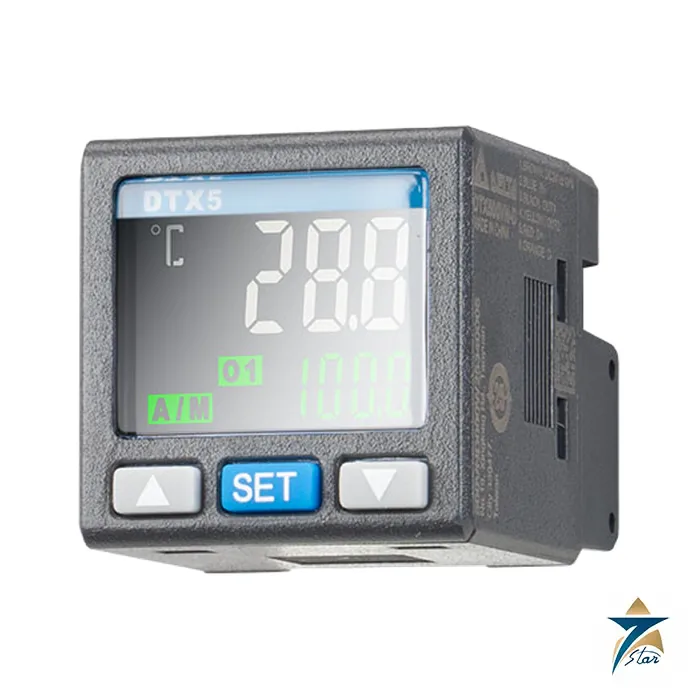
DTX500 30 × 30 mm mini temperature controller
The Delta DTX500 is a panel-mount temperature controller packed into a 30 × 30 mm front, with an LCD display and operating keys built into the same body. It reads thermocouple, platinum RTD and analog voltage or current signals, runs a PID or ON/OFF algorithm, and drives a heater or SSR through its control output. Seven Star LLC supplies the DTX500 in Oman and the GCC as an independent supplier in Muscat, mainly for OEM machines, small ovens and skid-mounted heating loops where front-panel space is scarce.
The name is a model designation, not a coded ordering string. The product page for the DTX500 lists one specification set, so there are no option digits to decode here. If you need a different output combination or a wider-format controller, tell us the function you need and we will suggest the matching family member, for example the DIN-rail DTC3000 described below.
DTX500 technical specifications
| Parameter |
Specification |
| Manufacturer / part number |
Delta / DTX500 |
| Format |
30 × 30 mm mini panel controller, dimensions 30 × 30 × 40.8 mm |
| Thermocouple inputs |
K, J, T, E, N, R, S, B, L, U, TXK, C, D |
| RTD inputs |
Pt100, JPt100, Cu50, Ni120 |
| Analog inputs |
0–5 V, 0–10 V, 0–20 mA, 4–20 mA, 0–50 mV |
| Sampling period |
20 ms or 50 ms (default 50 ms) |
| Display accuracy at 25 °C ambient |
Thermocouple: ±1 °C or ±0.3 % of PV, whichever is greater (varies by thermocouple type); platinum RTD: ±1 °C or ±0.2 % of PV, whichever is greater |
| Cold junction compensation error |
±0.5 °C at about 25 °C ambient, or ±1.5 °C from 0 to 50 °C ambient |
| Control method |
PID or ON/OFF, heating or cooling action, auto or manual mode |
| First output |
Voltage pulse, DC 12 V ±15 %, max 50 mA, for driving an SSR |
| Secondary output |
NPN transistor, max 30 V / 50 mA, residual voltage when ON max 1.5 V |
| Output cycle |
Control output and subsidiary output 0.1 to 60 s |
| Communication |
RS-485, Modbus ASCII or RTU; 2400 to 115200 bps |
| Supply |
DC 24 V ±10 %, power consumption 1.5 W or less |
| Operating temperature / humidity |
0 to +50 °C, no frost; 35 to 80 % RH, non-condensing |
| Storage temperature |
-20 to +65 °C |
| Vibration / shock |
10–55 Hz, 10 m/s², 3 axes, 10 min / max 300 m/s², 3 axes, 6 directions, 3 times each |
How the DTX500 controls temperature
The controller measures the process value (PV) at the selected sampling rate and compares it with the set value. Delta describes the algorithm as 2-DOF PID, meaning two degrees of freedom: the response to a setpoint change and the response to a disturbance can be tuned separately. In practice this is aimed at shortening recovery time after a door opening, a cold load or a change in line speed, without forcing a sluggish setpoint response.
The output chain is simple. The first output is a 12 V pulse train intended for a solid-state relay, with a cycle time you set between 0.1 and 60 s. The second output is an NPN transistor that can serve as a control output or as an alarm output, depending on how the parameters are set. The controller also carries anomaly detection, a loop break alarm (LBA) and several alarm modes, so a broken heater, a failed sensor or a stuck relay can be reported instead of silently drifting away from setpoint.
Where the DTX500 fits and related parts
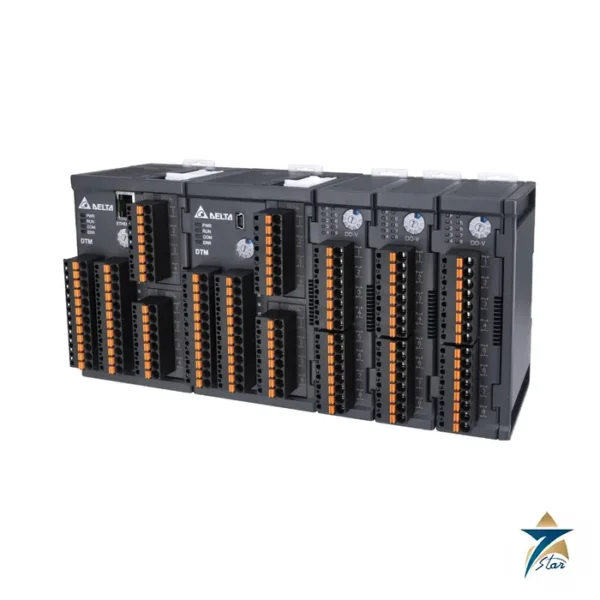
The DTX500 sits at the compact end of Delta’s temperature controller range. The same product page group also covers the DTC3000, a 12.9 mm slim DIN-rail controller with a relay subsidiary output, and the DTDM series, a modular multi-loop system with EtherCAT. Choose the DTX500 when the controller must be visible and operable from the front of a panel or machine; choose the DTC3000 when many loops share a cabinet and the display is not needed on every loop.
Because the supply is 24 V DC and the first output is a logic-level pulse, expect to pair the controller with an external SSR, a contactor driver or an interposing relay for the actual heater power. Thermocouples, RTDs, SSRs and 24 V DC power supplies are separate items that Seven Star can quote alongside the controller on request.
Selection and ordering checklist for the DTX500
- Sensor type and range: thermocouple letter type, Pt100 or other RTD, or an analog signal such as 4–20 mA.
- Output requirement: a pulse output for an SSR is standard on the first output; confirm that an NPN transistor, not a relay or analog output, suits your alarm or second-stage device.
- Supply: the unit needs DC 24 V ±10 %; plan a regulated supply and fusing.
- Panel cut-out and depth: the body is 30 × 30 mm at the front and 40.8 mm deep, mounted in the panel or with the bracket.
- Communication: Modbus ASCII/RTU on RS-485, with the baud rate and address matched to your PLC or SCADA master.
- Environment: rated 0 to +50 °C and 35 to 80 % RH non-condensing, so check cabinet temperature, not just room temperature.
Installation, commissioning and maintenance
Mount the controller in a clean panel cut-out or on the bracket, keeping the sensor leads away from heater and motor cables. For thermocouples, use the correct extension wire for the selected type right up to the terminals, because the cold junction compensation is done at the controller. Set the input type and range first, then the output cycle for the SSR, then alarms and the loop break time. Use the controller’s tuning function or manual PID values, and confirm the response on the actual load rather than on a bench dummy.
Maintenance is mostly external: re-verify the sensor against a reference when accuracy matters, check SSR heat sinking, and look at the alarm history after unexplained temperature deviations. Keep a record of the parameter set so that a replacement unit can be loaded with identical settings; the RS-485 Modbus port is the integration route to a PC or PLC; confirm the available parameter map in the user manual.
Typical applications for the DTX500 in Oman and the GCC
Delta lists electronics manufacturing, packaging machinery, food and beverage production, woodworking machinery and industrial ovens as application areas. In the Omani and wider Gulf market the same logic applies to small process heating tasks: sample conditioning heaters, laboratory and test ovens, heat-sealing stations, packaging lines, workshop curing ovens and OEM equipment built for local plants. The compact format helps where a skid or machine panel has little free front area.
The Gulf climate puts the emphasis on cabinet thermal design. The controller is specified to 50 °C, so panels in direct sun, in enclosed rooms without cooling or close to heaters need ventilation or air conditioning, and humidity ingress should be controlled with sealed entries. This is a general-purpose industrial controller, and we do not present it as a hazardous-area device.
DTX500 compared with other Delta temperature controllers
| Model |
Key features |
Typical use |
| DTX500 |
30 × 30 mm panel mount, LCD front, pulse + NPN transistor outputs, 24 V DC |
Machine and oven front panels |
| DTC3000 |
12.9 mm wide DIN-rail, 7 status LEDs, pulse + SPST relay output, 24 V DC |
High-density cabinets |
| DTDM series |
Modular, up to 32 PID loops and 128 I/O channels, EtherCAT module |
Multi-zone systems with a host controller |
Information to send with a DTX500 RFQ
- Quantity and whether the unit replaces an existing controller (send the old model and nameplate photo).
- Sensor type, measuring range and number of loops.
- Heater or SSR rating and the control output you intend to use.
- Alarm functions, communication protocol and PLC or SCADA make.
- Panel details, supply voltage and ambient conditions.
- Delivery location in Oman or elsewhere in the GCC.
Documents and quotation
A datasheet is not attached to this page. Send us the part number DTX500 and we will confirm which official documents are available for your configuration, together with lead time and commercial terms.
Seven Star LLC is an independent supplier in Muscat and is not an official representative of Delta. Quotations are prepared against the part number and quantity you supply.
Other Models in the Delta Tempctrl Range
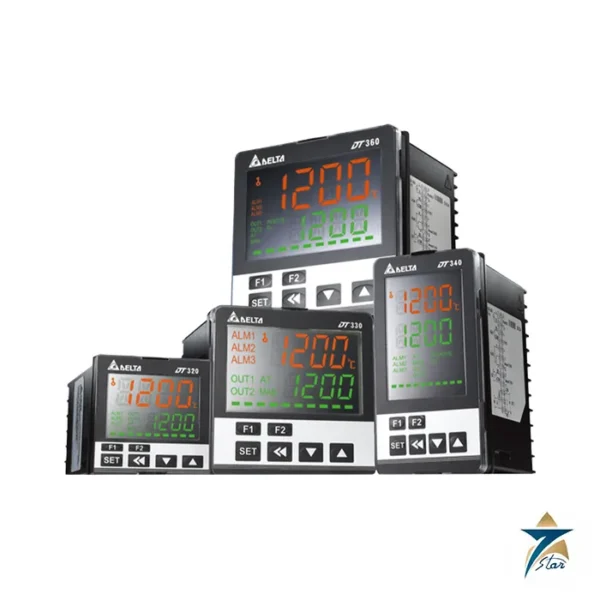
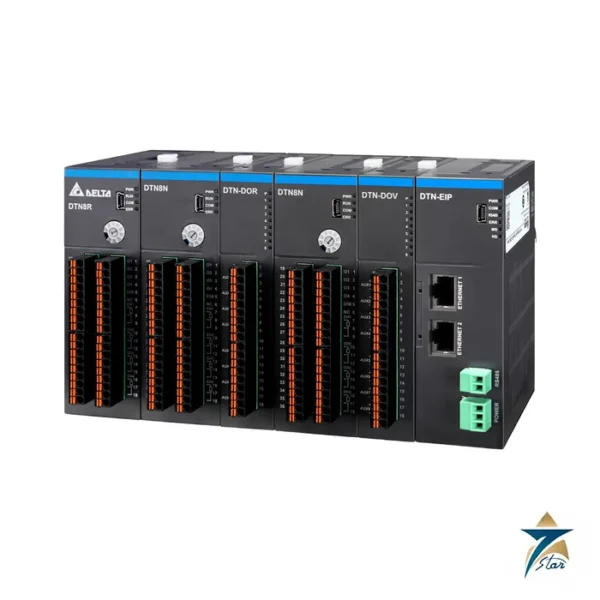
Seven Star LLC supplies models from the Delta Tempctrl range in Oman and the GCC. Compare the related models below and request a quote for the one that matches your application.


















Reviews
There are no reviews yet.