Early warning of lithium-ion battery off-gassing
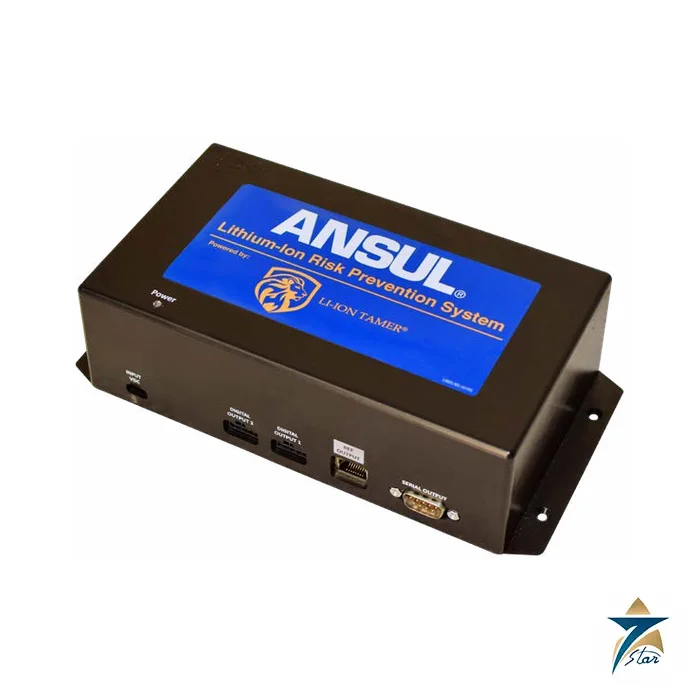
The Ansul Lithium-Ion Risk Prevention System monitors battery racks for the off-gases that a failing lithium-ion cell releases before thermal runaway. Ansul describes it as an early-warning detection layer for energy storage systems, with a 5 second response time, and says it is patent pending. The controller continuously monitors the ambient environment and the battery rack air and looks for changes of less than 1 ppm of lithium-ion off-gas compounds.
Technical specifications
| Parameter |
Specification |
| Manufacturer / brand |
Ansul, a Johnson Controls brand |
| Function |
Early detection of lithium-ion battery off-gases and toxic vapors |
| Sensors |
One reference sensor (ambient air) and one monitoring sensor (inside battery racks) per system |
| Detection sensitivity |
Changes of less than 1 ppm of lithium-ion off-gas compounds |
| Response time |
5 seconds |
| Interfaces |
Communicates with the battery management system; works with AUTOPULSE detection and INERGEN or SAPPHIRE suppression |
| Intended applications |
Wind farms, solar farms, data center battery rooms, battery manufacturers, EPC companies |
| Status in brochure |
Patent pending |
| Document |
Product overview, form F-2020071-02_A4 (copyright 2021) |
How it fits a battery room
On an off-gas alarm the system can signal the battery management system to disconnect batteries before thermal runaway, and it raises local and remote alarms to inform personnel and emergency teams. When combined with the AUTOPULSE detection and INERGEN or SAPPHIRE fire suppression systems, it may activate the suppression system to mitigate off-gas ignition. The brochure describes four stages: battery abuse, off-gas generation, smoke generation and fire, and places the system at the off-gas stage, ahead of smoke detection.
This is a gas-sensing prevention layer, not a replacement for fire detection or suppression in the room, and the system configuration varies with the battery materials and rack layout.
What to confirm before ordering
Confirm the battery chemistry, the number of racks, the battery management system interface, the power supply and the fire panel it will be wired to. The brochure does not list electrical ratings, ordering codes or approvals, so these must be requested from the manufacturer for the project.
Planning the sensor locations
The system compares two readings: the reference sensor in the ambient air of the room and the monitoring sensor in the battery rack air. The value of that comparison depends on where each sensor sits. The monitoring sensor should be placed where off-gases from the racks will reach it quickly, taking into account the airflow created by the room cooling units and any ventilation path. The reference sensor should represent the general room air without being directly in the exhaust stream of the batteries. Agree both positions with the manufacturer's design documents and the battery supplier's rack drawings before installation, because a sensor placed in a dead air pocket or directly in a supply air jet may see off-gas late or diluted.
Also review how the room may change over its life. Extra racks, relocated cooling units or new cable trays can alter airflow, so the sensor layout should be checked again whenever the battery system is extended.
Integration and commissioning
Commissioning is a joint task between the fire protection contractor, the battery integrator and the site operator. Each signal described in the brochure should be tested end to end: the off-gas alarm reaching the battery management system and causing the intended disconnection, the local and remote alarms reaching the people who must respond, and, where AUTOPULSE detection with INERGEN or SAPPHIRE suppression is part of the design, the agreed interaction with the suppression release logic. Write a cause-and-effect matrix before testing and tick off each line as it is proven.
Test methods for the gas sensing itself must follow the manufacturer's instructions. Record the results, the configuration used and the names of the witnesses, and keep them with the fire system handover file.
Battery rooms and containers in Oman and the GCC
Many solar farms, telecom sites and data center battery rooms in the region use containerised or prefabricated enclosures exposed to strong sun, high summer temperatures, wind-blown dust and, along the coast, humid air. These conditions put extra load on the cooling systems that keep batteries within their own temperature limits, and a cooling failure is one of the situations in which early warning of off-gassing is most useful. Make sure the detection system power supply and its alarm transmission path remain available when the cooling or main supply is lost, in line with the project fire design.
Dust ingress through doors, louvres and cable openings should be controlled, both to protect the batteries and to keep the detection equipment in good condition. Plan cleaning and filter changes for the room so that airflow patterns used in the sensor layout are not changed by blocked grilles.
Ongoing inspection and maintenance
Include the off-gas detection system in the site fire protection maintenance schedule, with inspection and test intervals taken from the manufacturer documents and the applicable local fire regulations. Review alarm and fault history with the battery operator, investigate every alarm even if no fire followed, and confirm that the battery management system link still works after software updates on either side. Training for site staff should explain that an off-gas alarm is an early warning that calls for action, not a nuisance signal to be silenced.
Keep the emergency response procedure next to the alarm point in plain language: who checks the room, from where it may be observed safely, when the battery supplier is called, and when the fire service must be informed. Rehearse this procedure with the operations team at least as often as the site emergency drills, and update it whenever contacts, the battery layout or the suppression arrangement change, so that the early warning gained by detecting off-gas is not lost through hesitation.
Documents and quotation
The attached file is the Ansul Lithium-Ion Risk Prevention System product overview (form F-2020071-02_A4, 8 pages). It is a marketing overview, not a design manual, so hardware part numbers and design limits must come from the manufacturer design documents. For a quotation send the hazard or protected volume, the number of enclosures and the site standard. See Fire Fighting for related fire protection equipment.





























Reviews
There are no reviews yet.