Honeywell STF700 SmartLine flange-mounted pressure and level transmitter
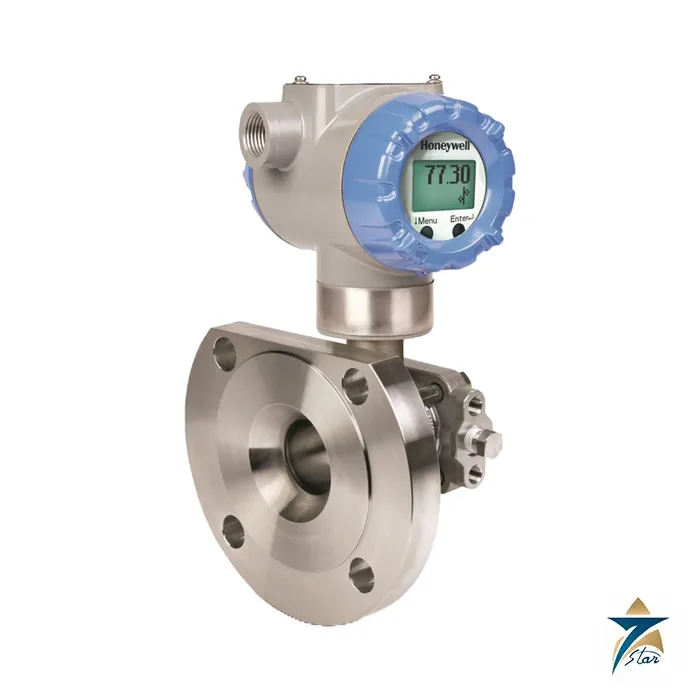
The Honeywell STF700 is a SmartLine ST 700 transmitter that bolts directly onto a tank or vessel flange. The diaphragm sits at the nozzle, so there are no impulse lines, no dead legs and no plugging, and the measured pressure difference between the nozzle and a reference connection is converted into level. Seven Star LLC supplies the STF700 in Oman and the GCC as an independent supplier in Muscat.
The datasheet describes flush and extended diaphragm versions plus a pseudo-flange version, all on the same piezoresistive sensor with automatic static pressure and temperature compensation. Accuracy is up to 0.05% of span (0.04% optional), stability is up to 0.02 to 0.03% of URL per year over ten years, and the STF700 reaches 100:1 rangeability with response times as fast as 100 ms.
The four STF700 model numbers
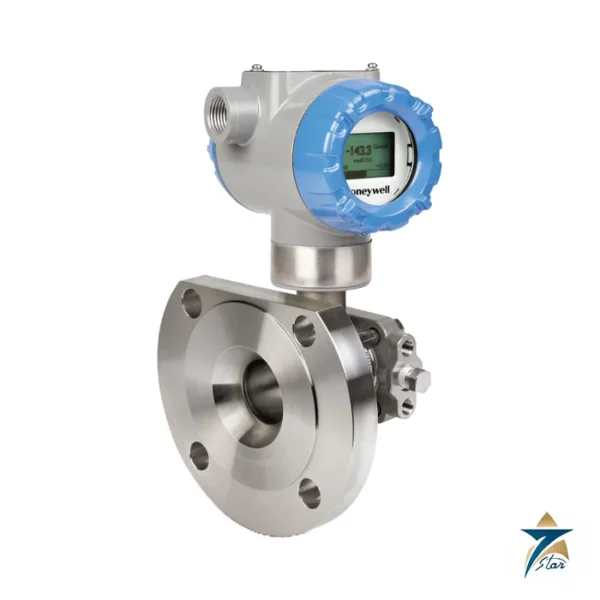
STF725 and STF735 carry the heavier flange mounting, with a flush or extended diaphragm. STF72P and STF73P are the P versions, a more compact pseudo-flange design. In each case the digit after the 2 or 3 indicates the range class, with 2 for inches of water and 3 for 100 psi.
STF700 technical specifications
| Parameter |
Specification |
| Manufacturer / part number |
Honeywell / STF700 (SmartLine flange-mounted level transmitter family) |
| Models and ranges |
STF725, STF72P: ±400 inH2O (±1,000 mbar), min span 4 inH2O (10 mbar); STF735, STF73P: ±100 psi (±7 bar), min span 1 psi (0.07 bar) |
| Reference accuracy |
0.05% of span standard, 0.04% optional (terminal based; analog output adds 0.006% of span) |
| Stability and turndown |
0.02% of URL per year (STF725, STF72P) and 0.03% (STF735, STF73P) for 10 years; turndown 100:1 |
| Total performance examples |
STF725 at 80 inH2O 0.536%, STF72P 0.191%; STF735 at 20 psi 0.514%, STF73P 0.167% of span (5:1 turndown, 28 °C shift, 300 psi static) |
| Output and protocol |
Two-wire 4-20 mA with HART 7; NAMUR NE 43 selectable; supply 10.8 to 42.4 VDC, 0 to 1,440 ohm |
| Ambient temperature |
−40 to 85 °C (DN PN40 flanges −10 to 50 °C); storage −55 to 120 °C |
| Process interface temperature |
STF725/735: −40 to 110 °C rated, to 175 °C operative (CTFE fill 150 °C maximum); meter body −40 to 125 °C operative |
| Flange connections |
STF725/735: 2, 3 or 4 inch ANSI Class 150 or 300, DN50, DN80 or DN100 PN40; extended diaphragm 2, 4 or 6 inch (50, 101, 152 mm); STF72P/73P: 2 or 3 inch ANSI Class 150 |
| MAWP (STF725/735, −29 to 38 °C) |
ANSI 150: 285 psi carbon steel, 275 psi 304/316 SS; ANSI 300: 740 psi carbon steel, 720 psi SS; DN PN40: 580 psi carbon steel, 534 psi SS; STF72P/73P: 230 psi (15.9 bar) |
| Diaphragm and head materials |
316L SS or Hastelloy C-276; heads 316 SS, zinc-plated carbon steel or Hastelloy; extension tube 316 SS |
| Fill fluids |
Silicone 200 or CTFE |
| Reference head and connection |
1/4 inch NPT, or 1/2 inch NPT with adapter and DIN options; single or dual ended with vent and drain choices |
| Housing |
Polyester powder coated aluminum or stainless; Type 4X / IP66 / IP67 |
| Weight |
STF725/735: 18 to 32 lb (8.2 to 14.5 kg); STF72P/73P: 14 to 19 lb (6.4 to 8.7 kg) with aluminum housing |
| Safety |
IEC 61508 SIL 2 / SIL 3; NAMUR NE-107 diagnostics; NACE option |
How a flange-mounted level transmitter works
The flange on the transmitter is bolted straight to a nozzle on the tank, so the diaphragm sees the hydrostatic head of the liquid plus the pressure in the vessel. The low-side connection takes the reference pressure, such as the vapor space of a closed vessel or atmosphere on an open tank, and the sensor measures the difference, which is proportional to the height of liquid above the diaphragm for a known density.
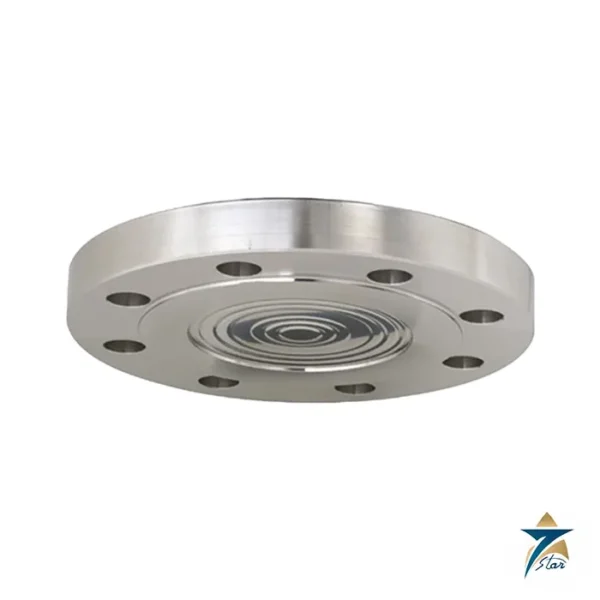
Because the fill fluid is sealed inside the meter body, nothing is exposed except the diaphragm face, which is why this design suits viscous, crystallizing or corrosive liquids that would block an impulse line. The STF725 and STF735 are also available with an extended diaphragm that projects into the nozzle, which avoids a pocket in thick-walled or lined connections. The datasheet offers extensions of 2, 4 and 6 inches.
The honest limit of any flange-mounted level transmitter is temperature. The process interface heats the meter body, and the fill fluid expands. Honeywell gives rated and operative limits for the interface and notes that the CTFE fill fluid is limited to 150 °C, so hot service must be checked against both numbers.
STF700 pressure ratings by flange
The MAWP of the STF725 and STF735 is set by the flange class and material and falls as temperature rises. The table shows the ambient-temperature (−29 to 38 °C) and 125 °C meter body values from the datasheet.
| Flange (STF725/735) |
Material |
−29 to 38 °C |
At 125 °C body |
| ANSI Class 150 |
Carbon steel |
285 psi (19.6 bar) |
245 psi (16.9 bar) |
| ANSI Class 150 |
316 SS |
275 psi (19.0 bar) |
225 psi (15.5 bar) |
| ANSI Class 300 |
Carbon steel |
740 psi (51.0 bar) |
668 psi (46.0 bar) |
| ANSI Class 300 |
316 SS |
720 psi (49.6 bar) |
590 psi (40.7 bar) |
| DN PN40 |
Carbon steel |
580 psi (40.0 bar) |
574 psi (39.6 bar) |
| DN PN40 |
316 SS |
534 psi (36.8 bar) |
434 psi (29.9 bar) |
The STF72P and STF73P have a 316L stainless Class 150 mounting flange, rated 230 psi (15.9 bar) in the normal range and 185 psi (12.8 bar) at 125 °C. Overpressure is 1.5 times MAWP.
Related SmartLine models for level and pressure
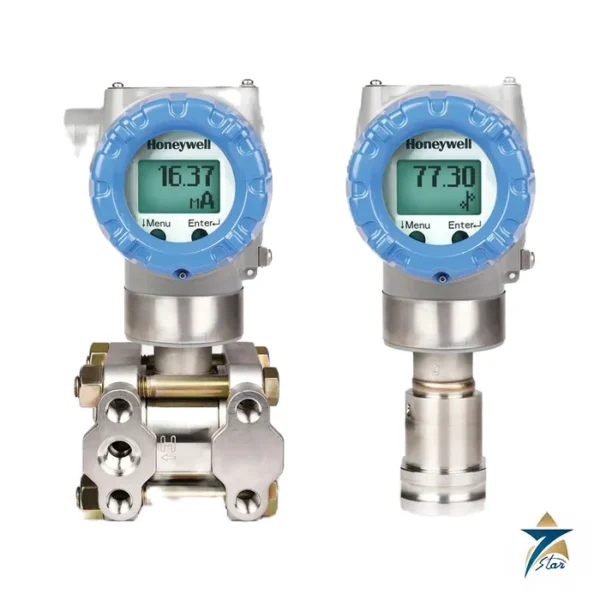
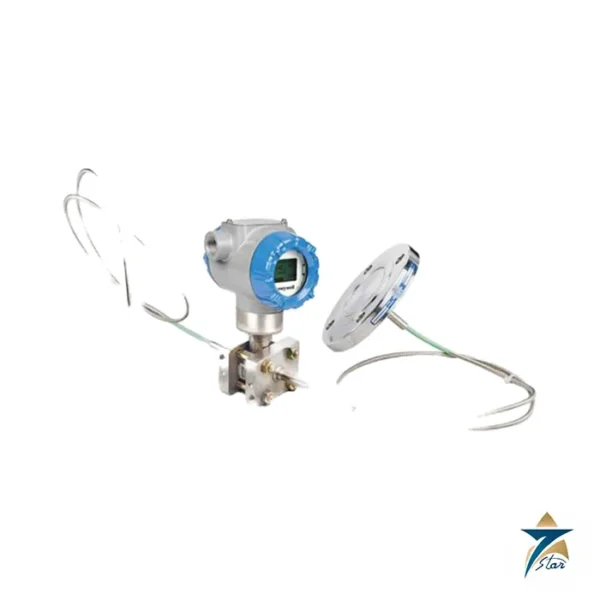
Other ST 700 models cover different duties: the STD700 for differential pressure with impulse piping, the STA700 for absolute pressure, STG-series gauge transmitters, the flush-mount STG73P for 1 inch sleeve connections and the STR700 with capillary remote seals when the transmitter must sit away from a hot nozzle. If the tank has a standard flange nozzle and the liquid is clean enough, the STF700 is usually the simplest and most compact solution; with long capillary or hot media, the STR700 and STR800 become better choices.
STF700 selection and ordering checklist
- Decide between the STF725/STF735 (flush or extended diaphragm, heavier flange) and the compact STF72P/STF73P pseudo-flange design.
- Match the nozzle: size (2, 3 or 4 inch), ANSI class or DN PN40, facing and material of the flange and mounting studs.
- Calculate level span from density, tank height and distance from the nozzle to the empty and full points, then choose the 2 or 3 range class.
- Select diaphragm, head and gasket-ring materials for the liquid, including Hastelloy C-276 where 316L is not suitable.
- Pick silicone or CTFE fill for the process temperature band and note the 150 °C CTFE limit.
- Choose reference head type, vent or drain, and bolting (carbon steel, 316 SS or NACE).
- Approvals, housing, display and external buttons, tag and calibration data.
Installing and maintaining the STF700
Check that the nozzle flange face, gasket and bolting match the datasheet and that the tank can take the weight, which can reach 32 lb (14.5 kg) on the larger models. Record the elevation of the diaphragm relative to the zero level of the tank, because the level calibration depends on it, and arrange the reference connection so that its condition does not change in service.
At commissioning, set zero and span with the display buttons or a HART configurator, entering the elevation offset. Honeywell recommends calibration verification every two years. Modular electronics, displays and terminal blocks are field-replaceable, so keep one set of each as a spare instead of a complete transmitter, and do not unbolt the flange or open the sealed meter body in the field.
Typical STF700 applications in Oman and the GCC
The STF700 is used on storage and day tanks, chemical injection and dosing tanks, separators and knock-out drums, deaerators, fuel and lube oil tanks and bunded sumps in oil and gas, power and water sites. Desalination plants use it on antiscalant and acid tanks and brine sumps, where a flush diaphragm avoids deposits.
Desert sun can overheat tank shells, so check the process interface and ambient limits for exposed nozzles, and use stainless housings near the coast. For vessels with hot product above the CTFE limit, consider the capillary seals of the STR700 instead.
Information to send with an STF700 RFQ
- Model type (STF725, STF735, STF72P or STF73P) or tank data to select one.
- Nozzle size, rating and facing, flush or extended diaphragm and extension length.
- Liquid, density, operating and design pressure and temperature.
- Wetted materials, fill fluid, hazardous area approval and display.
- Quantity, tag numbers and delivery location in Oman or the GCC.
Documents and quotation
The manufacturer technical information sheet for the STF700 is attached on this page, with the dimension drawings and selection guide. Please read it with the tank and nozzle drawings.
Send the model number or tank duty and Seven Star LLC will quote against it. Delivery time and certificates are confirmed in the offer.
Other Models in the Honeywell Smartline St700 Range
Seven Star LLC supplies models from the Honeywell Smartline St700 range in Oman and the GCC. Compare the related models below and request a quote for the one that matches your application.




















Reviews
There are no reviews yet.