Ashcroft B-Series pressure switches: B4 watertight and B7 explosion-proof
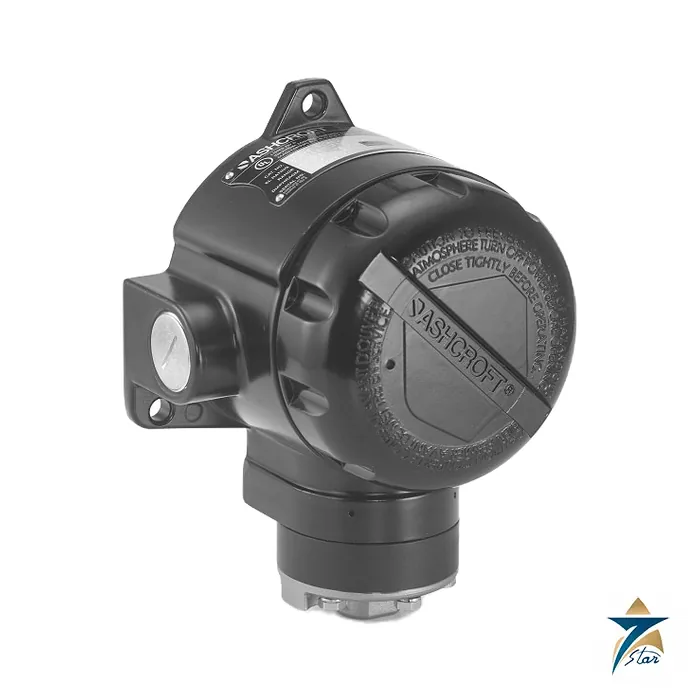
The Ashcroft B-Series is a family of single-setpoint, diaphragm-actuated pressure switches for vacuum and pressure up to 3,000 psi. It comes in two enclosure types: the B4, a watertight housing, and the B7, an explosion-proof housing. The switch element sits behind a diaphragm that moves with the process pressure, and a snap-action electrical element changes state when the setpoint is reached. Seven Star LLC supplies the B-Series in Oman and the GCC as an independent supplier in Muscat, and this page explains how the family is coded so that an RFQ can identify the exact switch.
Decoding the B-Series order code
The data sheet shows the example B4 20 B XPK 600#. Read from left to right, it is the B4 enclosure, switch element 20 (narrow deadband ac), a Buna-N actuator seal, the option PK (pilot light top mounted) and a 600 psi range. The code blocks are:
- Enclosure: B4 is the Type 400 watertight enclosure meeting NEMA 3, 4, 4X, 13 and IP66. B7 is the Type 700 explosion-proof enclosure for Div. 1 and 2, NEMA 7, 9 and IP66, with epoxy-coated aluminium as standard and a 316 stainless steel housing under option YW.
- Switch element: a two-digit code for the electrical element, for example 20 narrow deadband ac, 24 general purpose (the standard switch), 22 hermetically sealed, 27 high temperature 300 °F, 31 low-level gold contacts, 50 variable deadband, or the dual versions 61 to 71 with two SPDT elements.
- Actuator seal: B Buna-N, V Viton, T Teflon, S 316L stainless steel or P Monel.
- Options: X followed by a two-letter code such as C4, NH, MA or CN.
- Range: from the range table, for example 15#, 100#, 600# or 3000#, or inches of water for low ranges.
Technical specifications of the B-Series
| Parameter |
Specification |
| Manufacturer / part number |
Ashcroft / B-Series (B4 and B7) |
| Setpoint |
Factory set or field adjustable; adjustable 15 … 100 % of range on increasing pressure |
| Setpoint repeatability |
±1 % of full range, with a shift of 1 % of range per 50 °F from the 70 °F setting |
| Pressure ranges |
Vacuum to 3,000 psi |
| Electrical output |
SPDT or DPDT |
| Enclosure rating |
B4: NEMA 4X, IP66; B7: NEMA 7/9, IP66 |
| Enclosure material |
Epoxy-coated aluminium (standard); 316 stainless steel optional, NEMA 7/9 only |
| Diaphragm material |
Buna-N, Viton, Teflon, stainless steel or Monel |
| Pressure connection |
1/4 NPT female (standard); 1/2 NPT female or 1/4 NPT female with 1/2 NPT male combination (optional) |
| Electrical connection |
3/4 NPT female (standard); 1/2 NPT female or M20 x 1.5 (optional) |
| Ambient temperature |
-28 … +65 °C (-20 … 150 °F); calibrated at 70 °F |
| Process temperature |
0 … 150 °F (Buna-N or Teflon); 20 … 300 °F (Viton); 0 … 300 °F (stainless steel or Monel) |
| Approvals |
UL (B4 and B7), CSA, FM limit control and steam limit control, CE; ATEX Sira 02ATEX1391X and IECEx SIR 14.0077X for B7 with option CN; SIL 3 capable |
How the B-Series switch works and what deadband means
Pressure acts on the diaphragm or sealed actuator, and its force is balanced against an adjustable spring. When the pressure crosses the setpoint, a snap-action element changes the contact position. Because the contacts return only after the pressure has fallen by a small amount, every pressure switch has a deadband, the gap between actuation and reset. The data sheet tabulates approximate deadbands by range and element, expressed for a Buna-N diaphragm, and gives multipliers for other diaphragms: Viton by 1.4, Teflon by 1.2, and stainless steel or Monel by 1.7. For dual elements the single-element values are multiplied by 1.6. Setpoints may generally be set between 15 and 100 percent of range on increasing pressure and typically between 10 and 90 percent on decreasing pressure.
Choosing between B4 and B7 in a hazardous or washdown plant
The B4 is the practical choice for non-hazardous areas where water, hosing and corrosion are the threats, such as water treatment, wash bays and utilities. The B7 is the choice where the area classification or the plant standard calls for an explosion-proof enclosure: the data sheet marks it Class I Div. 1 groups B, C and D and Class II Div. 1 groups E, F and G, and the ATEX version is marked II 2GD Ex d IIC T6 Gb, Ex tb IIIC T85 °C Db, with an ambient range of -20 to +60 °C. The sheet also lists special designs for NACE and fire applications and states that the family is SIL 3 capable, but the claim relates to the family and the user must confirm the safety function requirements and the proof test regime for each loop.
Selection and ordering checklist for the B-Series
- Enclosure: B4 watertight or B7 explosion-proof, and aluminium or 316 stainless steel housing.
- Setpoint, direction (rising or falling) and the allowed deadband; choose a range where the setpoint sits well inside the span.
- Switch element and electrical load, AC or DC, including minimum current if contacts are gold.
- Diaphragm material compatible with the medium and temperature.
- Proof and burst limits, for example 1000 psi proof for the 100 and 200 psi ranges, so that surges are covered.
- Connection sizes, mounting bracket and conduit entry.
- Options such as NACE, factory-adjusted setpoint, tagging, calibration certificate or hydrostatic test.
Installation and maintenance of the B-Series
Mount the switch where vibration is low or use the bracket options, and keep the pressure port clear of sediment, since a plugged port slows the response. Set the trip point against a reference gauge with the line isolated, and then record the actual actuation and reset values on a commissioning sheet. Ambient temperature shifts the setpoint by about 1 percent of range per 50 °F, so a switch set in a cool workshop may trip a little differently in a hot yard. For the explosion-proof B7 keep the cover threads clean and fully engaged, use certified cable glands and never open the enclosure while energised in a classified area. Switches protecting a safety function should be proof tested at the interval defined in the loop calculation.
Typical B-Series applications in Oman and the GCC
The manufacturer lists offshore oil rigs, chemical and petrochemical plants, pulp and paper, steel mills, power plants, water and sewage treatment and other corrosive environments. In Oman and the GCC, B-Series switches are typically found on compressor lube oil and seal gas lines, fuel gas skids, instrument air headers, pump discharge protection, cooling water circuits and desalination feed lines, usually as a high or low pressure trip or alarm that sends a contact to the control system.
Information to send with an RFQ for the B-Series
- Full code, for example B7 24 B 100# with options
- Setpoint and direction, deadband tolerance and electrical load
- Medium, temperature and diaphragm material
- Hazardous area classification and certificates
- Quantity, delivery site
Documents and quotation
The Ashcroft B-Series pressure switch data sheet is attached on this page. It includes the range and deadband tables, the full element list and the options table.
Send the code or the duty data and Seven Star LLC will confirm availability and prepare a quotation.




















Reviews
There are no reviews yet.