Contactless single-phase switching of AC loads with zero-voltage control
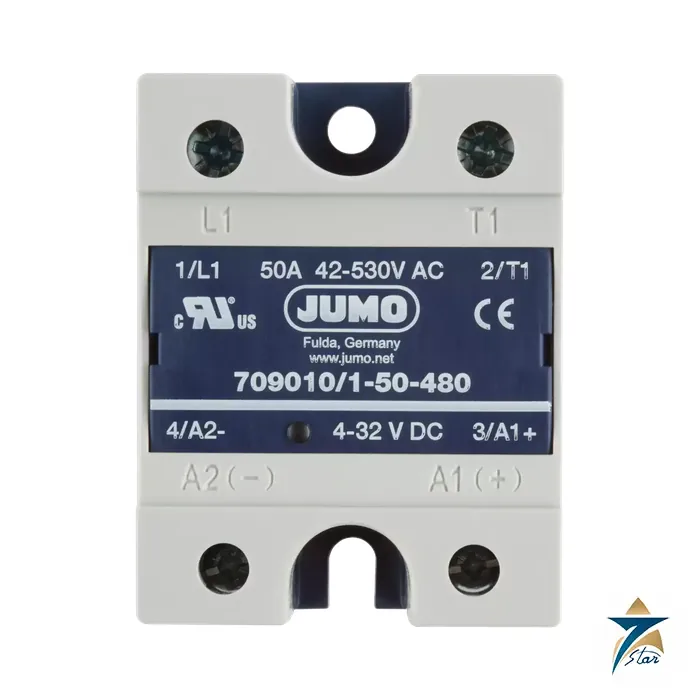
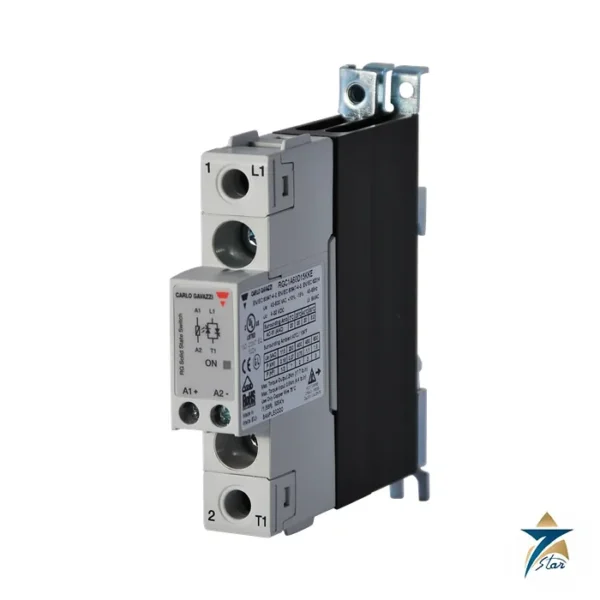
The JUMO TYA 432 (type 709010) is a thyristor power switch for contactless switching of alternating current consumers. It is designed for ohmic-inductive loads at a high switching frequency, a typical need in plastic packaging, air conditioning and heat technology, and industrial furnace construction. Because nothing mechanical opens and closes, there are no contacts to wear.
The control and power sections are galvanically isolated by optocouplers with an insulation voltage of 4 kV. The control signal range of DC 4 to 32 V is compatible with the logic outputs of JUMO controllers, and an LED shows the input status. A varistor integrated on the output side protects against voltage peaks from the mains.
The power section works as a zero voltage switch: it switches on at zero voltage and switches off at zero current, regardless of when the control signal changes. This avoids interference voltage and keeps the electromagnetic emissions low.
The power section is rated up to 50 A at 480 V in the larger type, and the housing weighs only about 60 g, so the switch is mounted directly on a heat sink with its base plate. The data sheet lists compliance with the EMC standards DIN EN 61000-6-4 for emission and DIN EN 61000-6-2 for immunity.
Technical specifications
| Parameter |
Specification |
| Type |
709010, JUMO TYA 432; single-phase circuit type 1 |
| Versions |
709010/1-25-240 (25 A, 24 to 265 V) and 709010/1-50-480 (50 A, 42 to 530 V) |
| Load voltage |
24 to 265 Veff (25 A type); 42 to 530 Veff (50 A type) |
| Load current |
25 Aeff or 50 Aeff maximum; minimum 150 mAeff |
| I2t (t = 10 ms) |
520 A2s for the 25 A type; 1800 A2s for the 50 A type |
| Frequency |
45 to 65 Hz |
| Peak blocking voltage |
650 Vs (25 A type); 1400 Vs (50 A type) |
| Leakage current |
3 mA |
| Control signal |
DC 4 to 32 V; switch-on above 2.75 V (25 A) or 3.75 V (50 A); switch-off below 2 V; 10 mA at 32 V |
| Operating mode |
Zero point control; response delay 0.5 x pulse period |
| Isolation |
Optocoupler; insulation voltage 4 kV between control and power section |
| Thermal resistance |
0.8 K/W (25 A type) and 0.5 K/W (50 A type) base plate to environment |
| Ambient temperature |
-20 to +70 °C; storage -40 to +100 °C; 95 % relative humidity, non-condensing |
| Connection |
Screw terminals: load up to 16 mm2, control up to 2.5 mm2 |
| Protection / weight |
IP20; Noryl housing; about 60 g; UL approval E223137 |
Sizing the switch and heat sink
Load current and load voltage cannot be combined freely; the data sheet states that only the stock versions are available, and the part numbers are 00673976 for 709010/1-25-240 and 00673981 for 709010/1-50-480. Pick the version from the supply voltage first, then from the load current with a margin.
A heat sink is required. The data sheet gives reduction tables that show the maximum thermal resistance of the heat sink for a given load current and ambient temperature. For example, a 15 A resistive load at 40 °C control cabinet temperature with the 25 A version needs a heat sink of no more than 3.8 K/W.
Use a silicone-based heat-conducting paste between heat sink and switch. If a silicone-free paste is used, check that it does not attack the plastic housing. For fault-free operation and better availability, the manufacturer recommends a matching semiconductor fuse placed in the load circuit.
The connection is simple: terminals 3/A1+ and 4/A2- take the control signal, while 1/L1 and 2/T1 carry the load. Screw terminals accept up to 16 mm2 on the load side. The control input draws about 10 mA at 32 V and switches on above 2.75 V for the 25 A type or above 3.75 V for the 50 A type, which is worth checking against the voltage your controller output really delivers.
The response delay is half a pulse period, so a controller should pulse the switch with a cycle time suited to the load. Mains frequency must be 45 to 65 Hz, and the minimum load current is 150 mA, which means very small loads may not switch reliably.
Applications
The TYA 432 is typically paired with a temperature controller that has a logic output. The controller pulses the DC control input and the switch passes full mains cycles to the heater, which gives smooth power control without the wear of a contactor.
Typical loads are heating elements in industrial furnaces, heat technology and packaging machines, and inductive loads such as small transformers within the stated power factor. Install it on a heat sink in the control cabinet at an ambient temperature between -20 and +70 °C.
Electrical safety data lists overvoltage category III with pollution degree 3 from outside and 2 inside the housing. Mount the unit vertically with free air flow around the heat sink, keep cabinet temperature within limits, and fuse the load circuit with a semiconductor fuse sized to the I2t value in the table.
Documents and quotation
This page carries the manufacturer PDF (JUMO TYA 432 data sheet 709010 (EN, 4 pages)) for checking dimensions and order codes. Use the quotation form to name the exact variant, options and delivery address, and we will answer with supply information. See also Contactors & Overload Relays for similar instruments.





Reviews
There are no reviews yet.